

10 Proven Ways to Improve Focus While Studying Backed by Science

10 Proven Ways to Improve Focus While Studying Backed by ScienceHow to Improve Focus While Studying – Backed by Science 🧠 (10 Proven Ways to Improve Focus While Studying Backed by Science)
In an age where digital distractions run rampant, staying focused while studying is tougher than ever. Social media, notifications, multitasking—even internal mind-wandering—can derail your learning. But thankfully, decades of research in psychology, neuroscience, and educational science offer proven strategies to boost focus, enhance memory, and maximize study effectiveness.
Whether you’re cramming for finals or aiming to study smarter, this comprehensive, science-backed guide will help you cultivate enduring concentration habits. Let’s dive in.
-
Understand Why Focus Falters
Focus isn’t just an attitude—it reflects biological rhythms, brain chemistry, and environmental triggers.
- Brain’s attention limits: Humans are wired to operate in bursts. Our ultradian rhythms (90–120 minute cycles) govern peaks and troughs in concentration and energy (researchmate.net).
- Mental fatigue: Sustained attention depletes attentional resources. Without regular breaks, performance drops dramatically .
- Distractions: Studies show it takes ~23 minutes to truly refocus after interruptions (globaltree.in).
- Multitasking myth: Switching between tasks causes inefficiency—errors increase, time elongates, stress rises (researchmate.net).
Understanding these mechanisms sets the stage for practical interventions.
-
Schedule Study Cycles Based on Natural Rhythms 🕰️
Pomodoro Technique
Developed in the 1980s by Francesco Cirillo, the Pomodoro Technique consists of:
- Studying for 25 minutes,
- Taking a 5-minute break,
- After four sessions, taking a longer 20–30 minute break (en.wikipedia.org, jagranjosh.com).
Research suggests this method can boost focus by up to 25%, preventing burnout and enhancing productivity (moldstud.com).
90-Minute Study Blocks
Aligning study time with ultradian rhythms—longer study sessions (~90 minutes) followed by ~20-minute breaks—can further optimize concentration (researchmate.net).
Tip: Experiment with both formats—Pomodoro for short bursts, 90-minute blocks for deep tasks like problem-solving or writing.
-
Use Active Recall & Spaced Repetition for Maximum Retention
Active Recall (Retrieval Practice)
Rather than passive review, test yourself: close your book and try recalling key information.
This taps into the testing effect, a phenomenon where retrieval improves memory. Studies show retrieval practice enhances long-term memory more than repeated reading (en.wikipedia.org).
Spaced Repetition
Spacing your review sessions (e.g., 1, 2, 4, 8 days apart) exploits how memory works. The earliest VI experiment (1939, Iowa) on 3,600 students confirmed its effectiveness . Modern learners using tools like Anki improve retention dramatically.
Desirable Difficulties
Introducing small challenges—like tougher flashcards or delayed feedback—enhances long-term learning (moldstud.com, en.wikipedia.org).
-
Incorporate Varied Learning Techniques
Feynman Technique
Named after physicist Richard Feynman: teach the topic as if to a child, using simple language. This exposes knowledge gaps and solidifies understanding (researchmate.net).
Mind Mapping & Dual Coding
Visually connecting ideas with mind maps or diagrams enhances neural encoding—words + visuals = stronger memory (studelp.com).
A Journal of Educational Psychology study reported grade increases of 15–30% with mind maps compared to linear notes (moldstud.com).
Interleved Practice
Mixing different topics or types of problems in one session (e.g., math + biology) improves transfer and comprehension versus blocked study (verywellmind.com).
-
Optimize Physical & Environmental Factors

Break Lifestyle Barriers
- Sleep: 7–9 hours nightly is essential. Sleep cements memory and enhances decision-making (saralstudy.com).
- Diet: Omega‑3 fats, leafy greens, nuts, and lean proteins support cognitive health (thetimes.co.uk). Avoid processed foods and alcohol .
- Hydration: Even mild dehydration reduces attention by ~30% .
- Exercise: A 20–30 minute workout spikes BDNF levels and dopamine—boosting focus and memory for 1–2 hours afterward .
Design Your Study Space
- Decluttered, well-lit environment enhances attention and comfort (researchmate.net).
- Noise control: Silence, ambient tones, or classical music can aid focus. Consider noise-cancelling headphones .
- Separate your study area from relaxation zones to avoid contextual interference.
-
Limit Digital Distractions
- Keep your phone in another room or on airplane mode (globaltree.in).
- Use site blockers like Freedom or StayFocusd, especially during Pomodoros (nootropicsplanet.com).
- Silence app notifications—studies show tech interruptions reduce performance significantly (thetimes.co.uk).
-
Build Psychological & Motivational Tools

10 Proven Ways to Improve Focus While Studying Backed by Science
Set Clear Goals & Rewards
Concrete targets (“finish Chapter 3 and solve five problems”) enhance 25% more focus compared to vague tasks (globaltree.in).
Use small rewards (snacks, short breaks) to maintain motivation and dopamine levels (globaltree.in).
Establish Routine & Peak Time Study
- Daily study schedule reduces anxiety and builds habit (peakperformance.institute).
- Study during your chronotype peak—morning for larks, evening for owls. Research shows 10–15% higher test scores when aligned (globaltree.in).
-
Train Your Mind with Meditation & Mindfulness
- Mindfulness meditation (5–10 min/day) improves sustained attention and working memory by ~16% (moldstud.com).
- A study using VR meditation showed a 275% increase in performance scores and 250% rise in calm EEG markers, after just 10 minutes (arxiv.org).
- Integrating mindfulness breaks during longer sessions (e.g., Pomodoro breaks) enhances resilience to distractions.
-
Leverage Physical Breaks Smartly
Short physical activity during breaks resets concentration and energizes the brain:
- 5-minute stretch or walk every 30–45 minutes avoids fatigue .
- 20-minute outdoor activity before studying enhances attention via cerebral blood flow and neurotrophins (studelp.com).
-
Reinforce Learning with Group & Reflective Techniques
Study Groups
Collaborative learning boosts retention by ~25% due to diverse viewpoints (moldstud.com).
Reflection & Planning
- End sessions by summarizing key ideas (“What did I learn today?”).
- Plan the next session to reduce cognitive load and improve clarity .
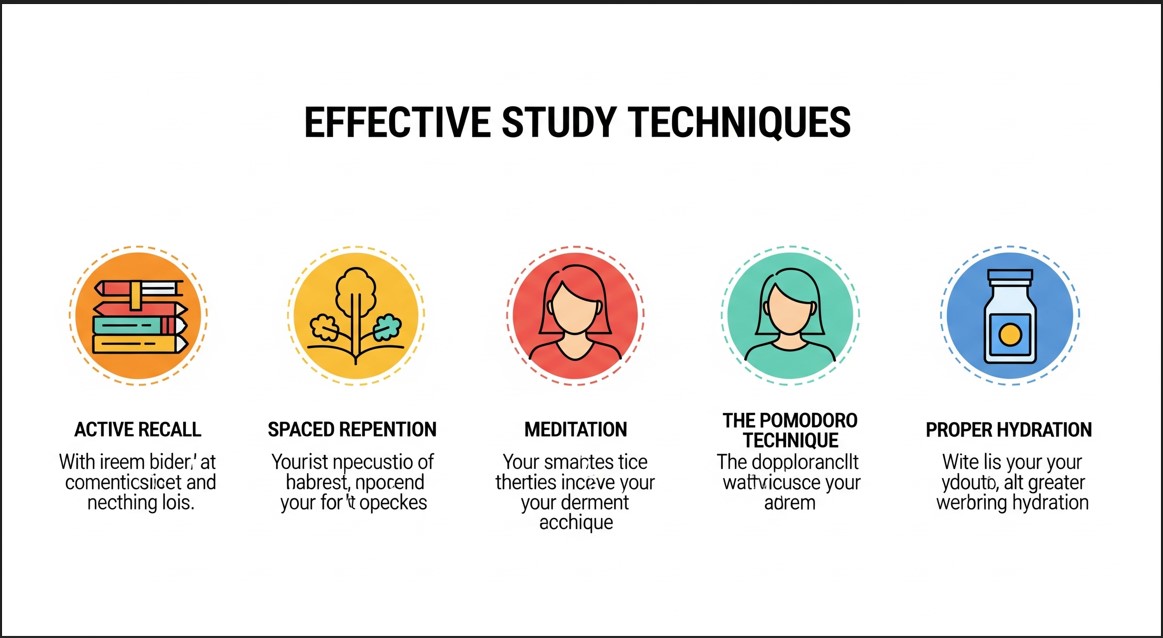
Sample Day Plan for Maximum Focus
-
Morning (Peak time)
- 20-min workout + protein-rich breakfast
- 90-min Pomodoro: active recall + spaced repetition
- 20-min break with walk + hydration
-
Late Morning
- Group session/feynman recap (active learning)
- 90-min Pomodoro: problem-solving/mind map visuals
- 10-min meditation + hydration
-
Afternoon (Lower peak)
- 20-min light study: review + spaced flashcards
- Mindfulness break or VR meditation
- Evening Review
- Reflect and plan next day study with clear goals
- Light reading or teaching concept to a study partner
Quick Reference Table
Strategy |
Why It Works |
| Pomodoro / 90-min blocks | Matches brain ultradian rhythms, prevents fatigue (researchmate.net, jagranjosh.com) |
| Active recall & spaced repetition | Enhances long-term memory and retention |
| Feynman & mind maps | Improves understanding via deep processing |
| Exercise + hydration + diet + sleep | Boosts BDNF, invokes clarity, cements memory |
| Meditation + mindfulness | Trains sustained attention, reduces anxiety |
| Distraction-free environment | Cuts interruptions and context switching |
Final Takeaway
Improving focus while studying isn’t about sheer willpower. It’s a blend of understanding your brain’s natural cycles, adopting learning methods grounded in cognitive science, optimizing lifestyle habits, and organizing study environments. The result? Smarter study sessions, improved retention, less burnout—and better grades.
Start with one or two techniques—like Pomodoro sessions or active recall—and gradually integrate others. With consistency, your attention span and learning stamina will soar.
Key Studies & Reports to Explore Further
- Testing Effect: Roediger & Butler (2011), Wikipedia April 2025 (en.wikipedia.org)
- Spaced Repetition: Spitzer 1939 + Leitner system (en.wikipedia.org)
- Mind Mapping Gains: Journal of Educational Psychology stats (moldstud.com)
- Exercise for Cognition: Oregon Health & Science U. + BDNF data (studelp.com)
- VR Meditation Study: Asati & Miyachi 2019 (arxiv.org)
By combining these powerful, proven methods, you’ll not only stay focused—you’ll study smarter, feel more in control, and achieve your academic goals more efficiently than ever before.
Remember: Focus is a muscle—it strengthens with regular, deliberate practice. Implement these strategies consistently, and you’ll create a study routine that’s not only productive—but also sustainable and enjoyable.
FAQs
1. Why do I lose focus while studying?
Focus can be disrupted due to digital distractions, fatigue, lack of sleep, poor diet, a cluttered environment, or studying for too long without breaks. Your brain naturally loses concentration after extended periods of mental effort.
2. What is the most effective study technique to improve focus?
The Pomodoro Technique is highly effective. It involves studying for 25 minutes, then taking a 5-minute break. This method boosts concentration and prevents burnout.
3. How long can the human brain focus at one time?
Most people can maintain peak focus for about 25 to 45 minutes. After that, attention starts to drop. Studying in short sessions with breaks is ideal.
4. Does multitasking harm concentration?
Yes. Multitasking reduces brain efficiency. Research shows it increases error rates and reduces comprehension by up to 40%.
5. Can music improve focus while studying?
Yes, but it depends. Instrumental or classical music may help. Lyrics can be distracting during reading or writing tasks.
6. Is exercise linked to better focus?
Absolutely. Studies show that just 20–30 minutes of physical activity can increase concentration and mental clarity by releasing endorphins and increasing blood flow to the brain.
7. What foods help boost concentration?
Foods rich in omega-3 fatty acids (like fish and walnuts), antioxidants (berries), and protein (eggs, beans) help. Avoid processed foods and sugary snacks.
8. Does dehydration affect focus?
Yes. Even mild dehydration can impair attention, short-term memory, and cognitive performance. Drink water regularly throughout the day.
9. How does sleep affect concentration?
Lack of sleep leads to reduced brain function, memory loss, and difficulty focusing. Aim for 7–9 hours of quality sleep per night.
10. What is active recall and why is it effective?
Active recall means testing yourself rather than rereading notes. It strengthens memory by retrieving information from your brain, enhancing retention.
11. How does spaced repetition improve focus?
Spaced repetition spreads out learning over time, which prevents cramming and mental overload. It also helps long-term memory and keeps sessions more engaging.
12. Can meditation help improve focus?
Yes. Regular meditation trains your brain to ignore distractions. Studies show that just 10 minutes a day can improve attention and working memory.
13. What is the best time of day to study for focus?
It depends on your chronotype. Morning people (larks) focus better early, while night owls perform better later. Find your peak productivity window.
14. Should I take breaks while studying?
Yes. Breaks prevent fatigue and restore mental energy. A 5–10 minute break every 30–45 minutes boosts long-term productivity.
15. How do I make my study space more focus-friendly?
Keep it clutter-free, quiet, and well-lit. Use a comfortable chair, remove distractions, and have only the materials you need for that session.
16. Do phone notifications affect focus?
Yes. Just hearing or seeing a notification can break your concentration. Turn off notifications or use airplane mode while studying.
17. What is the Feynman Technique?
It’s a method of studying where you explain a concept in simple terms, as if teaching someone else. It helps identify gaps in understanding.
18. How does caffeine affect focus?
In moderate amounts (like 1–2 cups of coffee), caffeine can enhance alertness and focus. Overconsumption may lead to jitteriness or crashes.
19. Is group studying helpful for focus?
Yes, when done correctly. Discussing topics with peers can reinforce learning and keep you motivated. Avoid turning study groups into social sessions.
20. Can mindfulness help with long-term focus?
Definitely. Mindfulness reduces stress and improves sustained attention. Regular practice helps resist distractions and improves emotional regulation.
21. How often should I change study topics?
Using interleaved practice (mixing subjects) enhances learning and focus. It prevents boredom and encourages deeper understanding.
22. How do I deal with mental fatigue while studying?
Take breaks, get proper sleep, hydrate, and avoid overstudying. Physical activity or a quick nap can refresh your mind.
23. Can chewing gum increase concentration?
Some studies suggest chewing gum can increase blood flow to the brain and enhance alertness temporarily. However, it’s not a long-term solution.
24. How can I manage digital distractions?
Use apps like Forest, StayFocusd, or Freedom to block distracting sites. Keep your phone away while studying.
25. Are there any brain games that improve focus?
Yes, games like Sudoku, Lumosity, or chess can enhance working memory and attention span over time when used consistently.
26. Does lighting affect concentration?
Yes. Natural light or cool white LED lighting reduces eye strain and increases alertness. Avoid dim lighting while studying.
27. Should I study the same subject all day?
No. Switch subjects every few hours to stay mentally fresh. Variety keeps the brain engaged and focused.
28. How do I handle boredom while studying?
Use interactive tools like flashcards, mind maps, or videos. Study in short sessions, set goals, and reward yourself to stay motivated.
29. What are the signs of poor focus during study?
Frequent re-reading, mind-wandering, tiredness, and low retention are all signs. When you notice these, take a break or change strategy.
30. What is the best long-term solution to improve focus?
Building consistent habits: quality sleep, regular exercise, healthy diet, mindfulness practice, and effective study techniques like active recall and Pomodoro will yield long-lasting improvements in focus.
Follow us on Instagram
OUR YOUTUBE CHANNEL

ALSO READ
Best Books for JEE and NEET 2025 A Comprehensive Guide
NEET 2026 Dropper Strategy Best Tips to Crack NEET in First Attempt