
19 EXCRETORY PRODUCTS AND THEIR ELIMINATION QUESTIONS
19 EXCRETORY PRODUCTS AND THEIR ELIMINATION QUESTIONS
Ammonia and urea are waste products derived from the metabolic breakdown of-
A) Lipids
B) Carbohydrates
C) Proteins
D) Sugars
Which of the following molecules is the most toxic to the cells?
A) NaCl
B) Urea
C) Uric acid
D) Ammonia
The terms “ammonotelic”, “Ureotelic”, and “Uricotelic” are used to describe-
A) Modes of excretory system development
B) The actions of hormones on the excretory systems
C) The types of nitrogenous waste produced by various classes of vertebrates
D) Modification of kidney tubules to enhance excretion
Which of the following statements is correct?
A) Many bony fishes, aquatic amphibian and aquatic insects are ammoniotelic
B) Ammonia is readily soluble
C) NH3 is generally excreted by the body surface or through gills (in fishes) as NH4 +
D) All
Which of the following statements is wrong?
A) Kidney does not play any significant role in the removal of ammonia
B) Ureotelic animals excrete most of the nitrogenous waste as urea
C) Ammonia and urea are the waste products derived from the metabolic breakdown of proteins
D) None of the above is wrong
Urea and uric acid are –
A) More toxic than NH3
B) Less toxic than NH3
C) Equally toxic to NH3
D) Non-toxic
Which of the following group of animals is ureotelic?
A) many terrestrial amphibians
B) Mammals
C) Marine fishes
D) All
NH3 is converted into urea in –
A) Kidney
B) Liver
C) Spleen
D) Intestine
Which of the following groups of animals is uricotelic?
A) Reptiles
B) Insects
C) Birds and land snail
D) All
Excretion of nitrogenous products in semisolid forms by –
A) Uricotelic animals
B) Ureotelic animals
C) Ammoniotelic animals
D) Amniotes
Least toxic nitrogenous waste is –
A) NH3
B) Urea
C) Uric acid
D) NH3 and urea
Which of following in small amount is retained in kidney matrix of some animals to maintain a desired osmolarity?
A) NH3 B) Urea C) Uric acid D) NH3 and uric acid
Terrestrial organisms must conserve water. The least amount of water is lost with the excretion of which nitrogenous waste product?
A) NH3
B) Uric acid
C) Urea
D) CO2
The less amount of water is lost with the excretion of which nitrogenous product?
A) NH3 and urea
B) NH3 and uric acid
C) NH3
D) Urea and uric acid
Which of the following is correct about protonephridia/flame cells?
A) Protonephridia are the excretory structures in Platyhelminthes (e.g. Planaria), rotifers and some annelids
B) Protonephridia are the excretory structures in the cephalochordates e.g. Amphioxus
C) Protonephridia are primarily concerned with ionic and fluid volume regulation i.e. osmoregulation
D) All
Match the column I with column II.
Coulumn I |
Column II |
||
| A | Nephridia | I | Crustaceans(Prawn) |
| B | Malphigian tubules | II | Annelids(Earthworm) |
| C | Anteenal Gland or
Green Glands |
III | Insects
(Cockroach) |
A) A-I, B-II, C-III
B) A-III, B – II, C – I
C) A-II, B – III, C-I
D) A-II, B- I, C-III
Which of the following statements is wrong about the human excretory system?
A) Excretory system consists of one pair of bean shaped kidneys, one pair of ureter, a urinary bladder and a urethra.
B) Kidneys are situated between the 12th thoracic and 3rd lumbar vertebrae close to the dorsal wall in abdominal cavity.
C) Right kidney is a little higher level than the left one.
D) All
Each kidney of adult human measures-
Le ngth |
Width |
Thickness |
Weight |
|
| A | 10 – 12
Cm |
5 – 7cm | 2 – 3 cm | 120-170
g |
| B | 10 – 20
Cm |
10 – 12
Cm |
6 – 12 cm | 40-50 gm |
| C | 2 – 6 cm | 10 – 12
Cm |
6 – 12 cm | 40-50
gm |
| D | 10 – 12
Mm |
5 – 7
Mm |
2 – 3 mm | 120-170
mg |
The part of kidney, gateway for ureter, nerves and blood vessels is-
A) Hilum
B) Renal pore
C) Minor calyx
D) Major calyx
Inner to the hilum of kidney is a broad funnel shaped space called-
A) Cortex
B) Medulla
C) Pelvis
D) Calyx
Which of the following statements is false?
I. Outer cortex and inner medulla are the two zones in kidney
II. Medulla is divided into about 8 to 18 renal pyramids
III. Pyramid projects into calyx
IV. Inwards extension of cortex between the pyramids is called renal column of Bertini
A) I and IV
B) II and IV
C) IV
D) None
Observe the following figure.
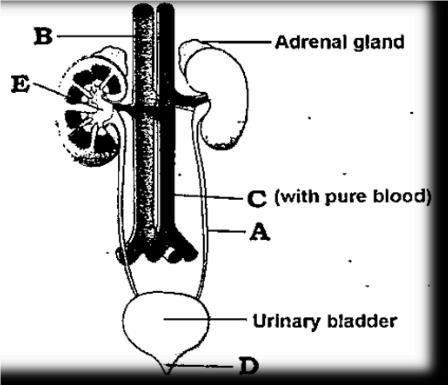
Identify A to E structure.
| A | B | C | D | E | |
| A) | Superior vena cava | Inferior vena cava | Dorsal Aorta | Urethra | Pelvis |
| B) | Inferior vena cava | Superior vena cava | Dorsal Aorta | Urethra | Pelvis |
| C) | Urethra | Inferior vena cava | Dorsal Aorta | Urethra | Pelvis |
| D) | Dorsal Aorta | Inferior vena cava | Urethra | Cortex | Pelvis |
Which one of the following is the structural and functional unit of kidney?
A) Urethra
B) Urinary bladder
C) Renal column
D) Nephron
Renal corpuscle or Malpighian body is-
A) Glomerulus only
B) Glomerulus along with Bowman’s capsule
C) Bowman’s capsule
D) Glomerulus with afferent arteriole
Which one of the following is a tube that carries urine from kidney to the urinary bladder?
A) Loop of Henle B) Ureter C) Urethra D) Uvula
Go through the following figure-
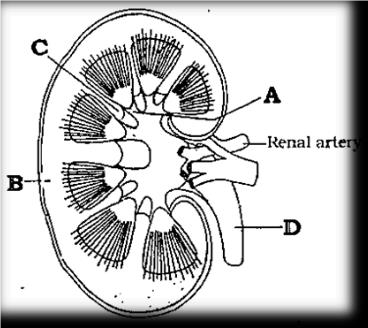
Identify A to D
A |
B |
C |
D |
|
| A) | Cortex | Calyx | Renal Column | Ureter |
| B) | Calyx | Cortex | Renal Column | Ureter |
| C) | Medulla | Cortex | Renal Column | Urethra |
| D) | Calyx | Cortex | Renal Column | Urethra |
Each kidney has how many nephrons?
A) About 2 million
B) About 1 million
C) About 5000
D) About 50000
The bed of capillaries in the vertebrate kidney where water, urea and salts are filtered out of the blood is the –
A) Bowman’s capsule
B) Collecting duct
C) Glomerulus
D) Loop of Henle
All of the following structures are situated in the renal cortex except –
A) Loop of Henle
B) Malpighian corpuscle
C) PCT
D) DCT
The DCTs of many nephrons open into a straight tube called –
A) PCT
B) Loop of Henle
C) Collecting duct
D) Bowman’s capsule
Which of the following statements is false?
A) Renal tubule starts with a double walled cup like structure called Bowman’s capsule
B) In majority of nephrons, the loop of Henle is too short and such nephrons are cortical nephrons
C) Juxta medullary nephron has long loop of Henle
D) None
Which is the correct pathway for passage of urine in humans?
A) Collecting tubule → ureter → bladder → urethra
B) Renal vein → renal ureter → bladder → urethra
C) Pelvis → Medulla → bladder → urethra
D) Cortex → Medulla → bladder → ureter
Match the column I with column II.
Column I |
Column II |
||
| A | Delivers blood to
glomerulus |
I | Ascending and
descending limb |
| B | Carries urine to
pelvis, also acts in water reabsorption |
II | Renal artery |
| C | Collects filtrate
from Bowman’s capsule |
III | Collecting duct |
| D | Loop of Henle | IV | PCT |
A) A – II, B – III, C – IV, D – I
B) A-I, B – III, C-II, D- IV
C) A – II, B – IV, C – I, D – III
D) A- IV, B – III, C – II, D – I
Which of the following is correct about Juxta medullary nephrons?
A) Vasa recta is prominent
B) Loop of Henle is long
C) NaCl is returned to the interstitium by ascending limb of vasa recta
D) All
Which of the following places the region of nephron in their correct sequence with respect to flow of tubular fluid?
A) PCT→ Descending limb of Henle (DLH) → Ascending limb of Henle (ALH) → DCT→ Collecting duct(CD)
B) PCT→ALH →DLH →OCT→CD
C) ALH →DLH →PCT→OCT→CD
D) OCT→ALH →DLH →PCT→CD
Vasa recta is –
A) shaped
B) S-shaped
C) U-shaped
D) J-shaped
In glomerulus, afferent arteriole –
A) Is wider than efferent arteriole
B) And efferent arteriole has similar diameter
C) Is narrower than efferent arteriole
D) Is narrow than efferent capillaries
Which of the following is incorrect?
A) Blood vessel leading to glomerulus is called efferent arteriole
B) Vasa recta, peritubular capillaries, Glomerulus all have blood
C) Cortical nephron has no or highly reduced vasa recta
D) Vasa recta runs parallel to the Henle’s loop in juxtamedullary nephrons
Urine formation involves-
A) Ultra filtration and reabsorption occurring in different parts of nephron
B) Ultrafiltration and reabsorption occurring in same part of nephron
C) Ultrafiltration, reabsorption and secretion occurring in different parts of nephron
D) Ultrafiltration, reabsorption and secretion occurring in same part of nephron
Match the column I with column II.
Coulumn I |
Column II |
||
| a | PCT | I | Concentrated urine formation |
| b | DCT | II | Filtration of blood |
| c | Loop of Henle | III | Reabsorption of 70 – 80% electrolytes |
| d | Countercurrent mechanism | IV | Ionic balance |
| e | Renal
corpuscle |
V | Maintenance of conc. gradient in medulla |
| a | b | c | d | e | |
| A) | III | IV | I | V | II |
| B) | III | V | IV | II | I |
| C) | I | III | II | V | IV |
| D) | III | I | IV | V | II |
Which of the following statements is correct?
I. Renal vein take blood away from kidney
II. Loop of Henle conserves water
III. Podocytes occur in inner wall of Bowman’s capsule
IV. Ultrafiltrate I nephric filtrate is plasma minus proteins.
A) I and II
B) I and Ill
C) III and IV
D) I, II, III, IV
The glomerular capillaries cause filtration of blood through ____ layers –
A) 1
B) 2
C) 3
D) 6
The layers between the blood in glomerular blood Bowman’s space are –
A) Tunica media + Cuboidal epithelium+Basement’s membrane
B) Endothelium + Epithelium of Bowman’s capsule + Basement membrane between the 2 layers
C) Endothelium of glomerular blood vessel + Endothelium of Bowman’s capsule + Parietal layer of Bowman’s capsule
D) Tunica media + Epithelium of Bowman’s capsule + Endothelium of Bowman’s capsule
On average, _______ mL of blood is filtrated by the kidney per minute which constitute roughly __ of the blood pumped out by each ventricle of heart in a minute. –
A) 125 ml, 1/6th
B) 100 -125 ml, 1/6th
C) 1100 -1200 ml, 1/5th
D) 5 L, 1/10th
The amount of the filtrate formed by the kidney / minute is called GFR (Glomerular Filtration Rate). The GFR of a healthy adult is- –
A) 80 mL/min
B) 125 mL/min
C) 300 mL/min
D) 20 mL/min
The GFR/day in a healthy adult is –
A) 5 L
B) 180 L
C) 200 L
D) 20 L
Juxtaglomerular apparatus, a special sensitive cellular region is formed in –
A) PCT and DCT
B) PCT and DCT at the location of their contact
C) PCT and loop of Henle at the location their contact
D) DCT and afferent arteriole at the location of their contact
Of the filtrate, nearly how many of it is reabsorbed by the renal tubules?
A) 5%
B) 99%
C) 50%
D) 25%
Which of following statements is false?
A) The kidney has built in mechanism for regulation of GFR
B) Tubular secretion does not play any significant role in urine formation
C) The amount of urine output per day in normal adult is about 1.5 L
D) During urine formation tubular cells secrete H+, K+ and NH3 in the filtrate
Which of the following statements about proximal convoluted tubule (PCT) is false?
A) It is lined by simple cuboidal brush border epithelium which increases the surface area
B) Nearly all the essential nutrients, 70 – 80% electrolytes, 70% H2O are reabsorbed by PCT
C) PCT is not the site of selective secretion
D) PCT helps to maintain the pH and ionic balance of body fluids
PCT helps to maintain the pH and ionic balance of body fluids by –
A) Selective secretion of H+, NH3 and K+ ions in filtrate
B) Reabsorption of from filtrate
C) Both a and b
D) Secreting regulatory hormone like renin and angiotensinogen
If Loop of Henle were absent from mammalian nephrons, which of the following is to be expected?
A) The urine will be more dilute
B) There will be no urine formation
C) The urine will be more concentrated
D) There will be hardly any change in quality and quantity of urine formed
Use following diagram to complete the statements about the human nephron –
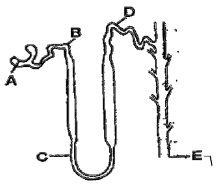
I. The composition of the filtrate would be most like plasma in the tubule next to the letter.
II. The urine would be most concentrated in the collecting duct next to letter
III. Most of the glomerular filtrate is reabsorbed into peritubular capillary next to the letter
IV. Conducting of urine to pelvis of the kidney from the structure next to the letter
V. Most water is reabsorbed by the structure next to the litter
I |
II |
III |
IV |
V |
|
| A) | A | C | B | E | D |
| B) | A | E | B | C | D |
| C) | A | B | E | C | D |
| D) | A | E | B | E | B |
I. Reabsorption in this region is minimum.
II. This region plays a significant role in the maintenance of high osmolarity of intestinal fluid
III. Its descending limb is permeable to water but almost impermeable to electrolytes
IV. Its ascending limb is impermeable to water but allows transport of electrolyte actively or passively
V. In descending limb filtrate is hypertonic while in ascending limb filtrate is hypotonic
The above characteristics are associated with –
A) PCT
B) Loop of Henle
C) DCT
D) Bowman’s capsule
Which of the following statements is correct?
I. Reabsorption of water occurs passively in the initial segment of nephron
II. Nitrogenous waste are absorbed by passive transport
III. Conditional reabsorption of Na+ and water takes place in DCT
IV. DCT reabsorbs HCO3 –V. DCT is capable of selective secretion of H+, K+ and NH3 to maintain pH and Na+ – K+ balance in blood
V. Substances like glucose, amino acids, Na+, etc in the filtrate are reabsorbed actively
A) I and II
B) II and III
C) IV and V
D) All
Tubular secretion helps to maintain a proper acid-base balance by removing one of the following from blood –
A) H+ and NH3
B) Uric acid
C) H+ and urea
D) NH3 and creatinine
Which of the following statements is false regarding the collecting duct?
I. Collecting duct is a straight duct
II. It extends from the cortex to medulla
III. Large amount of water could be reabsorbed from it to produce concentrated urine·
IV. Small amount of urea diffuses out from it into the medulla to keep up the osmolarity
V. It plays a role to maintain pH and ionic balance of blood by the selective secretion of H+ and K+ ions
A) Only I
B) Only III
C) IV and V
D) None
Mammals have the ability to produce ______ urine-
A) Hypotonic
B) Hypertonic
C) Isotonic
D) Alkaline
Which one plays an important role in counter current mechanism?
A) Vasa recta
B) PCT
C) Loop of Henle
D) A and C
In which of the following counter current operates-
A) In ascending limb of loop of Henle
B) In descending limb of loop of Henle
C) In ascending limb or descending limb of vasa recta
D) Between the 2 limb of Henle’s loop and those of vasa recta
Medullary gradient is developed by all the following except –
A) Reabsorption of Na+ from ascending limb of Henle’s loop into medullary interstitium
B) Reabsorption of Na+ from descending limb of Henle’s loop
C) Diffusion of small amount of urea from collecting duct into medullary interstitium
D) Proximity between Henle’s loop and vasa recta as well as the counter current in them
The medullary gradient is mainly caused by –
A) Urea & K+
B) H+ and K+
C) NaCl and Urea
D) Urea and H+
The counter current mechanism helps to maintain a concentration gradient. This gradient helps in –
A) Easy passage of water from medulla to collecting tubule and thereby concentrating urine
B) Easy passage of water from collecting tubule and thereby concentrating urine
C) Easy passage of water from medullary interstitial fluid to collecting tubule and thereby diluting urine
D) Inhibition of passage of water between the collecting tubule and medulla and so isotonic urine is formed
NaCl is transported by the ascending limb of Henle’s loop which is exchanged with –
A) DCT B) PCT C) Ascending limb of vasa recta D) Descending limb of vasa recta
NaCl is returned to the by the ascending limb of vasa recta –
A) Ascending limb of Henle’s loop
B) DCT
C) PCT
D) Interstitial fluid of medulla
Human kidney can produce urine nearly how many times concentrated than the initial filtrate formed?
A) 4
B) 2
C) 10
D) 100
The high osmolarity of the renal medulla is maintained by all of the following except –
I. Diffusion of salt from the ascending limb of the loop of Henle
II. Active transport of salt from the upper region of the ascending limb
III. The spatial arrangement of juxtamedullary nephrons
IV. Diffusion of urea from the collecting duct
V. Diffusion of salt from the descending limb of the loop of Henle
A) Only I
B) Only V
C) III and IV
D) I and V
Which one of the following is produced in the kidneys?
A) Rennin
B) Renin
C) Uricase
D)Arginase
Reabsorption of Na+ is controlled by –
A) Vasopressin or ADH
B) Aldosterone
C) Renin
D) Rennin
The reabsorption of water in the kidneys is under the control of a hormone –
A) STH
B) ACTH
C) LH
D) ADH/Vasopressin
Antidiuretic hormone secretion increases when the hypothalamus is stimulated by –
A) Angiotensin receptors
B) Glucose receptors
C) Osmoreceptors
D) Renin receptors
The kidneys help regulate acid-base balance by controlling the level of ____ in the blood-
A) CO2
B) H+
C)
D) B and C
The functioning of the kidneys is efficiently monitored and regulated by hormonal feedback mechanisms involving –
A) Hypothalamus only
B) JGA only
C) The heart only
D) Hypothalamus, JGA and heart (to certain extent)
Osmoreceptors in the body are activated by changes in –
A) Blood volume but not body fluid volume
B) Body fluid volume but not blood volume
C) Blood volume and body fluid volume
D) Blood volume, body fluid volume and ionic concentration
Which of the following sequences is correct for regulation of kidney function?
A) An excess loss of water from body→Stimulates hypothalamus→Osmoreceptors→ eurohypophysis→ADH→ Increases water permeability of DCT and CT→ Prevention of diuresis
B) An excess loss of fluid from body→Osmoreceptors→ Hypothalamus→Neurohypophysis→ ADH→ Increases water permeability of DCT and CT→Prevention of diuresis.
C) An excess loss of fluid from body→ Osmoreceptors→ Hypothalamus→ Neurohypophysis→Aldosterone→ Water permeability of DCT and CT increases→ Prevention of diuresis
D) An excess loss of fluid from body→ osmoreceptor→ Hypothalamus→ Adenohypophysis→ ADH→ Increases water permeability of DCT and CT→
Osmoregulation is the function of-
A) Oxytocin
B) Prolactin
C) Vasopressin (ADH)
D) None of the above
ADH is synthesised by, ___________ released by _______ and acts on _________.
A) Hypothalamus, Neurohypophysis, DCT and CT
B) Hypothalamus, Neurohypophysis, Loop of Henle
C) Hypothalamus, Adenohypophysis, DCT and CT
D) Hypothalamus, Adenohypophysis, Loop of Henle
Which of the following sequence is correct?
A) An increase in body fluid volume → switch off the Osmoreceptors → suppresses the ADH release
B) ADH → Constricting effect on blood vessel→ B. P. high~ Glomerular blood flow more → GFR more
C) Angiotensinogen→ Angiotensin I→ Angiotensin II→ Adrenal cortex →Aldosterone
D) All
Which of the following factors can active the JG cells to release renin?
A) A fall in glomerular blood pressure (GBP)
B) A fall in glomerular blood flow (GBF)
C) A fall in GFR
D) A fall in GFR I GBP I GBF
Which of the following statements is false?
A) Angiotensin II, being a powerful vasoconstrictor, increases glomerular pressure and thereby GFR
B) Angiotensin II activates the adrenal cortex to release aldosterone
C) Aldosterone promotes reabsorption of Na+ and water from the DCT and CT leading to an increase in B.P. and GFR
D) ANF causes vasoconstriction
RAAS (Renin -Angiotensinogen – Aldosterone System)-
A) Is triggered when the juxtaglomerular cells of JGA releases renin in response to various stimuli
B) Is responsible for regulation of kidney function
C) Are stimulated when ANF is more in blood
D) A and B are correct
Which of the following is true about Atrial Natriuretic factor (ANF)?
A) An increase in blood volume and B. P. stimulates cardiac atria to release ANF
B) ANF promotes vasoconstriction and thereby decrease B.P.
C) ANF acts as a check on RAAS
D) A and C
Renin-angiotensin pathway controls –
A) Ultrafiltration
B) Blood pressure
C) Glucose reabsorption
D) Cardia output
RAAS secretes which of the following hormones?
A) Glucocorticoids
B) Renin
C) Mineralocorticoids
D) All
The expulsion of urine from the urinary bladder is called –
A) Uricolysis
B) Micturition
C) Uremia
D) Anuria
In micturition –
A) Urethra relaxes
B) Ureter relaxes
C) Ureter contracts
D) Urethra contracts
The outline of principal event of urination is given below in unordered manner-
I. Stretch receptors on the wall of urinary bladder send signal to the CNS
II. The bladder fills with urine and becomes distended
III. Micturition
IV. CNS passes on motor messages to initiate the contraction of smooth muscles of bladder and simultaneous relaxation of urethral Sphincter
The correct order of steps for urination is –
A) I→ II→ III→ IV
B) IV→ III→ II→I
C) II→I→ IV→ III
D) III→ II →I → IV
The neural mechanisms causing urination is called –
A) Scarth reflex
B) Withdrawal reflex
C) Micturition reflex
D) None
Average pH of human urine is –
A) 6
B) 9
C) 3
D) 7
Match the column I with column II.
Coulumn I |
Column II |
||
| A) | Uremia | I) | Henle’s loop |
| B) | Ketonuria | II) | Ketone bodies in
urine |
| C) | Glycosuria | III) | Artificial kidney |
| D) | Blood dialyser | IV) | Glucose in urine |
| E) | Concentration of
urine |
V) | Accumulation of
urea in blood |
A) A – V, B – II, C – IV, D – III, E – I
B) A- Ill, B – II, C – IV, D – I, E – V
C) A-I, B – II, C – IV, D – Ill, E – V
D) A- I, B – II, C – IV, D – V, E – III
Diabetes mellitus is characterized by-
A) Oilgonuria
B) Ketonuria and glycosuria
C) Anuria
D) Haematuria
How much urea is excreted per day by a normal adult?
A) 0 gm
B) 25 – 30 gm
C) 50 gm
D) 1 – 2 gm
Other than kidneys, which of the following also helps in the elimination of excretory wastes?
A) Skin
B) Liver
C) Lungs
D) All
How much CO2 is removed per minute by our lungs-
A) 18 Ml
B) 200 Ml
C) 1L
D) 8 L
Which of the following statements is false?
A) Micturition is carried out by a reflex
B) Cholesterol is excreted in the bile and waxes are excreted in the sebum
C) 8 L urine is excreted per day
D) The primary function of sweat is excretion
Liver (largest gland) is both secretory and excretory organ. It secretes bile. Which of the following are major excretory products of bile?
A) Degraded and steroid hormones
B) Vitamins and drugs
C) Bilirubin and Biliverdin
D) Cholesterol
Most of excretory products of bile ultimately pass out along with-
A) Urine
B) Digestive wastes
C) Urea
D) Sweat
I. The human skin possesses sweat and sebaceous glands which eliminate some wastes in their secretion.
II. Sweat is waxy protective secretion having sterols, hydrocarbons and fatty acid
III. Sebum is an aqueous fluid having NaCl, lactic acid, urea, amino acids, glucose
Which one of the above statement is correct?
A) Only I
B) II and III
C) Only II
D) I and II
In uremia, artificial kidney is used for removing accumulated waste products like urea by the process called-
A) Micturition
B) Haemolysis
C) Ureotelism
D) Hemodialysis
In artificial kidney dialysing fluid contains all the constituents as in plasma expect-
A) Na+
B) Water
C) Glucose
D) Nitrogenous wastes
Kidney stone is produced by-
A) Deposition of sand particles
B) Crystallization of Ca- oxalate
C) Precipitation of protein
D) KCI or NaCl
Bright’s disease/Glomerulonephritis is-
A) Glycosuria
B) Cystitis
C) Inflammation of glomeruli
D) Ketonuria
Following are the steps of dialysis-
A. Blood is passed into a vein.
B. Blood is mixed with heparin.
C. Blood is mixed with anti-heparin.
D. Blood is drained from convenient artery.
E. Blood is passed through a coiled and porous cellophane tube bathing in dialysis fluid.
F. Removal of nitrogenous wastes from blood.
The correct sequence of steps is-
A) A → B → C → D → E → F
B) F → C → E → B → A → D
C) D → B → E → F → C → A
D) D → C → E → F → B → A
Match the excretory disorder given in column I with their description given in column II and select the correct option given below.
Column – I Column – II
Glycosuria I. Accumulation of uric in joints
Gout II. Mass of crystallised salts within the kidney
Renal calculi III. Inflammation in glomeruli
Glomerula nephrits IV. Presence of glucose in urine
(a) A-III; B-II; C-IV; D-I
(b) A-I; B-II; C-III; D-IV
(c) A-IV; B-I; C-II; D-III
(d) A-II; B-III; C-I; D-IV
Match the function given in column I with their respective structure given in column II and select the correct option given below:
Column I Column II
(Function) (Part of Excretory system)
Ultrafiltration I. Henle’s loopB.
Concentration of urine II. Ureter
Transport of urine III. Urinary bladder
Storage of urine IV. Malpighian corpuscle
Proximal convoluted tubule
(a) A-IV; B-V; C-II; D-III
(b) A-IV; B-I; C-II; D-III
(c) A-V; B-IV; C-I; D-III
(d) A-V; B-IV; C-I; D-II
Which of the following statements is correct?
(a) The descending limb of loop of Henle is impermeable to water.
(b) The ascending limb of loop of Henle is permeable to water.
(c) The descending limb of loop of Henle is permeable to electrolytes.
(d) The ascending limb of loop of Henle is impermeable to water
A decrease in blood pressure / volume will not cause the release of :
(a) Atrial natriuretic factor
(b) Aldosterone
(c) ADH
(d) Renin
In mammals, which blood vessel would normally carry largest amount of urea?
(a) Renal vein
(b) Dorsal aorta
(c) Hepatic vein
(d) Hepatic portal vein
Human urine is usually acidic because
(a) excreted plasma proteins are acidic.
(b) potassium and sodium exchange generates acidity.
(c) hydrogen ions are actively secreted into the filtrate.
(d) the sodium transporter exchanges one hydrogen ion for each sodium ion in peritubular capillaries.
Which of the following does not favour the formation of large quantities of dilute urine?
(a) Caffeine
(b) Renin
(c) Atrial-natriuretic factor
(d) Alcohol
Removal of proximal convoluted tubule from the nephron will result in
(a) more concentrated urine.
(b) no change in quality and quantity of urine.
(c) no urine formation.
(d) more diluted urine.
Which of the following causes an increase in sodium reabsorption in the distal convoluted tubule?
(a) Increase in aldosterone levels.
(b) Increase in antidiuretic hormone levels.
(c) Decrease in aldosterone levels.
(d) Decrease in antidiuretic hormone levels.
Use of an artificial kidney during haemodialysis may result in :
(a) Nitrogenous waste build-up in the body
(b) Non-elimination of excess potassium ions
(c) Reduced absorption of calcium ions from gastro-intestinal tract
(d) Reduced RBC production
Which of the following options is the most appropriate?
(1) (a) and (b) are correct
(2) (b) and (c) are correct
(3) (c) and (d) are correct
(4) (a) and (d) are correct
Match the following parts of a nephron with their function:
(a) Descending limb of Henle’s loop (i) Reabsorption of salts only
(b) Proximal convoluted tubule (ii) Reabsorption of water only
(c) Ascending limb of Henle’s loop (iii) Conditional reabsorption of sodium ion and water
(d) Distal convoluted (iv) Reabsorption of tubule ion, water and organic nutrients.
Select the correct option from the following:
(1) (a)-(i), (b)-(iii), (c)-(ii), d-(iv)
(2) (a)-(ii), (b)-(iv), (c)-(i), d-(iii)
(3) (a)-(i), (b)-(iv), (c)-(ii), d-(iii)
(4) (a)-(iv), (b)-(i), (c)-(iii), d-(ii)
Match the items in Column-I with those in Column-II:
Column-I Column-II
(a) Podocytes (i) Crystallised oxalates
(b) Protonephridia (ii) Annelids
(c) Nephridia (iii) Amphioxus
(d) Renal calculi (iv) Filtration slits
Select the correct option from the following :
(1) (a)-(iii), (b)-(iv), (c)-(ii), d-(i)
(2) (a)-(iii), (b)-(ii), (c)-(iv), d-(i)
(3) (a)-(iv), (b)-(iii), (c)-(ii), d-(i)
(4) (a)-(iv), (b)-(ii), (c)-(iii), d-(i)
The increase in osmolarity from outer to inner medullary interstitium is maintained due to :
(i) Close proximity between Henle’s loop and vasa recta
(ii) Counter current mechanism
(iii) Selective secretion of and hydrogen ions in PCT
(iv) Higher blood pressure in glomerular capillaries
(1) Only(ii)
(2) (iii) and (iv)
(3) (i), (ii) and (iii)
(4) (i) and (ii)
Select the correct statement :
(1) Atrial Natriuretic Factor increases the blood pressure.
(2) Angiotensin II is a powerful vasodilator.
(3) Counter current pattern of blood flow is not observed in vasa recta.
(4) Reduction in Glomerular Filtration Rate activates JG cells to release renin.
Which of the following would help in prevention of diuresis?
1) Decrease in secretion of renin by JG cells
2) More water reabsorption due to under secretion of ADH
3) Reabsorption of Na+ and water from renal tubules due to aldosterone
4) Atrial natriuretic factor causes vasoconstriction
Presence of which of the following conditions in urine are indicative of Diabetes Mellitus?
1) Renal calculi and Hyperglycaemia
2) Uremia and Ketonuria
3) Uremia and Renal calculi
4) Ketonuria and Glycosuria
Nitrogenous waste is excreted in the form of pellet or paste by:
1) Ornithorhynchus
2) Salamandra
3) Hippocampus
4) Pavo