
8 CELL THE UNIT OF LIFE PRACTICE QUESTIONS
In living organisms detailed description that brings out their knowledge of diversity is about
A) Their form B) Their appearance
C) Both D) None
What brought out the unit of diversity the cellular organisation of all life form:
A) Theory of evolution B) Species theory
C) Cell theory D) Darwinian theory
What is not true about physico-chemical approach:-
A) Established by analysis of living tissue for element and compounds.
B) Explains what type of organic compounds is present in living organism.
C) Explains the abnormal process that occur during any diseased condition.
D) This approach is known as forward biology.
Unicellular organism are capable of
A) Independent existence
B) Performing the essential functions of life.
C) Both
D) Does not ensure independent living
Living cell was firstly seen and described by:-
A) Robert Hooke B) Anton von Leeuwenhoek
C) Robert Koch D) Robert Brown
Cell theory was proposed by:-
A) Matthias Schleiden and Theodore Schwann
B) Schleiden; Schwann and Virchow.
C) Rudolf Virchow
D) Sutton and Boveri
All the plants are composed of different kinds of cells which forms the tissue of the plant, this statement was given by:-
A) A German botanist ; Rudolf Virchow .
B) A British zoologist ; Matthias Schleiden
C) A British zoologist ; Theodore Schwann
D) A German botanist; Matthias Schleiden
Who studied the different types of animal cells to propose cell theory:-
A) A British zoologist; Matthias Schleiden
B) A German botanist; Theodore Schwann.
C) A physicist; Rudolf Virchow.
D) A British zoologist; Theodore Schwann.
A thin outer layer studied by Theodore Schwann nowadays known as:-
A) Plasma membrane B) Cell wall
C) Glycocalyx D) Middle lamella
Based on studies of Matthias Schleiden; what is the unique character of plant cell?
A) Cell wall B) Middle lamella
C) Glycocalyx D) None of these
The hypothesis that the bodies of animals and plant are composed of cells and their products was proposed by:-
A) Schleiden and Schwann B) Rudolf Virchow
C) Schwann only D) Virchow and Schleiden
Scientist who gave the final shape to cell theory?
A) Schleiden B) Schwann
C) Virchow D) Schleiden & Schwann
Which of the following is related to cell theory :-
i) All living organisms are composed of cells and product of cells.
ii) Proposed by Schleiden and Schwann.
iii) Modified by Rudolf Virchow
iv) All cells arise from pre – existing cell.
v) “Omnis cellula – e – cellula”
A) Only one of the above B) Only two of the above
C) Only four of the above D) All five
What is the delimiting boundary around a human cheek cell?
A) Cell membrane B) Protoplasm
C) Protoplast D) Cell wall
What is the Semi – fluid matrix inside the cell?
A) Cell membrane B) Protoplast
C) Cytoplasm D) Nucleus
How many of the following statements are not true:-
i) All cells have membrane bound nuclei and nucleolus.
ii) Nucleus contains the chromosome
iii) DNA is the Genetic material.
iv) Cytoplasm is the main arena of cellular activities in plant and animal cells.
A) Only (ii), (iii), & (iv) B) Only (ii) & (iv)
C) Only (i) & (iii) D) Only (i)
Besides the nucleus; the _____cell have other membrane bound distinct structures.
A) Eukaryotic B) Prokaryotic
C) Both (a) and (b) D) None of these
What is the non – membranous organelle present in both Eukaryotic as well as Prokaryotic cell
A) Endoplasmic reticulum B) Protein
C) Mitochondria D) Ribosomes of 80s’ type
Animal cells have another non – membrane bound cellular organelle known as:-
A) Microbodies B) Nucleus
C) Lysosome D) Centrosome
Which of the following is not incorrect?
A) Mycoplasma is the smallest cell -> 0.3 μm in width.
B) Bacteria could be 3 μm to 5 μm in length
C) Human RBCs are about 7.0mm in diameter.
D) Cell’s shape is independent of their work they perform.
The prokaryotic cells are represented by:-
A) Bacteria
B) BGA
C) Mycoplasma & PPLO
D) All of these
All prokaryotic cell have this cellular boundary surrounding the cell – membrane except in mycoplasma
A) Glycocalyx B) Protoplast
C) Cell wall D) Cytoplasm
Which of the following is related to prokaryotic cell:-
A) Have no well defined nucleus
B) Have basically naked genomic material.
C) An addition to genomic DNA; the extra – genomic DNA is also present known as plasmid.
D) All of the above
Which of the following confirms certain unique phenotypic characters to some bacteria
A) Chromosomal material
B) Extra chromosomal material
C) Mitochondrial DNA
D) Genetic material present in chloroplast
A special form of cell membrane ; which is the characteristic of prokaryotes is:-
A) Plasmid
B) Cell wall
C) Cell membrane
D) Mesosomes.
Which of the following is membrane less bodies other than Ribosomes.
A) Cell wall
B) Inclusion
C) Mesosomes
D) Chromatophores
Which of the following is the essential infolding’s of cell membrane
A) Inclusion B) Mesosome C) Chromatophores D) Plasmid
What is the sequence of cell envelope in most of the prokaryotic cell (Outer to Inner)
A) Glycocalyx ->cell membrane -> cell wall.
B) Cell membrane -> cell wall -> Glycocalyx
C) Cell wall -> Glycocalyx -> cell membrane
D) Glycocalyx ->cell wall -> cell membrane.
The prokaryotic cell have a single protective unit made up of
A) Glycocalyx + cellulosic cell wall + cell membrane
B) Peptidoglycan cell wall + cell membrane + Glycocalyx
C) Chitinous cell wall + cell membrane + Glycocalyx
D) Silicous cell wall + Glycocalyx + cell membrane
How many of the following statements are correct:-
i) Glycocalyx is outermost layer.
ii) All three layer have same function.
iii) Bacteria can be classified on the basis of differences in the cell envelope.
iv) Bacteria can be classified on the basis of response to the staining procedure
A) Only one B) Only two C) Only three D) All four
The bacteria that take up gram stain are
A) Gram positive type. B) Gram negative type.
C) Both type
D) Neither gram positive nor gram negative.
The bacteria that do not take up gram stain are
A) Gram positive type.
B) Gram negative type.
C) Either gram positive or gram negative
D) Neither gram positive nor gram negative
Which of the following in a bacterial envelope is a loose sheath of slimy layer
A) Glycocalyx
B) Cell wall
C) Cell membrane
D) None of the above
Glycocalyx could be a thick and tough layer and known as:-
A) Slimy layer
B) Cyst
C) Capsule
D) None of the above
Which of the following determines the shape of a bacteria cell:-
A) Glycocalyx
B) Capsule
C) Cell membrane
D) Cell Wall
How many of the following in not incorrect regarding a cell membrane in prokaryotes
i) Selectively permeable in nature
ii) Structurally similar to eukaryotic cell membrane
iii) Interacts with outer world.
iv) Innermost layer of cell envelope
v) Living layer.
A) Only (ii), (iii) & (iv)
B) Only (i), (ii), (iii), (iv) & (v)
C) Only (i), (iii), (iv) & (v)
D) Only (i), (iv) & (v)
How many of the following is the membranous extensions into the cell of bacteria:-
Mesosomes, Tubules, Vesicles, Lamellae, Chromatophores, Inclusions
A) 6
B) 3
C) 5
D) 4
How many functions from the following, the mesosomes can perform
i) DNA replication ii) Respiration
iii) DNA distribution to daughter cells iv) Secretion
v) Increases surface area vi) Contains enzymatic content.
A) Only four
B) Only Three
C) All six
D) Only five
In cyanobacteria, there are some another membranous extensions except mesosomes are:
A) Inclusion
B) Fat globules
C) Chromatophores
D) All of the above
What are structures related to Bacterial flagellum:-
A) Basal body & filament
) Basal body, Hook & filament.
C) Hook & filament
D) Filament only.
Longest portion of flagellum is:-
A) Basal body B
) Hook
C) Filament
D) None of the above
Which of the following structure helps in motility in bacterial cell:-
A) Cell membrane
B) Pili
C) Fimbriae
D) Flagella
Which of the following is not a surface structure :-
A) Fimbriae
B) Pili
C) Flagella
D) Inclusion
Which of the following is small bristle like fibres sprouting out of the cell:-
A) Pili
B) Cilia
C) Flagella
D) Fimbriae
Which of the following is elongated tubular proteinaecious structure:-
A) Pili
B) Inclusion
C) Mesosome
D) Fimbriae
Which of the following help the bacteria attach to rocks in streams:-
A) Inclusion
B) Mesosome
C) Fimbriae
D) Pili
Ribosomes are associated with the structures in a bacterial cell:-
A) t – RNA strand
B) Golgi body
C) Cell membrane
D) E.R
Ribosomes in the bacterial cell are
A) 20nm to 30 nm in size.
B) Made up of two subunits(Larger 60s’ & smaller 40s’)
C) Made up of two subunits(Larger 50s’ & smaller 30s’)
D) Associated with E.R and cell membrane
A polysome is:-
A) Several mRNA bound to a single Ribosome.
B) Several subunits of ribosomes attached to each other.
C) Several ribosomes attached to a single strand of mRNA
D) Several mRNA attached to each other.
Which of the following structure translate the mRNA into proteins: in a bacterial cell:-
A) Inclusions of cytoplasm
B) Ribosomes of E.R
C) Ribosomes of Polysome.
D) Polysomes of Ribosome.
Inclusion bodies in a prokaryotic cell are:-
A) Reserve material containing structure
B) Cell membrane infoldings
C) Membrane bound structure
D) All of the above
What are example of inclusion bodies:-
i) Mesosome ii) Chromatophores
iii) Gas vacuole iv) Phosphate granules
v) Cyanophycean granules vi) Glycogen granules
A) Only (ii), (iii) & (iv)
B) Only (iii), (iv) & (v)
C) Only (iii), (iv), (v) & (vi)
D) Only (iv), (v) & (vi)
Inclusion bodies can be found in
A) All type of cells
B) All eukaryotic cell
C) BGA & green photosynthetic bacteria
D) Prokaryotic cell.
All of the above except are eukaryotic except:-
A) Protista
B) Plants
C) Monera
D) Animals
How many of the following statements are true regarding Eukaryotic cell.
i) Cytoplasm has extensive compartmentalization
ii) Presence of membrane bound organelle
iii) Organised nucleus
iv) A variety of complex locomotory and cytoskeletal structures.
v) Genetic material is organised into chromosomes
A) 2 B) 3 C) 4 D) 5
Statement – I:- Plant cells differs from animals cells.
Statement – ii:- The former one posses cell walls, plastids & a large vacuole which is absent in latter one.
A) Both statements are correct.
B) Both statement are incorrect.
C) Statement – I is correct but statement – II is incorrect.
D) Statement – I is incorrect but statement – II is correct.
Centrioles are present in
A) Animal cells
B) Plant cells
C) Both animal and plant cells.
D) All other than plant cells.
Which of the following correctly explain the diagram.
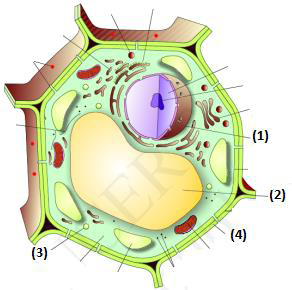
A) 1 -> Nuclear membrane 2 -> vacuole 3 -> peroxisome 4 -> cell wall
B) 1 -> Microvilli 2 -> cell wall 3 -> cytoplasm 4 -> Plasma membrane
C) 1 -> Vacuole 2 -> cytoplasm 3 -> Microvilli 4 -> cell wall
D) None of the above
The detailed structure of the membrane was studied:-
A) Only after the advent of the electron microscope in 1950s.
B) Enabled to deduce the possible structure of plasma membrane
C) Both
D) None
Which of the following cell’s study enabled the scientists to deduce the possible structure of Plasma membrane?
A) RBC
B) Cork cell
C) WBCs
D) Bacterial Cell
Cell membrane is mainly composed of
A) Lipids and Proteins
B) Proteins & Cholesterols
C) Lipids & Carbohydrates
D) Carbohydrates & Proteins
What is the correct arrangement of Lipid molecules in the cell membrane
A) Polar head -> Outside, non – polar tails -> Inner side.
B) Non – polar head -> Outside Polar tail – > Inner side
C) Polar tail -> Outside non – polar head – > Inner side
D) Polar tail -> inner side non – polar head -> outer side
What ensures that the non – polar tail is protected from aqueous environment?
A) Polar head -> Outside non – polar tails -> Inner side.
B) Non – polar head -> Outside Polar tail – > Inner side
C) Polar tail -> Outside non – polar head – > Inner side
D) Polar tail -> inner side non – polar head -> outer side
The constituents of cell membrane are:-
i) Phospholipid ii) Carbohydrate
iii) Proteins iv) Cholesterol
v) Phosphoproteins
A) Only (i), (ii) & (iv)
B) Only (ii), (iv) & (v)
C) Only (ii), (iii), (iv) & (v)
D) Only (i), (ii), (iii) & (iv)
Which of the following study revealed that cell membrane also contains proteins & carbohydrate:-
A) Electron microscopic study.
B) Phase – Contrast microscopic study.
C) Biochemical investigation study
D) Cobalt – chloride paper test study.
Which of the following statement is incorrect:-
A) The tail is hydrophobic of saturated hydrocarbons.
B) The tail is hydrophilic of saturated hydrocarbons.
C) The tail is hydrophobic of unsaturated hydrocarbons.
D) The tail is hydrophilic of unsaturated hydrocarbons
Which of the following statement is incorrect:-
A) The ratio of proteins and lipids varies considerably in different cells.
B) In erythrocytes; it has approximately 52% proteins and 40% lipids.
C) On the basis of ease of extraction membrane proteins are of extrinsic and intrinsic type.
D) None of the above
The improved model of the structure of cell membrane was proposed by:-
A) Messelson & Stahl
B) Schleiden & Schwann
C) Anton von Leeuwenhoek
D) Singer and Nichloson
The quasi–fluid nature of lipid enables:-
A) Flip–flop movement of proteins within the lipid bilayer.
B) Lateral movement of proteins within the lipid bilayer.
C) Flip–flop movement of lipid crossing the protein bilayer.
D) lateral movement of lipid crossing the protein bilayer.
One of the most important function of the plasma membrane is:-
A) Transport of molecules across it.
B) Flip – flop movement.
C) Secretion
D) Cell enlargement.
What ability explains the fluidity of cell membrane:-
A) Quasi – fluid nature of cell membrane.
B) Lateral movement of proteins.
C) Cell growth, formation of intercellular junctions; secretion; endocytosis; cell division
D) All of the above.
The plasma membrane is:-
A) Semi – permeable in nature
B) Impervious in nature
C) Impermeable in nature
D) Selectively permeable in nature.
How many of the following functions the cell membrane can perform:-
Active transport; Osmosis; Passive transport.
A) Only one
B) Only two
C) All
D) None
Na+ – K+ pump transports molecules
A) By passive transport
B) By active transport
C) By utilisation of ATP
D) Both B & C
The outer covering of fungi and plants is:-
A) Glycocalyx
B) Cell wall
C) Cell membrane
D) All
What is the function of cell wall:-
A) Gives shape to the cell
B) Protects the cell
C) Cell – to – cell interaction
D) All of the above
What are chemical composition of algal cell wall
Cellulose, Galactans, Mannans, Calcium carbonate, Chitin
A) Only two of them
B) Only three of them
C) Only four of them
D) All five of them
Cell wall of plants consists of:-
A) Cellulose & Pectin’s only
B) Cellulose, hemicellulose & Pectin’s only
C) Cellulose, hemicellulose, Pectin & Proteins.
D) Hemicellulose & Proteins only.
Which of the following is capable of growth
A) Primary cell wall
B) Secondary cell wall
C) Tertiary cell wall
D) All of them
Secondary cell wall is formed
A) Outside the primary cell wall.
B) Inside the cell membrane
C) Inside the plasmodesmata.
D) Inside the primary cell wall.
Which of the following in plant acts as glue between neighbouring plant cells:-
A) Ca – Pectate
B) Mg – Pectate
C) Ca & Mg – Pectate
D) None of the above
Which of the following is traversed by plasmodesmata:-
A) Cell wall & cell membrane
B) Cell membrane & Glycocalyx
C) Cell membrane, cell wall, Glycocalyx & Middle lamella.
D) Cell wall & middle lamella.
What are the constituent of Endomembrane system:-
A) Endoplasmic reticulum
B) Golgi body & E.R.
C) E.R; Golgi body; Lysosome & Vacuole.
D) E.R, Golgi body & Lysosome.
Why Mitochondria, Chloroplast & Peroxisome are not the part of Endo – system:-
A) They are autonomous organelles.
B) They are semi – autonomous organelles.
C) They are not coordinated with Endomembrane system.
D) They have their own genetic material.
Which of the following is the network of tiny-tubular structure scattered in cytoplasm:-
A) E.R
B) Golgi body
C) Lysosome
D) Vacuole
Which of the following structure divides the intercellular space into two compartments:-
A) E.R
B) Golgi body
C) Lysosome
D) None of the above
The extra luminal & luminal compartment represents:-
A) Cytoplasm & inside ER
B) Inside ER & cytoplasm
C) Outside ER & cytoplasm
D) Cytoplasm & outside ER
The ER having Ribosomes attached to its outer surface is known as
A) RER
B) SER
C) Both
D) None
RER is frequently observed in cells, actively involved in:-
A) Protein Synthesis
B) Lipid synthesis
C) DNA synthesis
D) Glucose synthesis
Which of the following is continuous with the outer membrane of nucleus:-
A) R.E.R
B) S.E.R
C) Golgi body
D) Lysosome
Steroidal hormones are synthesised by:-
A) R.E.R
B) Lysosome
C) S.E.R
D) Ribosome
Golgi body was firstly observed by
A) Camillo Golgi in 1898
B) Camillo Golgi in 1897
C) Camillo Golgi in 1895
D) Camillo Golgi in 1993.
Golgi body is
i) Reticular structure. ii) Densely stained structure
iii) Made up of cisternae, Tubule & Vesicle
iv) Concentric cisternae
A) Only (i) & (iii)
B) Only (ii), (iii) & (iv)
C) All of the above
D) Only (iii) & (iv)
What is the diameter of cisternae of Golgi body:-
A) 0.5μm to 1.0μm
B) 0.1 μm to 2.0 μm
C) 0.2 μm to 2.5 μm
D) 0.3 μm to 2.0 μm
The convex – face of cisternae of Golgi body is also known as:-
i) Cis – face ii) Forming face iii) Trans – face iv) Maturing face
A) (i) & (ii)
B) (ii) & (iii)
C) (iv) & (iii)
D) (i) & (iv)
Which of the following statement is correct:-
A) Cis & Trans faces are same but inter connected.
B) Cis & Trans faces different & not inter connected
C) Cisternae is 0.1 to 2.0 μm in diameter.
D) None of the above
Golgi body principally performs the functions of:-
A) Secretion
B) Packaging of materials.
C) Both
D) None
Materials to be packed in the ______Fuses with the ______face:-
A) Cis – face and Trans – face
B) Trans – face and cis – face
C) E.R and cis – face
D) E.R and trans – face
A number of proteins synthesized by ribosomes on the _____(i)_____ are modified in the ____(ii)____of the ____(iii)____
A) (i) ER (ii) Golgi body (iii) cisternae
B) (i)Golgi body (ii) cisternae (iii)ER
C) (i) cisternae (ii) RE (iii) Golgi body
D) (i) ER (ii) cisternae (iii) Golgi body
The vesicular structure formed by the process of packing in Golgi apparatus is:-
A) Vacuole
B) ER
C) Lysosome
D) All
The isolated lysosomal vesicle have been found to be very rich in
i) Lipases ii) Proteases iii) Carbohydrases
A) Only i) & ii)
B) Only ii) & iii)
C) Only i) & iii)
D) All
Enzymes present in lysosomes are accumulatively known as:-
A) Acid proteases
B) Lipases
C) Acid hydrolases
D) Carbohydrases
The membrane bound space in cytoplasm is known as:-
A) ER
B) Golgi body
C) Lysosome
D) Vacuole
Vacuole contains hydrolases; lipases; proteases; water; sap; excretory products & material not useful for the cell
A) Only four of the above
B) Only three of the above
C) Only five of the above
D) All of them.
The membrane of vacuole is
A) Single membrane
B) Tonoplast
C) Both
D) none
In a plant cell vacuole can occupy up to ______% space of cell
A) 70
B) 80
C) 90
D) 50
In plant tonoplast facilitates the transport of a number of ___(i)___; ____(ii)_____ the concentration gradient.
A) (i) Solutes (ii) Along
B) (i) ions (ii) Along
C) (i) ions (ii) against
D) (i) solutes (ii) against
How many of the following statements are not wrong:-
i) Concentration of same ions inside the vacuole is significantly higher.
ii) In amoeba contractile vacuole helps in osmoregulation & excretion.
iii) In Protistans, food vacuoles are formed by engulfing the food particle.
A) Only two
B) Only one
C) All three
D) None
Which of the following statement is correct about mitochondria:-
A) Easily visible under the microscope; without stain.
B) Number of mitochondria per cell is invariable
C) Number of mitochondria depends on the physiological activity of cell.
D) All of the above.
How many of the following statement is correct regarding mitochondria-
i) A sausage – shaped str. ii) Diameter is 0.2 – 1.0 μm
iii) Avg. Diameter is 0.5 μm iv) Length is 1.0 – 4.1 μm
A) One
B) Two
C) Three
D) Four
Each mitochondria is ___X_____ membrane bound structure; dividing its lumen into ____Y___ distinct compartment
A) X→ single Y→one
B) X →double Y→one
C) X→single Y→two
D) X → double Y→two
Matrix of mitochondria is:-
A) Filled with a dense homogenous substance.
B) Outer aqueous compartment
C) Space present between Inner and Outer membrane of Mitochondria
D) Present within the outer membrane of mitochondria
The outer membrane of mitochondria forms the ____ limiting boundary of the organelle, while the inner membrane forms a number of_____
A) Discontinuous ; infoldings
B) Infoldings; Cristae
C) Continuous ; Cristae
D) Cistae ; Infoldings
Which of the following increase the surface area:-
A) Matrix
B) Inner membrane
C) Outer membrane
D) Cristae
How many of the following statements are correct:-
i) Only outer membrane has enzyme for ETS
ii) Only inner membrane has enzymes.
iii) Outer membrane is devoid of enzymes.
iv) Mitochondria matrix has enzyme of kerb’s cycle.
v) Mitochondria is the site of aerobic respiration
vi) Matrix also possess SS – DNA molecule & few RNA molecules.
A) Only two
B) Only four
C) Only five
D) Only three
The matrix of mitochondria possess:-
Single circular DNA molecules; A few RNA molecules; 70s’ ribosomes;
Components required for the synthesis of proteins.
A) Only two of them
B) Only three of them
C) All of them
D) None of them
Mitochondria divides by:-
A) Endomitosis B) Meiosis C) Budding D) Fission
Plastids are found in:-
A) Only plants cells
B) Only Euglenoids
C) Both Plants and Euglenoids
D) Plants; Euglenoids & Cyanobacteria.
Classification of plastids are based on-
A) Chromatophores
B) Mesosomes
C) Inclusions
D) Pigments
Which of the following is responsible for trapping of light energy
A) Chlorophyll like a, b, c etc.
B) Carotenoids
C) Chlorophylls & carotenoids
D) Chromosomes
Carotenoids is group of
A) Chlorophyll pigments
B) Chlorophylls & carotene
C) Carotenes and xanthophyll’s
D) Carotenes ; xanthophyll’s & other pigments.
Leucoplast is :-
A) Unmodified plastids
B) Contains stored nutrients
C) Imparts colour to the plant cell
D) Imparts colour to the cyanobacteria
What are types of chloroplast:-
i) Chromoplast ii) Leucoplast iii) Amyloplast iv) Aleuroplast v) Elaioplast
A) Three of the above
B) Four of the above
C) Five of the above
D) None of the above
Elaioplast contains
A) Proteins and fats
B) Fats and starch
C) Fats and oils
D) Fats ; Protein and oils.
Aleuroplast contains
A) Proteins and fats
B) Fats and oils
C) Proteins & starch
D) Protein only
Majority of chloroplast of the green plants are found in :-
A) Mesophyll cells of roots
B) Mesophyll cells of stems
C) Mesophyll cells of leaves
D) Mesophyll cells of flowers.
Mesophyll cells are:-
A) Lens – shaped; Oval; Spherical only
B) Oval &spherical only
C) Discoidal & ribbon – shaped
D) None of them
What is dimension of chloroplast :-
A) Length 2 – 4 μm & width 5 – 10 μm
B) Length 1 – 2 μm & width 2 – 4 μm
C) Length 5 – 10 μm & width 2 – 4 μm
D) Length 2 – 4 μm & width 1 – 2 μm
Number of chloroplast per cell may vary from_______ per cell of chlamydomonas to ________ per cell in mesophylls.
A) 20 – 40; 1 – 5
B) 1 ; 20 – 40
C) 10 – 20; 20 – 40
D) 5; 10 – 20
Common features of mitochondria & chloroplasts are :-
A) Number of membrane & type of DNA molecules only
B) Number of membrane; Ribosomes type and DNA molecule type
C) Types of thylakoid & genetic material.
D) Types of thylakoid, genetic material and permeability of membrane.
What are types of thylakoid inside the chloroplast:-
A) Intergranal thylakoid and stroma lamellae
B) Granum thylakoid only
C) Stroma thylakoid only
D) None of the above
Flat membranous tubules connecting the thylakoids in chloroplast is known as:
A) Granal thylakoid
B) Grama
C) Stroma thylakoid / lamellae
D) All of the above
The membrane of chloroplast encloses a space known as:-
A) Matrix
B) Cytoplasm
C) Lumen
D) All of them
The stroma of chloroplast contains:-
(i) Enzyme for carbohydrate & proteins synthesis.
(ii) Small single stranded DNA molecule.
(iii) Ribosomes of 70’s type.
A) Only one the above
B) Only two of the above
C) Only three of the above
D) None of the above
Chlorophyll pigments are present in the:-
A) Matrix
B) Stroma
C) Membrane
D) Thylakoid
The ribosomes of chloroplast are:-
A) Same as Eukaryotic cell
B) 70’s type with single subunit
C) 70’s type with two subunits
D) All of the above
Which of the following statements are true regarding ribosomes :-
i) Granular structure
ii) First observed as dense particles by George Palade in 1953
iii) Composed of m – RNA & proteins.
iv) Surrounded by a single unit membrane
A) Two of them
B) Three of them
C) All of them
D) Only one of them
What are the types of Ribosomes in a Prokaryotic and Eukaryotic cell.
A) 70s’ and 80s’
B) 80s’ and 70s’
C) 70s’ and 70s’
D) 80s’ and 80s’
How many subunits are presents in a ribosome
A) Two; one large and one smaller subunits
B) Three; two large and one smaller subunits
C) Only one subunits
D) Three; one large and two smaller subunits.
Subunits 50s’ and 30s’ are found in
A) 60s’ type
B) 70s’ type
C) 80s’ type
D) 90s’ type
What is sedimentation co-efficient
A) Svedberg unit
B) Measurement of density
C) Measurement of size
D) All of these
What type of ribosome are found in Eukaryotic cell
A) 70s’ type only
B) 80s’ type only
C) Both 70s’ and 80s’ type
D) 70s’ ; 80s’ & 60s’ type
Cytoskeleton refers to the :-
A) Cilia and flagella only
B) Network of filamentous proteinaecious structure
C) Microtubules only
D) Both (A) & (C)
Microtubules; microfilaments & intermediate filaments are constituents of:-
A) Ribosomes
B) Central sheath
C) Cytoskeleton
D) Cytolamellae
Cytoskeleton in a cell is involved in functions like
A) Mechanical supports
B) Motility
C) Maintenance of the shape of cell
D) All of the above
Which of the following statements in untrue:-
A) Cilia and flagella are hair like outgrowth
B) Cilia are small and works like oars.
C) Flagella are longer and responsible for cell movement.
D) None of them
Statement – (I): both eukaryotic and prokaryotic cells contains flagella.
Statement – (II): eukaryotic flagella are structurally different from prokaryotic flagella.
A) Both statements are correct
B) Both statements are not correct
C) Statement – (I) is correct but statement – (II) is wrong
D) Statement – (I) is wrong but statement – (II) is correct
The core of cilia and flagella is known as
A) Central sheath
B) Central microtubule
C) Axoneme
D) Bridge
The microtubules in the cilia and flagella:-
A) Runs parallel to each other.
B) Forms the axoneme and outer membrane
C) Both (A) & (B)
D) Arranged centrally only
What is arrangement of microtubules in the cilium and flagellum
A) 9 – peripheral & 3 – central
B) Two – peripheral & 9 – central
C) 9 – peripheral & two central
D) All peripheral
The central sheath is:-
A) Connected to inter doublet bridges
B) Encloses peripheral doublets
C) Connected to peripheral microtubules
D) All of the above
Which of the following statement regarding cilia and flagella are not correct:
A) Peripheral doublets are inter connected by linker
B) Linker are also known as inter doublet bridge
C) Both emerges out from a centriole like structure
D) Linker are also known as basal body
Centrosome and centrioles can be found in:-
A) Animal cells only
B) Plant cells only
C) Both animal & plant cells
D) In plant & Bacterial cells
Centrioles in the centrosome are:-
A) Parallely arranged to each other
B) Perpendicularly arranged to each other
C) Arranged like a cart wheel
D) Made up of triplets of centrally arranged microtubules
The basal body of centriole has micro tubular arrangement of:-
A) 9 + 0
B) 9 + 2
C) 9 + 3
D) 3 + 9
The central part of the proximal region of the centriole is:-
A) Known as radial spoke
B) Known as a central hub
C) Connected to the peripheral doublets
D) All of the above
The structure that give rise to the spindle fibers during cell division in animal cell is:-
A) Cilia
B) Flagella
C) Both
D) Centriole
i) Nucleus as an organelle was first described by Robert brown
ii) Stained by the basic dyes, the material is known as chromatin by Robert brown
iii) Double membrane bound structure
How many of the above statement are not true about the nucleus & its material:-
A) Only one
B) Only two
C) Only three
D) Only four
The nucleus has highly extended and elaborate nucleoprotein fibers known as:-
A) Nucleoli
B) Chromosome
C) Chromatin
D) Nuclear matrix
The contents of an inter phase nucleus are:-
Nucleoli ; chromatin ; nuclear matrix; two membranes
A) Only two of the above
B) Only three of the above
C) Only four of the above
D) Only of the above
What forms the barrier between the cytoplasmic content and nuclear matrix:-
A) The outer membrane only
B) The inner membrane only
C) The perinuclear space
D) All of the above
i) The outer membrane of nucleus is continuous with rest of the cellular organelles
ii) The inner membrane is continuous with E.R
iii) Their are interruption known as pores present in outer membrane of nucleus
iv) Pores are formed by the fusion of both of the membranes.
How many of the above statements are incorrect:-
A) 2
B) 1
C) 3
D) 4
The nuclear pores facilitates :-
A) Movement of RNA & protein molecules in only one direction
B) Only proteins in both direction
C) Proteins in one direction & RNA in both directions
D) None of the these
Few of the mature cells have no any nucleus:-
A) Their function are not specific
B) Are dead cells with cytoplasm
C) Their function are controlled by some another cells.
D) All of the above
Statement – (I): The nucleus per cell varies per cell.
Statement – (II): Normally there is only one nucleus per cell.
A) Both (I) & (II) are true & (II) is correct explanation of (I)
B) Both (I) & (II) are true but (II) is not the correct explanation of (I)
C) (II) is wrong but (I) is true.
D) (I) is wrong but (II) is true.
The nucleus matrix contains:-
A) Nucleoplasm and chromatin
B) Nucleoplasm, Chromatin and Mitochondria
C) Nucleoplasm, chromatin &E.R
D) None of the above
What is not true about the nucleolus:-
A) Spherical structure present in the nucleoplasm ‘
B) Membrane less structure.
C) Also known as Ribosomal factory of the cell.
D) None of the above
At which phase of cell cycle the nucleolus has a loose and indistinct network of nucleoprotein fibers known as chromatin:-
A) Prophase
B) Anaphase
C) Interphase
D) Metaphase
Cell show structured chromosome during:-
A) All phases except anaphase
B) All phases except metaphase
C) All phases except Inter phase
D) All phases except m – phase
Chromatin contains
A) Histones; Non – histones & RNA
B) Histones & non – histone proteins only
C) DNA & some basic proteins
D) Both (A) & (C)
A human cell has approximately _____ meters long thread of DNA, distributed among its _______ chromosomes:-
A) 4; 46
B) 2; 46
C) 4; 23
D) 2; 23
Each chromosome
A) Has primary constriction
B) Is visible only in dividing cells.
C) Has disc shaped structure known as kinetochore
D) All of the above
Function of centriole is:
A) Provides site of attachment to the spindle fibers on chromosome
B) Holds two chromatids of a chromosome
C) Both (A) & (B)
D) None
What is type of chromosome having a middle centromere:-
A) Metacentric
B) Sub – metacentric
C) Acrocentric
D) Telocentric
What is the type of chromosome having its centromere near the telomere
A) Metacentric
B) Sub – metacentric
C) Telocentric
D) Acrocentric
Chromosomes having centromere slightly away from the middle is:-
A) Metacentric
B) Sub – metacentric
C) Telocentric
D) Acrocentric
Chromosome having one long and one short arm are:-
A) Metacentric & sub – metacentric
B) Sub – metacentric & acrocentric
C) Acrocentric & telocentric
D) Telocentric & metacentric
A non – staining is present on a few chromosome
A) Secondary constriction or centromere
B) Satellite or centromere
C) Secondary constriction or satellite
D) None of the above
Membrane bound minute vesicles containing enzymes are known as:-
A) Chloroplast
B) Mitochondria
C) Ribosomes
D) Micro bodies
Which of the following is true for nucleolus?
(a) Larger nucleoli are present in dividing cells.
(b) It is a membrane-bound structure.
(c) It is a site for active ribosomal RNA synthesis.
(d) It takes part in spindle formation.
The Golgi complex participates in:
(a) Fatty acid breakdown
(b) Formation of secretory vesicles
(c) Activation of amino acid
(d) Respiration in bacteria
Which of the following events does not occur in rough endoplasmic reticulum?
(a) Protein folding
(b) Protein glycosylation
(c) Phospholipid synthesis
(d) Cleavage of signal peptide
Select the incorrect match.
(a) Lampbrush – Diplotene bivalents chromosomes
(b) Allosomes – Sex chromosomes
(c) Polytene – Oocytes of amphibians chromosomes
(d) Submetacentric – L-shaped chromosomes chromosomes
Which of the following cell organelles is responsible for extracting energy from carbohydrates to form ATP?
(a) Ribosome
(b) Chloroplast
(c) Mitochondrion
(d) Lysosome
Mitochondria and chloroplast are semi-autonomous organelles. formed by division of pre-existing organelles and they contain DNA but lack protein synthesising machinary. Which one of the following options is correct?
(a) Both 1 and 2 are true
(b) 2 is true but 1 is false
(c) 1 is true but 2 is false
(d) Both 1 and 2 are false
Microtubules are the constituents of :
(a) Cilia, Flagella and Peroxisomes
(b) Spindle fibres, Centrioles and Cilia
(c) Centrioles, Spindle fibres and Chromatin
(d) Centrosome, Nucleosome and Centrioles
Which one of the following cell organelles is enclosed by a single membrane?
(a) Mitochondria
(b) Chloroplasts
(c) Lysosomes
(d) Nuclei
A protoplast is a cell
(a) Without nucleus
(b) Undergoing division
(c) Without cell wall
(d) Without plasma membrane
Which one of the following is not an inclusion body found in prokaryotes?
(a) Cyanophycean granule
(b) Glycogen granule
(c) Polysome
(d) Phosphate granule
Which of the following are not membrane-bound?
(a) Ribosomes
(b) Lysosomes
(c) Mesosomes
(d) Vacuoles
Identify the correct order of organisation of genetic material from largest to smallest.
(a) Genome, chromosome, nucleotide, gene
(b) Genome, chromosome, gene, nucleotide
(c) Chromosome, genome, nucleotide, gene
(d) Chromosome, gene, genome, nucleotide
Balbiani rings are sites of:
(a) Nucleotide synthesis
(b) Polysaccharide synthesis
(c) RNA and protein synthesis
(d) Lipid synthesis
Match the columns and identify the correct option.
Column-I Column-II
Thylakoids I. Disc-shaped sacs in Golgi apparatus
Cristae II. Condensed structure of DNA
Cisternae III. Flat membranous sacs in stroma
Chromatin IV. Infoldings in mitochondria
(a) A – III; B – IV; C – I; D – II
(b) A – III; B – I; C – IV; D – II
(c) A – III; B – IV; C – II; D – I
(d) A – IV; B – III; C – I; D – II
Cellular organelles with membranes are
(a) chormosomes, ribosomes and endoplasmic reticulum.
(b) endoplasmic reticulum, ribosomes and nuclei.
(c) lysosomes, Golgi apparatus and mitochondria.
(d) nuclei, ribosomes and mitochondria.
Satellite DNA is important because it
(a) Shows high degree of polymorphism in population and also the same degree of polymorphism in an individual, which is heritable from parents to children.
(b) Does not code for proteins and is same in all members of the population.
(c) Codes for enzymes needed for DNA replication.
(d) Codes for proteins needed in cell cycle.
DNA is not present in:
(a) Ribosomes
(b) Nucleus
(c) Mitochondria
(d) Chloroplast
Nuclear envelope is a derivative of :
(a) Membrane of Golgi complex
(b) Microtubules
(c) Rough endoplasmic reticulum
(d) Smooth endoplasmic reticulum
Select the correct matching in the following pairs.
(a) Smooth ER – Synthesis of lipids
(b) Rough ER – Synthesis of glycogen
(c) Rough ER – Oxidation of fatty acids
(d) Smooth ER – Oxidation of phospholipid
The function of the gap junction is to
(a) Facilitate communication between adjoining cells by connecting the cytoplasm for rapid transfer of ions, small molecules and some large molecules.
(b) Separate two cells from each other.
(c) Stop substance from leading across a tissue
(d) Performing cementing to keep neighbouring cells together.
Cell wall is absent in:
(a) Funaria
(b) Mycoplasma
(c) Nostoc
(d) Aspergillus
The chromosomes in which centromere is situated close to one end are:
(a) Acrocentric
(b) Telocentric
(c) Sub-metacentric
(d) Metacentric
Which structures perform the function of mitochondria in bacteria?
(a) Nucleoid
(b) Ribosomes
(c) Cell wall
(d) Mesosomes
The solid linear cytoskeletal elements having a diameter of 6 nm and made up of a single type of monomer are known as:
(a) Microtubules
(b) Microfilaments
(c) Intermediate filaments
(d) Lamins
The osmotic expansion of a cell kept in water is chiefly regulated by:
(a) Mitochondria
(b) Vacuoles
(c) Plastids
(d) Ribosomes
Match the following and select the correct answer.
Column I Column II
Centriole I. Infoldings in mitochondria
Chlorophyll II. Thylakoids
Cristae III. Nucleic acids
Ribozymes IV. Basal body cilia or flagella
(a) A – IV; B – II; C – I; D – III
(b) A – I; B – II; C – IV; D – III
(c) A – I; B – III; C – II; D – IV
(d) A – IV; B – III; C – I; D – II
The shorter and longer arms of a submetacentric chromosome are referred to as
(1) s-arm and l-arm respectively
(2) p-arm and q-arm respectively
(3) q-arm and p-arm respectively
(4) m-arm and n-arm respectively
Which of the following pair of organelles does not contain DNA :-
(1) Mitochondria and Lysosomes
(2) Chloroplast and Vacuoles
(3) Lysosomes and Vacuoles
(4) Nuclear envelope and Mitochondria
Which of the following statement is not correct?
(1) Lysosomes have numerous hydrolytic enzymes.
(2) The hydrolytic enzymes of lysosomes are active under acidic pH.
(3) Lysosomes are membrane bound structures.
(4) Lysosomes are formed by the process of packaging in the endoplasmic reticulum.
The concept of ” Omnis cellula-e cellula” regarding cell division was first proposed by:
(1) Rudolf Virchow
(2) Theodore Schwann
(3) Schleiden
(4) Aristotle
Which of the following cell organelles is present in the highest number in secretory cells?
(1) Mitochondria
(2) Golgi complex
(3) Endoplasmic reticulum
(4) Lysosomes
Non-membranous nucleoplasmic structures in nucleus are the site for active synthesis of
(1) Protein synthesis
(2) mRNA
(3) rRNA
(4) tRNA
Which of the following nucleic acids is present in an organism having 70S ribosomes only?
(1) Single stranded DNA with protein coat
(2) Double stranded circular naked DNA
(3) Double stranded DNA enclosed in nuclear membrane
(4) Double stranded circular DNA with histone proteins
Match the column-I with column-II :-
Column-I Column-II
(a) Golgi apparatus (i) Synthesis of protein
(b) Lysosomes (ii) Trap waste and excretory products
(c) Vacuoles (iii) Formation of glycoproteins and glycolipids
(d) Ribosomes (iv) Digesting biomolecules
Choose the right match from options given below :-
(1) (a)-(iii), (b)-(iv), (c)-(ii), (d)-(i)
(2) (a)-(iv), (b)-(iii), (c)-(i), (d)-(ii)
(3) (a)-(iii), (b)-(ii), (c)-(iv), (d)-(i)
(4) (a)-(i), (b)-(ii), (c)-(iv), (d)-(iii)
“Ramachandran plot” is used to confirm the structure of :-
(1) RNA
(2) Proteins
(3) Triacylglycerides
(4) DNA
Inclusion bodies of blue- green, purple and green photosynthetic bacteria are
(1) Contractile vacuoles
(2) Gas vacuoles
(3) Centrioles
(4) Microtubules
The biosynthesis of ribosomal RNA occurs in :
(1) Ribosomes
(2) Golgi apparatus
(3) Microbodies
(4) Nucleolus
The size of Pleuropneumonia – like Organism (PPLO) is :
(1) 0.02 mm
(2) 1-2 mm
(3) 10-20 mm
(4) 0.1 mm
Which of the following statements about inclusion bodies is incorrect?
1) These represent reserve material in cytoplasm
2) They are not bound by any membrane
3) These are involved in ingestion of food particles
4) They lie free in the cytoplasm
Which is the important site of formation of glycoproteins and glycolipids in eukaryotic cells?
1) Polysomes
2) Endoplasmic reticulum
3) Peroxisomes
4) Golgi bodies
When the centromere is situated in the middle of two equal arms of chromosomes, the chromosome is referred as:
(1) Telocentric
(2) Sub-metacentric
(3) Acrocentric
(4) Metacentric
Which of the following is an incorrect statement?
(1) Microbodies are present both in plant and animal cells.
(2) The perinuclear space forms a barrier -between the materials present inside the nucleus and that of the cytoplasm
(3) Nuclear pores act as passages for proteins and RNA molecules in both directions between nucleus and cytoplasm.
(4) Mature sieve tube elements possess a conspicuous nucleus and usual cytoplasmic organelles.
Match List-I with List-II
List-I List-II
a) Cristae i) Primary constriction in chromosome
b) Thylakoids ii) Disc-shaped sacs in Golgi apparatus
c) Centromere iii) Infoldings in mitochondria
d) Cisternae iv) Flattened membranous sacs in stroma of plastids
1) a-i, b-iv, c-iii, d-ii
2) a-iii, b-iv, c-i,d-ii
3) a-ii, b-iii, c-iv, d-I
4) a-i, b-iii, c-ii, d-i
The organelles that are included in the endomembrane system are :
Endoplasmic reticulum, Golgi complex, Lysosomes and vacuoles
Golgi complex, Mitochondria, ribosomes and Lysosomes
Golgi complex, Endoplasmic reticulum, Mitochondria and Lysosomes
Endoplasmic reticulum, Mitochondria , Ribosomes and Lysosomes
Match List – I with List – II
List – I List – II
a) Metacentric chromosome i) Centromere situated close to the end forming one extremely short and one very long arms
b) Acrocentric chromosome ii) Centromere at the terminal end
c) Sub-metacentric iii) Centromere in the middle forming two equal arms of chromosomes
d) Telocentric chromosome iv) Centromere slightly away from the middle forming one shorter arm and one longer arm Choose the correct answer from the options given below:
1) (a) – (iii), (b) – (i), (c)- (iv), (d) – (ii)
2) (a) – (i), (b) – (iii), (c)- (ii), (d) – (iv)
3) (a) – (ii), (b) – (iii), (c)- (iv), (d) – (i)
4) (a) – (i), (b) – (ii), (c)- (iii), (d) – (iv)
Which of the following statements with respect to Endoplasmic Reticulum is incorrect?
1) RER has ribosomes attached to ER
2) SER is devoid of ribosomes
3) In prokaryotes only RER are present
4) SER are the sites for lipid synthesis