
21 NEURAL CONTROL AND COORDINATION QUESTIONS
21 NEURAL CONTROL AND COORDINATION QUESTIONS
Coordination is considered as an important process in an animal body because
A) it helps to maintain homeostasis.
B) it enables different organs to interact and function efficiently.
C) it ensures the normal functioning of vital organs.
D) all of these
The neural system within human body provide
A) chemical coordination through hormones
B) point to point connections
C) electrical coordination
D) both (b) and (c)
Neurons are the specialised cells of nervous system in
A) humans only
B) all vertebrates only
C) mostly all animals including vertebrates and invertebrates
D) both (A) and (B)
The neurons in all animals are capable of
i. detecting various stimuli in environment
ii. receiving and transmitting stimuli to CNS
iii. processing various internal and external stimuli
Select the most appropriate option.
A) I, II and III are correct
B) Only II is correct
C) II and III are correct
D) I and II are correct
The nervous system of Hydra is composed of
A) brain and peripheral nerves
B) network of neurons
C) ganglia and plexuses
D) brain and nerve nets
Why is nervous system of insects considered better organised as compared to Hydra and Planaria?
A) Insects possess brain, ganglia and neural tissues.
B) Hydra and planaria do not possess nervous system at all.
C) Hydra possess the least developed nerve cord while insects contain highly developed ventral nerve cord.
D) Planaria do not possess brain while a rudimentary brain is found in insects.
The ganglia found in insects are
A) masses of fat bodies
B) aggregated neurons which gives off nerves
C) point where numerous neurons meet
D) degenerated neuron masses
Assertion: Nervous system and endocrine system jointly coordinate and integrate activities of organs.
Reason: Endocrine system regulate all the activities of nervous system.
A) Both Assertion and Reason are true and Reason is correct explanation of Assertion.
B) Both Assertion and Reason are true,but Reason is not the correct explanation of Assertion.
C) Assertion is true, but Reason is false.
D) Assertion is false, but Reason is true.
Assertion: Neural organisation become complex in vertebrates as compared to invertebrates.
Reason: The ganglion in insects acts as a brain.
A) Both Assertion and Reason are true and Reason is correct explanation of Assertion.
B) Both Assertion and Reason are true, but Reason is not the correct explanation of Assertion.
C) Assertion is true, but Reason is false.
D) Assertion is false, but Reason is true.
The two major divisions of human neural system are
A) CNS and brain
B) ANS and PNS
C) CNS and PNS
D) Brain and spinal cord
Consider the following statements.
(A) Central nervous system is the major site of information processing.
(B) Central nervous system is composed of brain and cranial nerves.
Select the correct option.
A) A is true, B is false. B) A is false, B is true.
C) Both A and B are true. D) Both A and B are false.
The major structural component of peripheral nervous system is
A) spinal cord B) nerves
C) visceral organs D) all of these
Refer to the given diagram and choose the correct option accordingly.
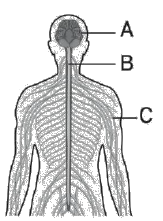
A) C is the major site of information processing.
B) A, B and C constitute central nervous system.
C) C represents neurons.
D) B is a component of CNS while ‘C’ constitutes PNS.
The nerve fibres of PNS are
A) afferent B) efferent C) both afferent and efferent D) only motor
Refer to the diagram representing the transmission of impulse through PNS.
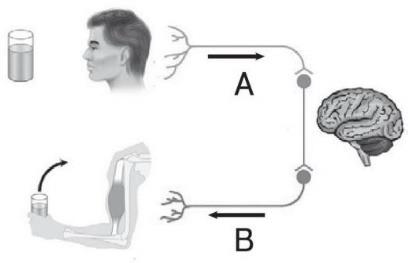
Which of the following option is most pertinent?
A) A and B are afferent nerves.
B) A is afferent nerve while B is efferent nerve
C) A is efferent nerve while A is afferent nerve.
D) Both A and B are efferent nerves.
Consider the following statements.
I. Two major division of CNS are somatic neural system and autonomic neural system.
II. Both somatic and autonomic neural system are antagonistic in their functions.
Select the correct option.
A) I is true, II is false.
B) Both I and II are true.
C) I is false, II is true.
D) Both I and II are false.
Select the correct statement.
A) Somatic neural system consists of both afferent and efferent nerves.
B) Autonomic neural system consists of only afferent fibres.
C) Only efferent nerves are found in somatic and autonomic neural system.
D) Both afferent and efferent fibres are found in somatic and autonomic neural system.
The two divisions of autonomic nervous system are
A) antagonistic to each other
B) complementary to each other
C) highly reduced and non-functional in humans
D) functional as a single system in humans
Visceral nervous system within human body
(1) is the division of peripheral nervous system.
(2) is the division of central nervous system.
(3) consists of nerve fibres and ganglia.
(4) carry impulses from one visceral organ to another.
Which of the following option is the most appropriate?
A) 1 and 2 are correct
B) 2 and 4 are correct
C) 1, 3 and 4 are correct
D) 2, 3, 4 are correct
Which component of neural system would control the functioning of heart and stomach?
A) Somatic neural system.
B) Only sympathetic nervous system.
C) Only parasympathetic nervous system.
D) Both sympathetic and parasympathetic nervous system.
Match the following columns:
Column-I Column-II
(a) Afferent fibres (1) Involuntarily controlled muscles
(b) Somatic neural system (2) Carry impulse away from the CNS
(c) Autonomic neural system (3) Voluntarily controlled muscles
(d) Efferent fibres (4) Carry impulse towards the CNS
Which of the following is the correct option?
a b c d
(A) 2 1 3 4
(B) 2 3 1 4
(C) 4 3 1 2
(D) 4 1 3 2
Identify A-C.
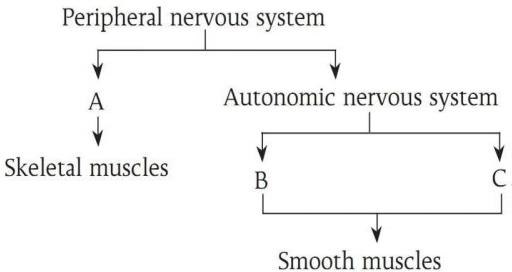
Select the correct option.
A |
B |
C |
|
| A) | Spinal cord | Afferent nerves | Efferent nerves |
| B) | Somatic nervous system | Parasympathetic
nervous system |
Afferent and
efferent nerves |
| C) | Sympathetic nervous system | Efferent nerves | Afferent nerves |
| D) | Somatic neural system | Sympathetic
nervous system |
Parasympathetic
nervous system |
Assertion: A person would not be able to perceive hot or cold sensation if afferent fibres of PNS are degenerated in him.
Reason: All the afferent nerve fibres are motor nerves.
A) Both Assertion and Reason are true and Reason is correct explanation of Assertion.
B) Both Assertion and Reason are true,but Reason is not the correct explanation of Assertion.
C) Assertion is true, but Reason is false.
D) Assertion is false, but Reason is true.
Assertion: Autonomic nervous system is controlled voluntarily by humans.
Reason: All the muscular activities are inhibited by sympathetic nervous system.
A) Both Assertion and Reason are true and Reason is correct explanation of Assertion.
B) Both Assertion and Reason are true, but Reason is not the correct explanation of Assertion.
C) Assertion is true, but Reason is false.
D) Assertion is false, but Reason is true.
The basic structural components of a neuron are
A) cell body and axon B) cell body and dendrites
C) axon and dendrites D) cell body, axon and dendrites
Identify the incorrectly matched pair of cell organelle found in neuron and its function.
A) Nucleus – Contain DNA
B) Mitochondria – Energy production
C) Golgi apparatus – Protein synthesis
D) Lysosomes – Scavengers of neurons
Neurons differ from a typical cell because of the presence of
A) nucleolus
B) Nissl’s granules
C) protein synthesizing machinery
D) microfilaments
Nissl bodies are mainly composed of
A) proteins and lipids
B) DNA and RNA
C) nucleic acids and SER
D) free ribosomes and RER
The dendrites of a neuron are
A) long, unbranched processes associated with cell body and axon
B) short, highly branched processes of cell body
C) long and branched processes of cell body
D) short, unbranched processes of cell body and axon
Which of the following characteristic is correct about dendrites?
A) non-functional, degenerating axons
B) involved in carrying impulse away from the cell body
C) involved in transmitting impulse toward the cell body
D) involved in transmitting impulse toward and away from the cell body
The only similarity between the cell body and dendrites is the presence of
A) golgi bodies B) Nissl’s granules
C) nucleus D) mitochondria
While studying the structural details of a neuron, how would you distinguish an axon from a dendrite?
A) Axon is a long process whose distal end is branched.
B) Dendrites are branched irregularly while the axon gives off long branches alternatively.
C) Axon contains Nissl’s granules while dendrites do not.
D) Axons are numerous while each neuron contain only two dendrites.
Synaptic knob
(1) is terminal bulb-like structure of dendrites and axons.
(2) contains neurotransmitter – filled vesicles.
(3) is a protoplasmic extension of cell body.
Which of the following option is most appropriate?
A) 1 and 2 are correct B) Only 3 is correct
C) Only 2 is correct D) 1 and 3 are correct
Consider the following statements.
(A) Axons carry impulse away from the cell body.
(B) The synaptic knob of axons are found in contact with neuro-muscular junctions.
Select the correct option.
A) A is true, B is false. B) Both A and B are false.
C) Both A and B are true. D) A is false, B is true.
Refer to the given diagram of the structure of a neuron and identify A, B and C.
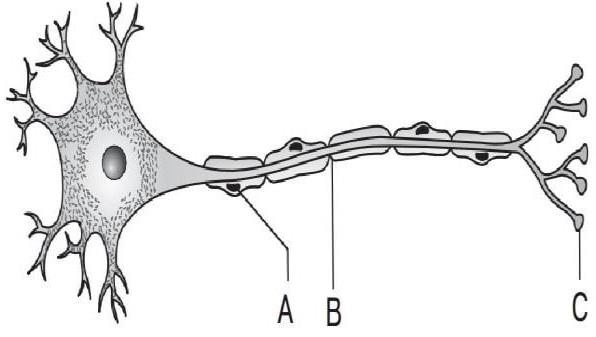
Select the correct option.
A |
B |
C |
|
| A) | Nissl’s granule | Axon | Schwann Cell |
| B) | Schwann cell | Nodes of Ranvier | Synaptic Knob |
| C) | Synaptic Knob | Dendrite | Synaptic Knob |
| D) | Nucleus | Myelin sheath | Nissl’s granule |
Match the following columns.
Column-I Column-II
(a) Neurotransmitters (1) Ribosomal granules
(b) Nissl’s granules (2) Short and branched
(c) Dendrites (3) Contained in synaptic knob
(d) Axon (4) Carry impulse away from cell body
Select the correct option.
a b c d
A) 1 3 2 4
B) 3 1 4 2
C) 3 1 2 4
D) 1 3 4 2
On what basis, neurons are classified as unipolar, bipolar or multipolar?
A) Transmission of impulse
B) Number of axons and dendrites
C) Sensory or motor nature
D) Number of nucleus within cell body
A neuron with one axon and one dendrite is known
A) unipolar B) bipolar
C) nonpolar D) multipolar
A multipolar neuron contains multiple
A) dendrites B) axons C) axons and dendrites D) synaptic bulbs
Select the correct statement regarding unipolar neuron.
A) It contains cell body only.
B) It contains one dendrite and one axon.
C) It contains one dendrite and one cell body only.
D) It contains one axon only.
Match the following columns.
Column-I Column-II
(Types of Neurons) (Location)
(a) Multipolar neuron (1) Embryonic stages
(b) Bipolar neuron (2) Retina of eyes
(c) Unipolar neuron (3) Cerebral cortex
Select the correct option.
a b c
A) 3 2 1
B) 2 1 3
C) 1 3 2
D) 2 3 1
Consider the following statements.
(A) Myelinated and non-myelinated neurons are differentiated on the basis of type of neurons.
(B) Humans contain only myelinated neurons.
Select the correct option.
A) A is true, B is false. B) A is false, B is true.
C) Both A and B are true. D) Both A and B are false.
The myelin sheath around the axons is formed by
A) osteocytes and astrocytes B) astrocytes and Schwann cells
C) Schwann cells and oligodendrocytes D) oligodendrocytes and osteoclasts
Nodes of Ranvier are
A) granulated bodies in cytoplasm
B) gaps between adjacent myelin sheath on axons
C) modulated bodies at the ends of dendrites
D) vesicles at the terminal ends of axons
The myelinated neurons are found in
A) cranial nerves B) spinal nerves
C) nerves of ANS D) cranial and spinal nerves
Consider the following statements.
(A) Unmyelinated nerve fibres are commonly found in the cranial nerves.
(B) Unmyelinated nerve fibres transmit impulse at slower rate.
Select the correct option.
A) Both A and B are true. B) A is true, B is false.
C) Both A and B are false. D) A is false, B is true.
Assertion: The axons of neurons can receive signals from other neurons.
Reason: A multipolar neuron contains numerous axons.
A) Both Assertion and Reason are true and Reason is correct explanation of Assertion.
B) Both Assertion and Reason are true, but Reason is not the correct explanation of Assertion.
C) Assertion is true, but Reason is false.
D) Assertion is false, but Reason is true.
Assertion: The speed of nerve impulse along axon would slowdown in the absence of Schwann cells.
Reason: Schwann cells are abundantly found in cells body of neurons.
A) Both Assertion and Reason are true and Reason is correct explanation of Assertion.
B) Both Assertion and Reason are true,but Reason is not the correct explanation of Assertion.
C) Assertion is true, but Reason is false.
D) Assertion is false, but Reason is true.
Select the incorrect statement.
A) Neurons possess the excitability due to their polarised membranes.
B) Neural membrane contains different types of ion channels.
C) A resting neuron is not permeable to any ion.
D) During polarised state, conduction of nerve impulse does not occur along axonal membrane.
The potential difference across an axonal membrane during rest is maintained by
A) Na+ and Cl- ions B) Na+ and K+ ions
C) K+ and Cl- ions D) Na+ and HCO3 – ions
The resting axonal membrane is
(1) permeable to K+ ions.
(2) permeable to Na+ ions.
(3) impermeable to negatively charged proteins of axoplasm.
Select the correct option.
A) 1 and 2 are correct. B) 1, 2 and 3 are correct.
C) 2 and 3 are correct. D) 1 and 3 are correct.
Consider the following statements.
(A) At rest, the axoplasm inside the axon contain low concentration of K+ ions.
(B) The concentration gradient across axonal membrane is generated due to the different concentration of Na+ and K+ ions across it.
Select the correct option.
A) A is true, B is false. B) Both A and B are false.
C) A is false, B is true. D) Both A and B are true.
When a neuron is not conducting any impulse i.e. resting, the axonal membrane is –
A) Comparatively more permeable to K+ and impermeable (nearly impermeable) to Na+
B) Impermeable to negatively charged proteins present in the axoplasm
C) Both
D) More permeable to Na+ ions than K+
In a resting axonal membrane
A) both outside and inside fluid is positively charged.
B) both outside and inside fluid is negatively charged.
C) outside fluid is positively charged while inside is negatively charged.
D) inside fluid is positively charged while outside is negatively charged.
Match the following columns.
Column-I Column-II
(a) Na+ ions during resting stage (1) More inside, less inside
(b) K+ ions during resting stage (2) More outside, less inside
(c) Action potential (3) Depolarised Membrane
(d) Resting potential (4) Polarised membrane
Select the correct option.
a b c d
A) 2 1 4 3
B) 2 1 3 4
C) 1 2 3 4
D) 1 2 4 3
What change would you find in a polarised membrane after a stimulus is applied at a particular point (P)?
A) The whole membrane becomes impermeable to Na+ ions.
B) At point P, the membrane allows movement of Na+ and K+ equally.
C) At point P, the membrane becomes permeable to Na+ ions.
D) At point P, the membrane becomes impermeable to both Na+ and K+ ions.
A depolarised axonal membrane contains
A) equal amount of Na+ and K+ ions at outside and inside.
B) positive charge inside and negative charge outside.
C) positive charge outside and negative charge inside.
D) negative charge at both outside and inside.
Na+ − K+ pump
I. Needs energy (ATP) to work
II. Expels 3 Na+ for every 2K+ ions imported
III. Works against a concentration gradient
Maintains resting potential
A) All are correct B) Only II and III are correct
C) Only I and III are correct D) None is correct
Consider the following statements.
(A) The stimulus-induced increased permeability of Na+ ions helps in the conduction of action potential.
(B) Increased permeability of K+ ions helps to restore the resting potential of the membrane.
Select the correct option.
A) A is true, B is false. B) Both A and B are true.
C) A is false, B is true. D) Both A and B are false.
Match the following columns.
Column-I Column-II
(a) Synaptic vesicles (1) Bind to neurotransmitters
(b) Receptors of postsynaptic membrane (2) Contain neurotransmitters
(c) Electrical synapse (3) Rare in human system
(d) Chemical synapse (4) Slow conduction of nerve impulse
Select the correct option.
a b c d
A) 2 1 3 4
B) 2 1 4 3
C) 1 2 3 4
D) 1 2 4 3
Which of the following set of structures constitutes a synapse?
A) Axon terminal, synaptic vesicles, receptors.
B) Presynaptic and pest synaptic membranes.
C) Synaptic cleft, receptors, post synaptic membrane.
D) Presynaptic membrane, synaptic cleft, post synaptic membrane.
During an action potential
(1) impulse is conducted along the axons
(2) Na+ ions move outwards
(3) permeability of membrane to K+ ions decreases
Select the most appropriate option.
A) 1, 2, 3 are correct. B) 1 and 2 are correct.
C) 1 and 3 are correct. D) Only 1 is correct.
Synapse is a junction between
A) two neurons B) CNS and PNS
C) spinal cord and nerves D) cell body and axon
Select the incorrect statement
A) Synaptic cleft is not necessarily found between all the neurons.
B) At synapse, the impulse travels along the single direction, i.e., from presynaptic to post synaptic membrane.
C) Electrical synapses are rare in human body.
D) Chemical synapses are faster than the electrical synapses.
The chemicals found in the synaptic cleft are known as
A) prohormones B) hormones
C) neurotransmitters D) proenzymes
Consider the following statements.
(A) The neurotransmitters help in the transmission of impulses at chemical synapses.
(B) Neurotransmitters have no role in electrical synapses. Select the correct statement
A) A is true, B is false. B) A is false, B is true.
C) Both A and B are false. D) Both A and B are true.
The neurotransmitter-filled synaptic vesicles are found in
A) post synaptic membranes
B) receptor sites of post-synaptic vesicles
C) axon-terminal
D) tips of dendrites
From the following diagram of axon terminal and synapse, identify at least two correctly labelled structures.
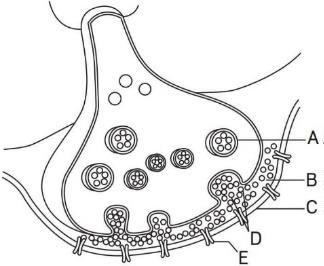
A) B – Receptor, C – Neurotransmitter
B) A – Synaptic Vesicles, E – Receptor
C) C – Post synaptic membrane, D – K+ions
D) D – 𝑁𝑎+ ions, A – Neurotransmitters
To release the neurotransmitters, synaptic vesicles
(1) get burst open
(2) require stimulation through action potential
(3) get digested by the lysosomes at axon terminals
Which of the following option is most appropriate?
A) 1 and 2 are correct. B) 2 is correct. C) 2 and 3 are correct. D) 1 is correct.
Receptor sites for neurotransmitters are present on
A) membranes of synaptic vesicles B) pre-synaptic membrane
C) tips of axons D) post-synaptic membranes
The opening of ion-channels on postsynaptic membrane generates
A) excitatory potential B) inhibitory potential
C) either (a) or (b) D) no action potential
Assertion: Neurons are excitable cells.
Reason: The membrane of neurons remain in polarised state.
A) Both Assertion and Reason are true and Reason is correct explanation of Assertion.
B) Both Assertion and Reason are true, but Reason is not the correct explanation of Assertion.
C) Assertion is true, but Reason is false.
D) Assertion is false, but Reason is true.
Assertion: The resting axonal membrane possess positive charge outside.
Reason: The concentration of K+ ions is higher outside the axonal membrane at rest.
A) Both Assertion and Reason are true and Reason is correct explanation of Assertion.
B) Both Assertion and Reason are true,but Reason is not the correct explanation of Assertion.
C) Assertion is true, but Reason is false.
D) Assertion is false, but Reason is true.
Assertion: Synaptic cleft is the point of fusion of pre-synaptic and post synaptic membrane at synapse.
Reason: Impulse transmission across chemical synapse is faster than that across an electrical synapse.
A) Both Assertion and Reason are true and Reason is correct explanation of Assertion.
B) Both Assertion and Reason are true, but Reason is not the correct explanation of Assertion.
C) Assertion is true, but Reason is false.
D) Assertion is false, but Reason is true
Consider the following statements.
(A) Brain is the central control system of human body.
(B) Brain can control both voluntary movements and functioning of vital involuntary organs.
Select the correct option.
A) A is true, B is false. B) Both A and B are false.
C) A is false, B is true. D) Both A and B are true.
Select the incorrect statement.
A) Brain is protected by the skull.
B) Human brain can regulate thermoregulation and circadian rhythm of body.
C) Inside the skull, humans possess two cranial meninges.
D) Processing of vision and speech occur in human brain.
The cranial meninges from outer to inner region of brain are
A) dura mater, arachnoid, pia mater
B) pia mater, dura mater, arachnoid
C) arachnoid, Pia mater, dura mater
D) arachnoid, dura mater, pia mater
Which cranial meninges is in contact with brain tissue?
A) Dura mater and arachnoid B) Arachnoid and pia mater
C) Pia mater D) Dura mater
All the given structures are included in forebrain except
A) cerebrum B) hypothalamus C) pons D) thalamus
Match the following columns.
Column-I Column-II
(a) Cerebrum (1) Grey matter of brain
(b) Cerebral cortex (2) Major part of human brain
(c) Corpus callosum (3) Tract of nerve fibres
(d) Association areas (4) Neither sensory nor motor in function
Which of the following is the correct option?
a b c d
A) 4 3 2 1
B) 2 1 3 4
C) 1 4 1 2
D) 3 2 4 1
The two longitudinal cerebral hemispheres are connected by
A) cerebral cortex B) association area
C) corpus callosum D) corpus albicans
Cerebral cortex is
A) outer folded layer of cerebrum
B) non-functional area of cerebrum
C) inner white layer of cerebrum and cerebellum
D) only functional area of cerebrum
Select the correct statement regarding cerebral cortex.
A) It is white in appearance due to the presence of axons in it.
B) It is white in appearance due to the presence of cell bodies of neurons.
C) It is grey in appearance due to the presence of cell bodies of neurons.
D) It is grey in appearance due to the presence of axons in it.
The cerebral cortex contains
A) motor area B) sensory areas
C) motor and sensory areas D) motor, sensory and association areas
The inner region of cerebral hemisphere
A) is grey in appearance
B) contain axonal fibres covered by myelin sheath
C) contain cell bodies of the neurons
D) both (b) and (c)
Refer to the diagram showing sagittal section of human brain.
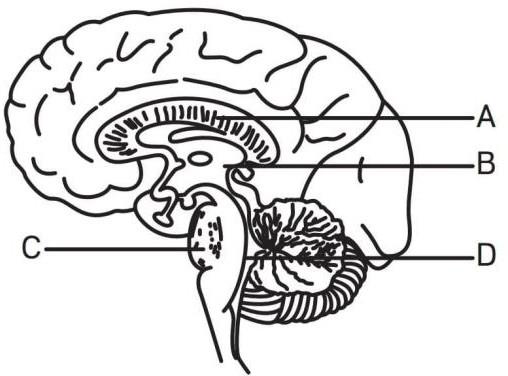
Identify the parts labelled as A–D.
| A | B | C | D | |
| A) | Cerebrum | Medulla | Cerebellum | Medulla |
| B) | Hypothalamus | Cerebellum | Medulla | Pons |
| C) | Corpus callosum | Thalamus | Pons | Cerebra l aqueduct |
| D) | Thalamus | Corpus callosum | Medulla | Cerebellum |
Thalamus in human brain
(1) is surrounded by cerebrum.
(2) acts as a major coordinating centre for sensory and motor signalling.
(3) is under the direct control of hypothalamus.
Which of the following option is most appropriate?
A) 1 and 2 are correct. B) 2 and 3 are correct.
C) only 3 is correct. D) 1, 2 and 3 are correct.
The structure found at the base of thalamus
A) is vestigial organ.
B) controls urge of eating and drinking.
C) involved in thermoregulation.
D) both (b) and (c).
Hypothalamic hormones are secreted by
A) glial cells B) Schwann cells
C) oligodendrocytes D) neurosecretory cells
Which part of the brain is responsible for thermoregulation?
A) Hypothalamus B) Corpus callosum
C) Medulla oblongata D) Cerebrum
Which of the following structure or region is incorrectly paired with its function?
A) Medulla oblongata: Controls respiration and cardiovascular reflexes.
B) Limbic system: Consists of fibre tracts that interconnect different regions of brain; controls movement.
C) Hypothalamus: Production of releasing hormones and regulation of temperature, hunger and thirst.
D) Corpus callosum: Band of fibres connecting left and right cerebral hemispheres.
Limbic system within human brain is found
A) at the base of brain stem
B) inner portion of cerebral hemispheres
C) adjacent to cerebellum
D) above the cerebral cortex
All the listed structures are the parts of limbic system except
A) Hippocampus B) amygdala C) medulla D) hypothalamus
Consider the following statements.
(A) Limbic system regulates endocrine activities along with hypothalamus.
(B) Limbic system helps to regulate excitement, pleasure, rage and fear.
Select the correct option.
A) A is true, B is false. B) Both A and B are true.
C) A is false, B is true. D) Both A and B are false.
Match the following columns.
Column-I Column-II
(a) Hypothalamus (1) Inner part of cerebral cortex
(b) White matter (2) Neurosecretory cells
(c) Amygdala (3) Between thalamus and pons
(d) Midbrain (4) Part of limbic system
Select the correct option.
a b c d
A) 3 2 1 4
B) 2 1 4 3
C) 1 3 2 4
D) 4 2 3 1
Cerebral aqueduct is found in
A) forebrain B) midbrain C) hindbrain D) in between forebrain and midbrain
Corpora quadrigemina are
A) four rounded swellings at dorsal portion of midbrain.
B) two plate-like structures which separate forebrain and midbrain.
C) circular hollow brain ventricles containing cerebrospinal fluid.
D) elongated, cylindrical canals which connect midbrain to brainstem. Hindbrain
Which of the following structures is not found in hindbrain?
A) Pons B) Cerebellum C) Medulla D) Hippocampus
What is the function of pons?
A) It conveys information from midbrain to target organs.
B) It controls involuntary smooth muscles and voluntary skeletal muscles.
C) It interconnects different regions of the brain.
D) All of these.
How can cerebellum be differentiated from the pons of hindbrain?
A) Cerebellum has white matter outside while pons contain grey matter outside.
B) Cerebellum has highly convoluted surface while pons contain fibre tracts.
C) Cerebellum is smaller in size as compared to pons.
D) All of these.
Consider the following statements.
(A) Cerebellum is a part of hindbrain.
(B) Cerebellum helps to maintain body posture and equilibrium.
Select the correct option.
A) A is true, B is false B) Both A and B are false.
C) Both A and B are true. D) A is false, B is true.
The medulla oblongata
(1) is a part of hindbrain.
(2) control autonomic functions like breathing, heart rate, etc
(3) relay motor and sensory signals between spinal cord and higher brain regions. Select the most appropriate option.
A) 1, 2 and 3 are correct. B) 1 and 2 are correct.
C) Only 1 is correct. D) Only 2 is correct.
The brain stem is formed by
A) forebrain, midbrain, hindbrain
B) midbrain, hindbrain
C) cerebrum, cerebellum, spinal cord
D) midbrain, pons, medulla oblongata
Match the following columns.
Column-I Column-II
(a) Brain stem (1) Emotions
(b) Cerebellum (2) Brain ventricle Containing CSF
(c) Limbic system (3) Breathing and consciousness
(d) Cerebral aqueduct (4) Balance and coordination
Select the correct option.
a b c d
A) 4 3 2 1
B) 2 1 4 3
C) 3 4 1 2
D) 1 2 3 4
Assertion: Cerebral cortex appear grey in colour.
Reason: It contains the cell bodies of the neurons.
A) Both Assertion and Reason are true and Reason is correct explanation of Assertion.
B) Both Assertion and Reason are true, but Reason is not the correct explanation of Assertion.
C) Assertion is true, but Reason is false.
D) Assertion is false, but Reason is true.
Assertion: Association areas can carry out complex functions like communication and memory.
Reason: These areas are completely motor in nature.
A) Both Assertion and Reason are true and Reason is correct explanation of Assertion.
B) Both Assertion and Reason are true, but Reason is not the correct explanation of Assertion.
C) Assertion is true, but Reason is false.
D) Assertion is false, but Reason is true.
Assertion: Damage of limbic system would affect the emotional behaviour of a person.
Reason: The amygdale is the emotion centre of the brain.
A) Both Assertion and Reason are true and Reason is correct explanation of Assertion.
B) Both Assertion and Reason are true, but Reason is not the correct explanation of Assertion.
C) Assertion is true, but Reason is false.
D) Assertion is false, but Reason is true.
Reflex action is
A) voluntarily controlled response of CNS.
B) involuntary response to peripheral nervous stimulation.
C) involuntary response to environmental stimulus which does not involve CNS.
D) Both (B) and (C)
The reflex actions are controlled by
A) CNS B) PNS C) ANS D) Both (B) and (C)
The reflex pathway is composed of
A) afferent neurons only B) efferent neurons only
C) motor neurons only D) Both (A) and (B)
Consider the following statements.
(A) Afferent neurons are found close to the sensory organs.
(B) The efferent neurons carry signals from CNS to the effectors.
Select the correct option.
A) A is true, B is false. B) Both A and B are false.
C) A is false, B is true. D) Both A and B are true.
Which of the following option represents the correct sequence of nerve impulse transmission in a reflex arc?
A) Interneuron Dorsal root ganglion Sensory organ
B) CNS Efferent neuron Interneuron
C) Sensory organ Afferent neuron Dorsal root ganglion
D) Efferent neuron CNS Afferent neuron
In a reflex arc, what is the role of an interneuron?
A) It relays impulse to effector at motor end plate.
B) It transmits impulse from the white matter to grey matter of spinal cord.
C) It receives impulse from afferent neuron and transmits it to motor neuron.
D) It connects two dorsal root ganglions.
Among the following listed structures, knee-jerk doesn’t involve
A) motor neuron B) spinal cord C) interneuron D) brain
In the given diagram of reflex action, identify A, B and C.
Select the correct option.
Assertion: All autonomic actions of body are reflex action.
Reason: Reflex actions do not require CNS.
A) Both Assertion and Reason are true and Reason is correct explanation of Assertion.
B) Both Assertion and Reason are true but Reason is not the correct explanation of Assertion.
C) Assertion is true, but Reason is false.
D) Assertion is false, but Reason is true.
Assertion: Sneezing in response to an allergen is reflex action
Reason: It is an involuntary action.
A) Both Assertion and Reason are true and Reason is correct explanation of Assertion.
B) Both Assertion and Reason are true, but Reason is not the correct explanation of Assertion.
C) Assertion is true, but Reason is false.
D) Assertion is false, but Reason is true.
Assertion: In a reflex arc, efferent neuron receives signal from sensory organ.
Reason: The afferent neuron relays impulses to PNS in a reflex arc.
A) Both Assertion and Reason are true and Reason is correct explanation of Assertion.
B) Both Assertion and Reason are true, but Reason is not the correct explanation of Assertion.
C) Assertion is true, but Reason is false.
D) Assertion is false, but Reason is true.
Consider the following statements.
(A) The olfactory receptors help us to receive the sense of smell.
(B) The olfactory receptors are coated by mucus.
Select the correct option.
A) A is true, B is false. B) Both A and B are false.
C) A is false, B is true D) Both (A) and (B) are true.
The olfactory epithelium is made up of
A) sensory cells B) basal cells
C) sensory, sustentacular and basal cells D) sustentacular and sensory cells
The olfactory epithelium neurons transmit the signals from
A) environment to olfactory bulb
B) one olfactory bulb to another
C) olfactory bulb to PNS
D) environment to CNS
To which region of brain, olfactory bulb is connected?
A) Cerebrum B) Limbic system C) Cerebral aqueduct D) Corpus callosum
Gustation and olfaction are achieved through
A) proprioceptors B) mechanoreceptors
C) baroreceptors D) chemoreceptors
Consider the following statements.
(A) The gustatory receptors are found at the base of tongue.
(B) The tongue detects taste through taste buds.
Select the correct option.
A) A is true, B is false. B) Both A and B are false.
C) A is false, B is true. D) Both A and B are true.
Assertion: The sense of olfaction is concerned with limbic system.
Reason: Olfactory bulb is a part of cerebrum.
A) Both Assertion and Reason are true and Reason is correct explanation of Assertion.
B) Both Assertion and Reason are true, but reason is not the correct explanation of Assertion.
C) Assertion is true, but Reason is false.
D) Assertion is false, but Reason is true.
Assertion: Gustatory cells gets directly activated after being exposed to dissolved chemicals.
Reason: Three cranial nerves carry taste stimulus to brain.
A) Both Assertion and Reason are true and Reason is correct explanation of Assertion.
B) Both Assertion and Reason are true, but Reason is not the correct explanation of Assertion.
C) Assertion is true, but Reason is false.
D) Assertion is false, but Reason is true.
Select the incorrect statement.
A) The sockets of skull containing eyes are orbits.
B) The wall of eyes is made up of two layers.
C) Retina is the innermost layer of eye ball.
D) None of these.
The outermost, middle and innermost layers of eyeball are
A) sclera, choroid, retina B) retina, cornea, iris
C) iris, sclera, cornea D) choroid, cornea, retina
Consider the following statements.
(A) Cornea is the anterior portion of sclera.
(B) Cornea helps to refract the light entering the eyes.
Select the correct option.
A) A is true, B is false. B) Both A and B are false.
C) A is false, B is true. D) Both A and B are true.
Which of the following statement is correct?
A) Cornea consists of dense connective tissue of elastin and can repair itself.
B) Cornea is convex, transparent layer which is highly vascularised.
C) Cornea consists of dense matrix of collagen and is the most sensitive portion of the eye.
D) Cornea is an external, transparent and protective proteinaceous covering of the eyeball.
Match the following columns.
Column-I Column-II
(a) Retina (1) Contains blood vessels
(b) Sclera (2) Neural cells
(c) Choroid (3) Dense connective tissue
Select the correct option.
a b c
A) 1 2 3
B) 3 1 2
C) 1 3 2
D) 2 3 1
Which of the following statement is correct regarding choroid?
A) It contains numerous blood vessels.
B) It has no role in vision.
C) It is the major component of the lens of eyes.
D) It secretes aqueous humor.
The ciliary body is the anterior part of
A) sclera B) retina C) cornea D) choroid
What is the correct description about iris?
A) Nonvascular, opaque portion of eye
B) Pigmented, opaque and vascular structure of eye.
C) Nonvascular, visible coloured portion of eye.
D) Vascular, non-pigmented posterior most portion of eye.
The transparent lens in the human eye is held in its place by
A) ligament attached to ciliary body
B) ligaments attached to the iris
C) smooth muscles attached to the iris
D) smooth muscles attached to the ciliary body
An aperture in front of lens is called
A) fovea B) blind spot C) pupil D) iris
The diameter of pupil is regulated by
A) aqueous humor B) retina C) rods D) iris
How many neural cells are found in retina?
A) Two B) Five C) Three D) Four
The arrangement of neural cells in retina from inside to outside is
A) ganglion cells, bipolar cells, photoreceptors cells.
B) photoreceptor cells, ganglion cells, bipolar cells.
C) bipolar cells, ganglion cells, photoreceptor cells.
D) bipolar
cells, photoreceptor cells, ganglion cells.
Within retina, the rods and cones are the type of
A) bipolar and photoreceptor cells, respectively
B) ganglion cells
C) photoreceptor cells
D) photoreceptor and ganglion cells
Consider the following statements.
(A) Photopigments are light sensitive proteins in rods and cones.
(B) Rods contain rhodopsin while cones contain three different type of photopigments.
Select the correct option.
A) A is true, B is false. B) Both A and B are true.
C) A is false, B is true. D) Both A and B are false.
Match the following columns.
Column-I Column-II
(a) Iris (1) Secrete aqueous humor
(b) Ciliary body (2) Photosensitive layer of eye
(c) Retina (3) Devoid of receptor cells
(d) Blind spot (4) Regulate the amount of light entering into eyes
Select the correct option.
a b c d
A) 2 3 4 1
B) 4 1 2 3
C) 1 2 3 4
D) 3 4 1 2
The cone cells of retina provide
A) photopic vision B) colour vision
C) photopic and colour vision D) scotopic vision
Which of the following statements is not correct?
A) In the knee-jerk reflex, stimulus is the stretching of muscle and response is its contraction.
B) An action potential in an axon does not move backward because the segment behind is in a refractory
phase.
C) Depolarisation of hair cells of cochlea results in the opening of the mechanically gated potassium-ion
channels.
D) Rods are very sensitive and contribute to daylight vision.
Rhodopsin in the rod cells of retina
(1) is purplish-red protein.
(2) contains opsin protein.
(3) contains retinene which is an aldehyde of vitamin D.
Select the most appropriate option.
A) 1 and 2 are correct. B) 1 and 3 are correct.
C) Only 2 is correct. D) 1, 2 and 3 are correct.
Good vision depends on adequate intake of carotene rich food.
Select the best option from the following statements.
(A) Vitamin A derivatives are formed from carotene.
(B) The photopigments are embedded in the membrane discs of the inner segment.
(C) Retinal is derivative of Vitamin A.
(D) Retinal is a light absorbing part of all the visual photopigments.
Options:
A) B, C, A B) A, B C) A, C, D D) A, C
Which of the following options is wrong?
A) Eye muscles are attached with sclera
B) Visual purple 1s concerned with dim light, while visual violet is concerned with bright light
C) The colour differentiation is done by cones
D) None
What would happen if the three photopigments of cone cells are stimulated equally?
A) No colour vision and daylight vision would be produced.
B) Sensation of black light would be produced
C) Sensation of white light would be produced.
D) Mosaic vision of different colours would be produced.
Photosensitive compound in human eye is made up of
A) opsin and retinal
B) opsin and retinol
C) transducin and retinene
D) guanosine and retinol
Consider the following statements.
(A) The optic nerves and blood vessels enter the eyes through blind spot.
(B) Blind spot contains abundant rod cells but no cone cells. Select the correct option.
A) A is true, B is false. B) Both A and B are false.
C) A is false, B is true. D) Both A and B are true.
Select the correct statement.
A) Macula lutea is a red coloured spot at the entrance of optic nerves.
B) Fovea is the central portion of macula lutea, containing abundant cone cells.
C) Macula lutea is the only structure of retina which contain rod and cone cells.
D) No true image is formed at fovea due to the overlapping of photoreceptor cells.
The point of greatest visual acuity in human eye is
A) fovea B) blind spot C) iris D) pupil
Consider the following statements.
(A) Aqueous chamber containing aqueous humor is found in the space between lens and retina.
(B) Vitreous chamber containing vitreous humor is found in the space between lens and cornea.
Select the correct option.
A) A is true, B is false. B) Both A and B are false.
C) A is false, B is true. D) Both A and B are true.
In the given structure of human eye, identify the location of fovea, cornea choroid and sclera.
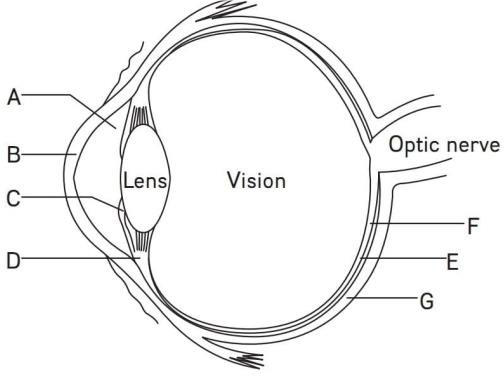
Fovea Cornea Choroid Sclea
A) B C A D
B) G B D A
C) F B E G
D) D A B C
The light rays of visible wavelength are focused on
A) retina through cornea B) lens through pupil
C) pupil through iris D) retina through iris
How does the potential differences generated in photoreceptor cells when light of suitable wavelength enters the human eye?
A) Light cause chemical modification of rhodopsin and iodopsin so that they form a new compound.
B) Light causes the conversion of opsin to retinal.
C) Light causes dissociation of opsin and retinal so as to cause structural changes of opsin.
D) Light causes destruction of opsin and retinal so that iodopsin can change membrane potential.
The route of transmission of action potential by optic nerves to visual cortex of brain is
A) Photoreceptor cells » Bipolar cells » Ganglion cells.
B) Ganglion cells » Bipolar cells » Photoreceptor cells
C) Bipolar cells » Photoreceptor cells » Ganglion cells
D) Bipolar cells » Ganglion cells » Photoreceptor cells
Assertion: Sclera and cornea form the fibrous coat of human eye.
Reason: Sclera and cornea contain abundant blood vessels.
A) Both Assertion and Reason are true and Reason is correct explanation of Assertion.
B) Both Assertion and Reason are true, but Reason is not the correct explanation of Assertion.
C) Assertion is true, but Reason is false.
D) Assertion is false, but Reason is true.
Assertion: The posterior region of the eyeball possesses the points of no vision and maximum visual resolution.
Reason: Fovea contain abundant rod cells but lack cone cells.
A) Both Assertion and Reason are true and Reason is correct explanation of Assertion.
B) Both Assertion and Reason are true, but Reason is not the correct explanation of Assertion.
C) Assertion is true, but Reason is false.
D) Assertion is false, but Reason is true.
Assertion: Neural impulses are analysed by the visual cortex of the brain.
Reason: Image formed on retina is recognised based on earlier memory and experience.
A) Both Assertion and Reason are true and Reason is correct explanation of Assertion.
B) Both Assertion and Reason are true, but Reason is not the correct explanation of Assertion.
C) Assertion is true, but Reason is false.
D) Assertion is false, but Reason is true.
The structural component of external ear is
A) pinna
B) pinna and auditory meatus
C) pinna, auditory meatus and eardrum
D) auditory meatus and tympanic membrane
Consider the following statements.
(A) Fine hairs and wax secreting glands are found in the skin of pinna and auditory meatus.
(B) Pinna and auditory meatus are vestigial organs of human ear.
Select the correct option.
A) A is true, B is false. B) Both A and B are false.
C) A is false, B is true. D) Both A and B are true.
The wax-secreting glands in auditory meatus is
A) Weber’s glands B) Ebner’s glands
C) Ceruminous glands D) Krause’s glands
The membrane found between the outer and middle ear is
A) basilar membrane B) Reissner’s membrane
C) tympanic membrane D) tectorial membrane
The outer and inner surface of tympanic membrane is composed of
A) connective tissues B) mucus membrane
C) mucus membrane outside and connective tissue inside
D) connective tissue outside and mucus membrane inside
The middle ear consists of
A) ear ossicles
B) cochlea and labyrinth
C) auditory meatus and tympanic membrane
D) ear ossicles and cochlea
Match the following columns.
Column-I Column-II
(a) Auditory meatus (1) Receive sound vibrations from environment
(b) Pinna (2) Conduct vibrations to tympanic membrane
(c) Ear ossicles (3) Conduct vibrations to inner ear
Select the correct option.
a b c
A) 1 3 2
B) 3 1 2
C) 2 1 3
D) 1 2 3
The arrangement of ear ossicles from outer to inner ear is
A) stapes, malleus, incus
B) incus, stapes, malleus
C) malleus, stapes, incus
D) malleus, incus, stapes
Select the incorrect statement.
A) The stapes is found attached to the oval window of cochlea.
B) Ear ossicles increase the efficiency of sound wave transmission to inner ear.
C) Eustachian tube connects inner ear to the pharynx.
D) Eustachian tube helps in equalising the pressure on either side of tympanic membrane.
Consider the following statements.
(A) The fluid-filled inner ear has two parts – bony labyrinth and membranous labyrinth.
(B) The membranous labyrinth surrounds the bony labyrinth in inner ear.
Select the correct option.
A) A is true, B is false. B) A is false, B is true.
C) Both A and B are false. D) Both A and B are true.
Match the following columns.
Column-I Column-II
(a) Labyrinth (1) Ear drum
(b) Tympanic membrane (2) Filled with perilymph
(c) Bony labyrinth (3) Inner ear
(d) Membranous labyrinth (4) Filled with endolymph
Choose the most appropriate match.
a b c d
A) 3 1 4 2
B) 3 1 2 4
C) 1 3 2 4
D) 1 3 4 2
Identify the incorrectly matched pair.
A) Membranous labyrinth Surrounded by perilymph
B) Scala vestibuli Coiled portion of labyrinth
C) Cochlea Responsible for hearing
D) Scala media Filled with endolymph
Within the bony labyrinth, the three chambers (upper to lower) are
A) scala vestibuli, scala media, scala tympani
B) scala tympani, scala corti, scala media
C) scala utricle, scala media, scala vestibule
D) scala corti, scala media, scala vestibuli
Match the following columns.
Column-I Column-II
(a) Reissner’s membrane (1) In between outer and middle ear
(b) Basilar membrane (2) A component of organ of corti
(c) Tympanic membrane (3) In between scala vestibuli and scala media
(d) Tectorial membrane (4) In between scala media and scala tympani
Select the most appropriate option.
a b c d
A) 4 2 1 3
B) 2 3 4 1
C) 4 3 1 2
D) 3 4 1 2
The scala vestibuli and scala tympani terminates at
A) oval window of cochlea.
B) round window of middle ear.
C) oval window and round window, respectively.
D) round window and oval window, respectively.
In the given diagram of cochlea, identify A, B and C.
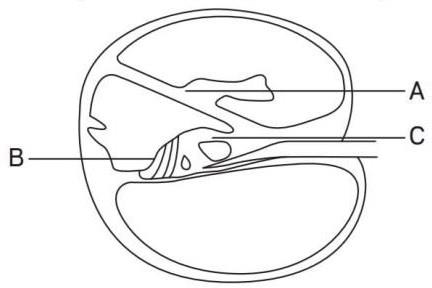
Select the correct option.
|
|
A |
B |
C |
| A) | Reissner’s membrane | Organ of corti | Tectorial membrane |
| B) | Tectorial membrane | Utricule | Basilar membrane |
| C) | Basilar membrane | Tectorial membrane | Reissner’s membrane |
| D) | Basilar membrane | Macula | Organ of Corti |
The organ of corti within cochlea can be located on
A) tectorial membrane B) basilar membrane
C) Reissner’s membrane D) tympanic membrane
Select the incorrect statement regarding the structure of organ of corti.
A) It contains hair cells that acts as auditory receptors.
B) The hair cells are found on the inner side, arranged in rows.
C) The basal end of hair cells is closely associated with the afferent nerve fibre.
D) In between ends of hair cells and afferent nerves, tectorial membrane is present.
What is the location of vestibular apparatus in human ear?
A) Adjacent to malleus of middle ear.
B) Above the cochlea of inner ear.
C) At the junction of round window and Eustachian tube.
D) Within the Eustachian tube.
Vestibular apparatus consists of
A) otoliths and organ of corti
B) organ of corti only
C) semicircular canals only
D) semicircular canals and otolith
Consider the following statements.
(A) The three semicircular canals of inner ear are found in different planes at right angle to each other.
(B) The two semicircular canals play major role in hearing while the third canal is vestigial.
Select the correct option.
A) A is true, B is false. B) A is false, B is true.
C) Both A and B are false. D) Both A and B are true.
The sensory part of otoliths is
A) utricle B) saccule C) macula D) Both (A) and (B)
Crista ampullaris containing hair cells is found
A) within otoliths. B) at the base of semicircular canals.
C) within the semicircular canals. D) at the tip of semicircular canals and otoliths.
Which of the following receptors are specifically responsible for maintenance of balance of body and posture?
A) Crista ampullaris and macula
B) Basilar membrane and otoliths
C) Hair cells and organ of corti
D) Tectorial membrane and macula
Refer to the given diagram and identify the correct function of the labelled structures.
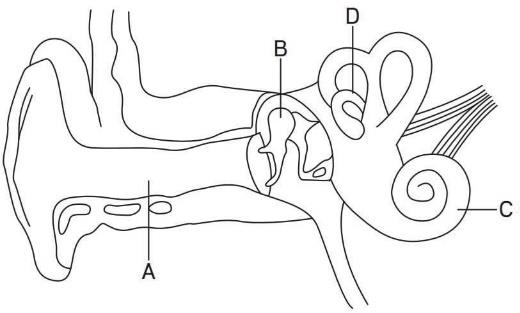
A) B – Stapes – Vibration of oval window
B) A – Auditory meatus – Transmit neural signals to auditory cortex
C) D – Semicircular canals –Amplification of auditory signals
D) C – Cochlea – Main hearing organ
Refer to the following events which occur during hearing.
(I) Rippling in basilar membrane
(II) Waves in the lymph of cochlea
(III) Vibration of ear drum
(IV) Pressing of hair cells against the tectorial membrane
Select the correct order in which the following events occur.
A) II, III, I, IV B) I, IV, II, III
C) III, II, I, IV D) II, IV, I, III
How does the nerve impulses in ear are generated?
A) Due to the bending of hair cells towards tectorial membrane.
B) Due to the vibrations in utricle and otoliths.
C) Due to the streaming of perilymph in semicircular canals.
D) Due to the contact between crista ampularis and macula.
Assertion: Stapes is found attached to the tympanic membrane.
Reason: Stapes is the largest ear bone.
A) Both Assertion and Reason are true and Reason is correct explanation of Assertion.
B) Both Assertion and Reason are true, but Reason is not the correct explanation of Assertion.
C) Assertion is true, but Reason is false.
D) Assertion is false, but Reason is true.
Assertion: The hair cells of organ of corti acts as auditory receptors.
Reason: The base of hair cells is in close contact with afferent fibres of auditory nerves.
A) Both Assertion and Reason are true and Reason is correct explanation of Assertion.
B) Both Assertion and Reason are true, but Reason is not the correct explanation of Assertion.
C) Assertion is true, but Reason is false.
D) Assertion is false, but Reason is true.
Assertion: Vestibular apparatus has no role in hearing.
Reason: Crista and macula helps in maintaining body posture and balance.
A) Both Assertion and Reason are true and Reason is correct explanation of Assertion.
B) Both Assertion and Reason are true, but Reason is not the correct explanation of Assertion.
C) Assertion is true, but Reason is false.
D) Assertion is false, but Reason is true
Nissl bodies are mainly composed of
(a) proteins and lipids. (b) DNA and RNA.
(c) free ribosomes and RER. (d) nucleic acids and SER.
The transparent lens in the human eye is held in its place by
(a) ligaments attached to the ciliary body. (b) ligaments attached to the iris.
(c) smooth muscles attached to the ciliary body. (d) smooth muscles attached to the iris.
Good vision depends on adequate intake of carotene rich food. Select the best option from the following statements.
(i) Vitamin A derivatives are formed from carotene.
(ii) The photopigments are embedded in the membrane discs of the inner segment.
(iii) Retinal is a derivative of vitamin A.
(iv) Retinal is a light absorbing part of all the visual photopigments.
(a) (i), (iii) and (iv) (b) (i) and (iii) (c) (ii), (iii) and (iv) (d) (i) and (iv)
Myelin sheath is produced by
(a) astrocytes and Schwann cells. (b) oligodendrocytes and osteoclasts.
(c) osteoclasts and astrocytes. (d) Schwann cells and oligodendrocytes.
Receptor sites for neurotransmitters are present on
(a) pre-synaptic membrane. (b) tips of axons.
(c) post-synaptic membrane. (d) membrane of synaptic vesicles.
Photosensitive compound in human eye is made up of :
(a) guanosine and retinol (b) opsin and retinal
(c) opsin and retinol (d) transducin and retinene
Destruction of the anterior horn cell of the spinal cord would result in loss of
(a) voluntary motor impulses. (b) commissural impulses.
(c) integrating impulses. (d) sensory impulses.
Which of the following regions of the brain is incorrectly paired with its function?
(a) Cerebellum – Language comprehension
(b) Corpus callosum – Communication between the left and right cerebral cortices
(c) Cerebrum – Calculation and contemplation
(d) Medulla oblongata – Homeostatic control
In mammalian eye, the ‘fovea’ is the centre of the visual field, where
(a) the optic nerve leaves the eye. (b) only rods are present.
(c) more rods than cones are found. (d) high density of cones occur, but has no rods.
A gymnast is able to balance his body upside down even in the total darkness because of ______.
(a) vestibular apparatus (b) tectorial membrane (c) organ of Corti (d) cochlea
Which one of the following statements is not correct?
(a) Retinal is the light absorbing portion of visual photopigments.
(b) In retina, the rods have the photopigment rhodopsin while cones have three different photopigments.
(c) Retinal is a derivative of vitamin C.
(d) Rhodopsin is the purplish red protein present in rods only.
Stimulation of a muscle fibre by a motor neuron occurs at
(a) the neuromuscular junction. (b) the transverse tubules.
(c) the myofibril. (d) the sacroplasmic reticulum.
Injury localised to the hypothalamus would most likely disrupt
(a) short – term memory. (b) co-ordination during locomotion.
(c) executive functions, such as decision making. (d) regulation of body temperature.
Which part of the brain is responsible for thermoregulation?
(1) Cerebrum (2) Hypothalamus (3) Corpus callosum (4) Medulla oblongata
Which of the following statements is correct?
(1) Cornea is an external, transparent and protective proteinacious covering of the eye-ball.
(2) Cornea consists of dense connective tissue of elastin and can repair itself.
(3) Cornea is convex, transparent layer which is highly vascularised.
(4) Cornea consists of dense matrix of collagen and is the most sensitive portion of the eye.
Which of the following statements is not correct?
(1) An action potential in an axon does not move backward because the segment behind is in a refractory phase
(2) Depolarisation of hair cells of cochlea results in the opening of the mechanically gated potassium -ion channels.
(3) Rods are very sensitive and contribute to daylight vision.
(4) In the knee-jerk reflex, stimulus is the stretching of muscle and response is its contraction.
Which of the following receptors are specifically responsible for maintenance of balance of body and
posture?
(1) Basilar membrane and otoliths (2) Hair cells and organ of corti
(3) Tectorial membrane and macula (4) Crista ampullaris and macula
Match the following columns and select the correct option:
Column – I Column – II
(a) Rods and (i) Absence of Cones photoreceptor cells
(b) Blind Spot (ii) Cones are densely packed
(c) Fovea (iii) Photoreceptor cells
(d) Iris (iv) Visible coloured portion of the eye
(1) (a)-(iii), (b)-(i), (c)-(ii), (d)-(iv) (2) (a)-(ii), (b)-(iii), (c)-(i), (d)-(iv)
(3) (a)-(iii), (b)-(iv), (c)-(ii), (d)-(i) (4) (a)-(ii), (b)-(iv), (c)-(iii), (d)-(i)
Which of the following is associated with decrease in cardiac output?
(1) Sympathetic nerves (2) Parasympathetic neural signals
(3) Pneumotaxic centre (4) Adrenal medullary hormones
Math the following columns and select the correct option
Column-I Column-II
a) Organ of Corti i) Connects middle ear and pharynx
b) Cochlea ii) Coiled part of the labyrinth
c) Eustachian tube iii) Attached to the oval window
d) Stapes iv) Located on the basilar membrane
a) b) c) d)
1) i ii iv iii
2) ii iii i iv
3) iii i iv ii
4) iv ii i iii
Select the incorrect statement regarding synapses:
1) The membranes of presynaptic and postsynaptic neurons are in close proximity in an electrical synapse.
2) Electrical current can flow directly from one neuron into the other across the electrical synapse.
3) Chemical synapses use neurotransmitters
4) Impulse transmission across a chemical synapse is always faster than that across an electrical synapse.