
20 LOCOMOTION AND MOVEMENT QUESTIONS
20 LOCOMOTION AND MOVEMENT QUESTIONS
Streaming of cytoplasm/cyclosis is seen in
(A) Amoeba
(B) Macrophages
(C) Leukocytes
(D) All
Which of the following statements is correct?
(A) Cytoplasmic streaming helps in pseudopodia formation or amoeboid movement
(B) Cytoplasmic streaming is caused by contracting microfilament
(C) Both a and b
(D) Locomotion is not a voluntary movement
I. Paramecium employs cilia for pushing food in cytopharynx and in locomotion
II. Hydra takes help of tentacles for both food capturing and locomotion
III. All locomotion’s are movements and vice-versa
IV. Methods of locomotion vary with habitats and the demands of situation
V. Ciliated epithelium is found in respiratory tract, renal tubules and reproductive tracts
Which of the above statements is false?
(A) I and III
(B) III
(C) III and V
(D) IV and V
Which of the following statements is false?
(A) Locomotion and many other movements required coordinated muscular activities
(B) Muscle is a specialised tissues of endodermal in origin
(C) There are about 639 muscles which contribute about 40 – 50 % of adult body weight
(D) Muscles show contractibility, excitability and flexibility
Which of the following statements about the skeletal muscles is correct?
(A) They are striated muscles
(B) They are voluntary muscles
(C) They are primarily involved in locomotory actions
(D) All
Which of the following statements about visceral muscles is correct?
(A) They are non-striated muscles (smooth muscles)
(B) They are involuntary muscles
(C) They have various functions
(D) All
Cardiac/heart muscles are –
(A) Striated and involuntary (B) Not fatigued
(C) Branched (D) All
Which of the following statements is false?
(A) Smooth muscles are found in urinary bladder, alimentary canal and genitaltract
(B) A striated muscle is syncytium (multinucleate)
(C) The cytoplasm of striated muscle is called endoplasm
(D) The plasma membrane and ER ofstriated muscles are called sarcolemma and sarcoplasmic reticulum respectively
The source of Ca+2 for the muscle is –
(A) T-tubule
(B) Sarcosome
(C) Sarcolemma
(D) Sarcoplasmic reticulum
The fascia surrounding a muscle is madeup of –
(A) Cartilage
(B) Collagenous connective tissues
(C)Adipose tissue
(D) Blood vessels
Contractile fibrils of muscles are called –
(A) Neurofibrils
(B) Collagen fibres
(C) Myofibrils
(D) Yellow fibres
Myofibrils show alternate dark and lightbands in –
(A) Cardiac muscles
(B) Smooth muscles
(C) Striped muscles
(D) a and c
Select the true statement(s) –
(A) A-band is present in the middle ofsarcomere
(B) H-zone is present in the middle of Aband
(C) M-line is present in the middle of Hzone
(D) All of the above
Which is the smallest one?
(A) Muscle fibre
(B) Myofibril
(C) Actin
(D) Sarcomere
Match Column I with Column II –
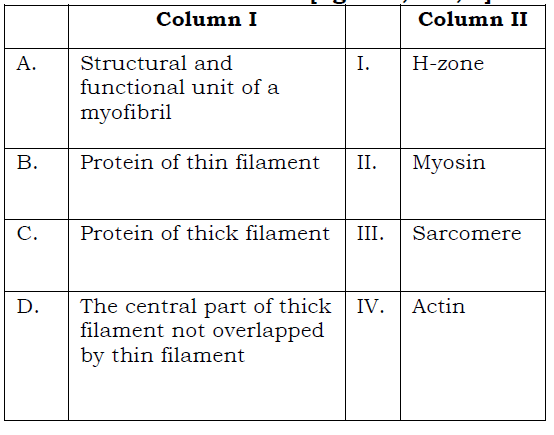
(A) A-I, B-II, C-III, D-IV
(B) A-I, B-III, C-II, D-IV
(C) A- I, B – IV, C – III, D – II
(D) A- III, B – IV, C – II, D – I
Z-line divides the myofibrils into –
(A) Sarcomere
(B) Sarcolemma
(C) Sarcosome
(D) Microtubules
Sarcomere is the area between –
(A) 2 H-zones
(B) 2 Z-lines
(C) 2 M-lines
(D) 2A-bands
Light bands (thin filaments) contain actin and are called –
(A) A-bands or Isotropic band
(B) A-bands or Anisotropic bands
(C) I-bands or Isotropic bands
(D) I-bands or Anisotropic bands
Dark bands (thick filaments) contain myosin and are called –
(A) A-bands or Isotropic band
(B) A-bands or Anisotropic bands
(C) I-bands or Isotropic bands
(D) I-bands or Anisotropic bands
Which of the following statements about the striated muscles is false?
I. In the centre of each I-band is an elastic fibre (Z-line) which bisects it
II. Thin filaments are firmly attached to the Z-line
III. M-line is a fibrous membrane in the middle of A-bands
IV. A sarcomere comprises one full A-bands and 2 half I-bands
(A) All
(B) IV
(C) I and II
(D) None
The region between the ends of the A-bands of 2-adjoining sarcomeres is called
(A) The Z-band (B) The H-zone (C) The T-tubule (D) The I-band
Choose the letter from the figure that most appropriately corresponds to the structure –
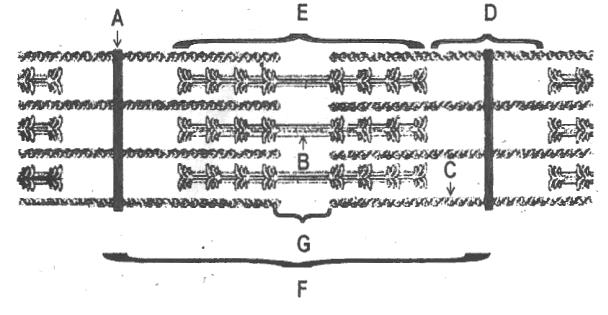
A-band II. I-band III. Sarcomere IV. H-zone V. Myosin
Actin, Troponin, Tropomyosin VII. Z- line
(A) I – E, II – D, III – F, IV – G, V – B, VI -C, VII -A
(B) I – E, II – D, III – C, IV – G, V – B, VI -A, VII – F,
(C) I – E, II – D, III – F, IV – G, V – C, VI -A, VII – B
(D) I – E, II – D, III – F, IV -A, V – B, VI – C,VII – G
An individual sarcomere consist of-
(A) A stack of actin fibres
(B) A stack of myosin units
(C) Overlapping actin and myosin
(D) Overlapping myosin arid membrane
Which of the following statements about the molecular arrangement of actin and myosin in myofibrils is false?
I. Each actin (thin filament) is made of 2F (filamentous) actins.
II. F-actin is the polymer of G (globular) actin.
III. 2F- actins are twisted into a helix
IV. Two strands of tropomyosin (protein) lie in the grooves of F-actin
V. Troponin molecules (complex proteins) are distributed at regular intervals on the tropomyosin
VI. Troponin forms the head of the myosin molecule
VII. The myosin is a polymerised protein
(a) I, II, III (B) Only VII (C) Only VI (D) Only III
One myosin filament in the myofibril of skeletal muscle fibres is surrounded by how many actin filaments –
(A) 8 (B) 2 (C) 6 (D) 4
The cross bridges of the sarcomere in skeletal muscle are made up of –
(A) Actin (B) Myosin (C) Troponin (D) Myelin
The functions of tropomyosin in skeletal muscle include –
(A) Sliding on actin to produce shortening.
(B) Release Ca+2 after initiation of contraction
(C) Acting as “relaxing protein” at rest by covering up the sites where myosin binds to actin
(D) Generates ATP
Tropomyosin is moved by which of following proteins –
(A) Calmodulin
(B) Actin
(C) Troponin
(D)Acetylcholine
Ca+2 bind _________ in the skeletal muscles and leads to exposure of the binding site for _______ on the filament ___________.
(A) Troponin, myosin, actin
(B) Troponin, actin, relaxin
(C) Actin, myosin, troponin
(D) Tropomyosin, myosin, actin
Following is the figure of actin (thin) filaments. Identify A, Band C.
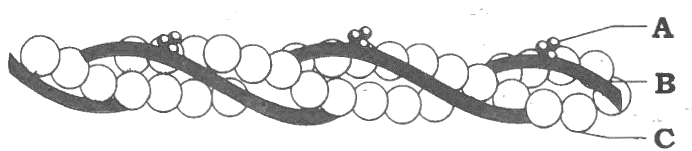
(A) A- Tropomyosin, B – Troponin, C – Factin
(B) A- Troponin, B – Tropomyosin, C -Myosin
(C) A- Troponin, B – Myosin, C -Tropomyosin
(D) A- Troponin, B – Tropomyosin, C – Factin
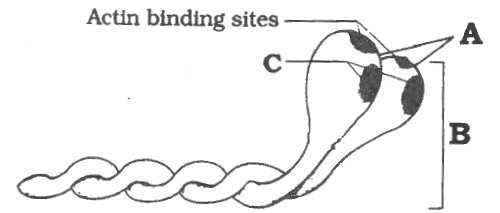
The above figure is related with myosin monomer (meromyosin). Identify A to C –
(A) A- head, B – cross arm, C – GTP binding sites
(B) A- head, B – cross arm, C – Ca+2 binding sites
(C) A- head, B – cross arm, C –ATP binding sites
(D) A- cross arm, B – head, C –ATP binding sites
Which of the following statements is false?
(A) Each myosin is a polymerised protein
(B) Many meromyosin constitute one thick filament (myosin)
(C) Each meromyosin’s tail is called heavy meromyosin (HMM) and head is called light meromyosin (LMM)
(D) The globular head is an active ATPase enzyme and has binding sites for ATP
and active sites for actin The action potential that triggers a muscle contraction travels deep within the muscle cell by means of _________.
(A) Sarcoplasmic reticulum
(B) Transverse tubules
(C) Synapse
(D) Motor end plates
ATP provides energy for muscle contraction by allowing for-
(A) An action potential formation in the muscle cell
(B) Cross-bridge detachment of myosin from actin
(C) Cross-bridge attachment of myosin to actin
(D) Release of ca+2 from sarcoplasmic reticulum
A motor unit is best described as –
(A) All the nerve fibres and muscle fibres in a single muscle bundle
(B) One muscle fibre and its single nerve fibre
(C) A single motor neuron and all the muscle fibres that it innervates
(D) It is the neuron which carries the message from muscle to CNS
Motor end plate is a –
(A) Neuromuscular junction
(B) Dendron of motor neuron
(C) Plate of motor neuron
(D) Gradient of proton motive force
Electrical excitation in a muscle fibre most directly causes –
(A) Movement of tropomyosin
(B) Attachment of the cross bridges to actin
(C) Release of Ca+2 from sarcoplasmic reticulum
(D) Splitting of ATP
The energy for muscle contraction is most directly obtained from –
(A) Phosphocreatine
(B) ATP
(C) Anaerobic respiration
(D) Aerobic respiration
According to the sliding filament theory –
(A) Actin (thin filament) moves past myosin (thick filament)
(B) Myosin moves past actin
(C) Both myosin and actin move past each other
(D) None of these is correct
Put the following phrases in proper order to describe what occurs at the neuromuscular junction to trigger muscle contraction.
I. Receptor sites on sarcolemma.
II. Nerve impulse.
III. Release of Ca+2 from sarcoplasmic reticulum
IV. The neurotransmitter acetylcholine is released
V. Sarcomere shorten
VI. Synaptic cleft
VII. Spread of impulses over
sarcolemma on T-tubules
(A) II, IV, I, VI, VII, III, V
(B) II, IV, VI, I, VII, III, V
(C) I, II, III, IV, V, VI, VII
(D) VII, VI, V, IV, III, II, I
Go through the following diagram describing muscle contraction. Now identify A to E.
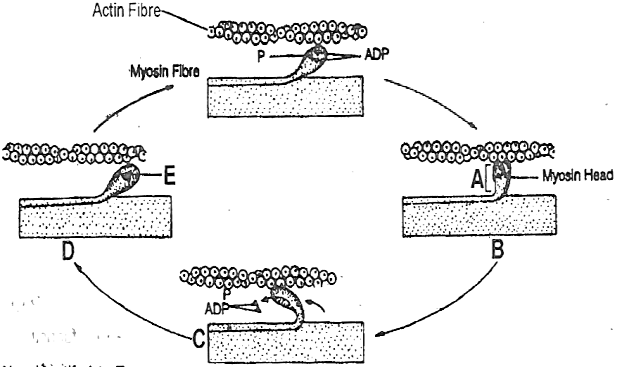
(A) A- Cross bridge, B – Cross bridgeformation, C-Breaking of cross bridge, D –Sliding (rotation), E -ATP
(B) A- Cross bridge, B – Cross bridge formation, C – Sliding/rotation, D –Breaking of cross bridge, E -ATP
(C) A- Cross bridge, B – Breaking of Cross bridge, C – Sliding/rotation, D – Cross bridge formation, E -AMP
(D) A- Cross bridge, B – Cross bridgeformation, C – Sliding/rotation, D – ADP, E – Breaking of cross bridge
How does the troponin-tropomyosin complex affect cross-bridge cycling?
(A) When [Ca2+] is low, the troponintropomyosin complex blocks actin’s binding site for myosin. When [Ca2+]is high, the complex rolls out of the way, allowing myosin to bind to actin and initiate the cross-bridge cycle.
(B) The troponin-tropomyosin complex regenerates ATP for the myosin ATPase.
(C) The troponin-tropomyosin complex regulates calcium release from the terminal cisternae.
(D) The troponin-tropomyosin complex binds to the myosin head, facilitating contact with the actin filaments
Relaxation of muscle is due to –
(A) Pumping of Ca+2 into sarcoplasmic cisternae
(B) Presence of ATP
(C) Conformational change in troponin and masking of actin filaments
(D) A and C
The diagrams given above show 3 different condition of sarcomeres. Identify these conditions –
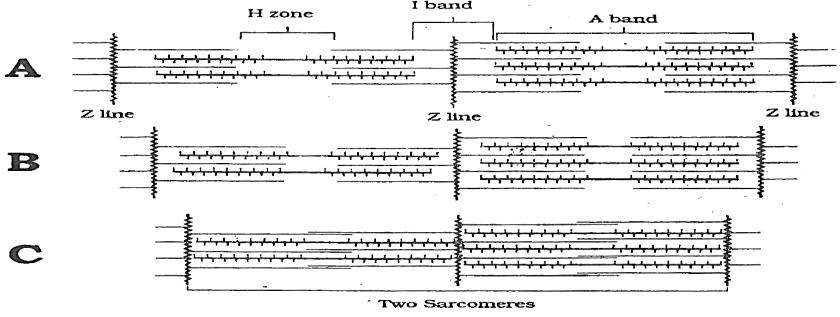
(A) A– contracting, B – relaxed, C –maximally contracted
(B) A – relaxed, B – contracting, C –maximally contracted
(C) A- maximally contracted, B –contracting, C – relaxed
(D) A- relaxed, B – maximally contracted,C–contracting
When a skeletal muscle shortens during contraction which of these statements is false?
(A) The I-band shortens
(B) The A-band shortens
(C) The H-zone becomes narrow
(D) The sarcomeres shorten
The muscle band that remains unchanged during muscle contraction and relaxation of the skeletal muscle is
(A) I (B)A (C) H (D) Z line
Which of the following statements is correct?
(A) During muscle contraction chemical energy changes into mechanical energy
(B) Muscle fatigue is due to lactic acid formation due to anaerobic respiration
(C) The reaction time of the fibres can vary in different muscles
(D) All
The compound or pigment acting as an oxygen store in skeletal muscles is –
(A) Myoglobin
(B) Haemoglobin
(C) Myokinase or ATP
(D) Cytochrome
I. Number of mitochondria less.
II. Number of mitochondria more
III. Sarcoplasmic reticulum is abundant
IV. Myoglobin content high
V. Sarcoplasmic reticulum moderate
VI. Aerobic muscles
VII. Depend on anaerobic respiration for energy
VIII. Less myoglobin content
A. Red muscles
B. White muscles
Identify above (I to VIII) traits as characteristic of A and B types of
muscles-
A- I, III, VII, VIII; B -II, IV, V, VI
(B) A-II, IV, V, VI; B-I, III, VII, VIII
(C) A-I, III, IV, VII; B – II, V, VI, VIII
(D) A- II, V, VI, VIII; B – I, III, IV, VII
Skeletal system consists of –
(A) Only bones
(B) Only cartilage
(C) A framework of bones and a few cartilage
(D) A framework of cartilage. and a few bones
Bone has a very hard matrix due to presence of-
(A) NaCl
(B) Ca-salts
(C) K-salts
(D) Fe-salts
Cartilage has slightly pliable matrix due to –
(A) Chondroitin salts
(B) Osteoblast
(C) Chondroblasts
(D) Osteoclast
How many bones make up the human skeleton?
(A) 948
(B) 96
(C) 796
(D) 206
Number of bones in human axial skeleton is –
(A) 80 (B) 106 (C) 206 (D) None
Match Column I with Column II –
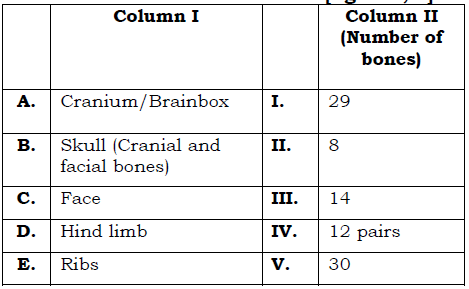
(A) A-I, B-II, C-III, D-V, E-IV
(B) A- II, B – I, C – III, D – V, E – IV
(C) A – I, B – II, C- III, D – IV, E – V
(D) A- V, B – IV, C – III, D – II, A- I
Hyoid/Tongue bone is –
(A) T-shaped (B) J-shaped (C) U-shaped (D) L-shaped
A normal human being has how many ear ossicle?
(A) 3 (B) 6 (C) 9 (D) None
Which one of the following is not included under ear ossicles –
(A) Malleus (B) Ileum (C) Incus (D) Stapes
Human Cranium has small protuberance(s) at the posterior end called __________ and ____ in number.
that articulates with first vertebra (atlas vertebra)-
(A) occipital condyle, 6 (B) occipital condyle, 2
(C) occipital condyle, 4 (D) occipital condyle, 3
Human skull is –
(A) Dicondylic (B) Monocondylic (C) Procoelous (D) Hetercoelous
Which of the following statements about human vertebral column is false?
(A) Vertebral column consists of 26 vertebrae
(B) It is ventrally placed
(C) It extends from the base of skull and constitutes the main framework of the trunk
(D) Neural canal in vertebra is the passage for spinal cord
Human adult vertebral formula is-
(A) C4 T8 L4 S8 C8 (B) C7 T8 L5 S6 C7
(C) C7 T12 L2 S1 C2 (D) C7 T12 L5 S1 C1
Which of the following vertebra in adult human are fused ones?
(A) Thoracic and lumber (B) Thoracic and cervical
(C) Sacral and coccygeal (D) Cervical and coccygeal
Which of the following is not the function of vertebral column?
(A) Protects spinal cord and supports the head
(B) Serves as the point of attachment for ribs and musculature of the back
(C) Both
(D) Supports Tarsals and Metacarpals
Which of the following is not correct about sternum?
(A) It is commonly called breast bone
(B) It is flat bone
(C) It is 2 in number
(D) It is located on the ventral mid line of thorax
Each typical rib is a thin flat bone connected ____ to the vertebral column and ___________ to the sternum-
(A) Dorsally, ventrally (B) Ventrally, dorsally
(C) Dorsally, dorsally (D) Ventrally, Ventrally
Typical ribs are –
(A) Monocephalic (B) Dicephalic
(C) Tricephalic (D) Tetracephalic
Match Column I with Column II –
Column I Column II
True ribs I. 3 pairs
False ribs II. 2 pairs
Floating ribs III. 7 pairs
(A) A-I, B-II, C-III (B) A-III, B-I, C-II
(C) A- III, B – II, C – I (D) A-ll, B-l, C-III
Match Column I with Column II –
Column I Column II
False ribs I. 1st to 7th pair
True ribs II. 11th and 12th pair
Floating ribs III. 8th to 10th pair
Sternum IV. One
(A) A-I, B-II, C-III, D- IV
(B) A-IV, B-III, C-II, D- I
(C) A- I, B – III, C – II, D- IV
(D) A-III, B-I, C-II, D- IV
Identify the ribs –
A. Ribs are attached to the sternum ventrally and to the vertebrae dorsally.
B. Ribs are attached to sternum through costal cartilage (hyaline) of 7th rib
C. Ribs are not attached to sternum
I. True ribs
II. False ribs
III. Floating ribs
(A) a-I, b-II, c-III (B) a-I, b-III, c-II
(C) a-II, b-I, c-III (D) a-III, b -II, c-I
Which of the following ribs are called vertebrochondral ribs?
(A) True ribs (B) False ribs (C) GorIIIa ribs (D) Floating ribs
Rib cage is formed by all except –
(A) Thoracic vertebrae (B) Lumbar vertebrae
(C) Ribs (D) Sternum
Each limb (upper or lower) consists of how many bones –
(A) 30 (B) 60 (C) 101 (D) 8
The accompanied figure is rib cage.
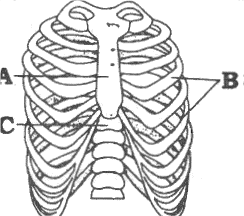
Identify A, Band C respectively-
(A) Coccyx, ribs, vertebral column
(B) Sternum, ribs, vertebral column
(C) Scapula, ribs, vertebral column
(D) Tarsal, ribs, vertebral column
Number of bones in human appendicular skeleton is –
(A) 80 (B) 120 (C) 126 (D) 206
Number of bone in each upper limb is –
(A) 1, 1, 1 (B) 8, 5, 14
(C) 2, 2, 2, 16, 10, 28 (D) 1, 1, 1, 8, 5, 14
Phalangeal/digital formula for human hand/foot is-
(A) 0, 2, 2, 3 (B) 0, 2, 3, 3 ,3
(C) 2, 2, 3, 3, 3 (D) 2, 3, 3, 3, 3
The hand contains ____ carpals (wrist bones), ____ metacarpals (palm bones), and ___ phalanges.
(A) 14, 5, 8 (B) 5, 8, 14 (C) 8, 5, 14 (D) 1, 5, 5
The accompanied diagram shows right pectoral girdle and upper arm (frontal view). Identify A to G
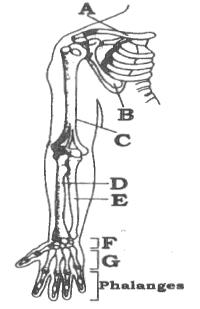
(A) A- 1st Vertebra, B – Scapula, C -Humerus, D – Radius, E – Ulna, F – Carpals, G – Metacarpals
(B) A- Scapula, B – Clavicle, C – Humerus, D – Radius, E – Ulna, F – Carpals, G – Metacarpal
(C) A- Ilium, B – Scapula, C – Humerus,D – Radius, E – Ulna, F – Carpals, G – Metacarpals
(D) A- Clavicle, B – Scapula, C – Humerus, D – Radius, E – Ulna, F – Carpals, G –Metacarpals
An acromion process is characteristically found in –
(A) Pelvic girdle of mammals (B) Pectoral girdle of mammals
(C) Skull bone (D) Vertebrae of mammals
The shoulder blade is large triangular bone situated in the dorsal part of the thorax between the 2nd and the 7th ribs. It is called _
(A) Clavicle (B) Ilium (C) Scapula (D) Carpals
For articulation of head of humerus a depression found in scapula is called –
(A) Acetabulum (B) Manubrium
(C) Occipital condyle (D) Glenoid cavity
Which of the following statement is correct?
(A) Pectoral and pelvic girdle bones help in the articulation of the upper and lower limbs respectively with the axial skeleton
(B) Each girdle is formed of 2 halves
(C) Each half of pectoral girdle consists of a clavicle (collar bone) and Scapula
(D) All
Which of the following statements is false?
(A) Scapula has the spine which projects as acromion process
(B) Below acromion process is a glenoid cavity
(C) Each clavicle (collar bone) articulates with acromion
(D) Clavicle is long S-shaped bone with 4 curvatures
Which one of the following is the longest bone in human?
(A) Radius (B) Tibia
(C) Femur (Thigh bone) (D) Clavicle (Collar bone)
Human foot consists of 26 bones. Whatare the number of tarsals (ankle bones), metatarsals and phalanges?
(A) 7, 5, 14 (B) 5, 7, 14 (C) 1, 1, 5 (D) 5, 5, 5
A cup shaped bone covering knee ventrally is called –
(A) Cuneiform (B) Tarsal (C) Patella (D) Carpal
Study the accompanying figure. Identify A, B, C and D –
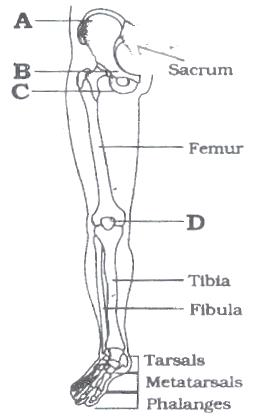
(A) A- Pubis, B – ilium, C – Ischium, D – Patella
(B) A- Ischium, B – Pubis, C – ileum, D– Patella
(C) A- ileum, B – Pubis, C – Ischium, D– Patella
(D) A- ilium, B – Pubis, C – Ischium, D–Patella
Acetabulum occurs in –
(A) Cranium (B) Pectoral girdle
(C) Pelvic girdle (D) Vertebrae
Pelvic girdle (hip girdle) is composed ____ coxal (hip) bones-
(A) 3 (B) 2 (C) 4 (D) 5
Pelvic girdle consists of-
(A) Ileum, ischium and pubis
(B) Ilium, ischium and pubis
(C) Ilium, ischium and clavicle
(D) Coracoid, ischium and pubis
Two halves of pelvic girdle articulate ventrally at a fibrocartilaginous joint called –
(A) Pubic symphysis (B) Synchodroses
(C) Gomphoses (D) Sutures
Each coxal bone is formed by the fusion of 3 bones named as –
(A) Ileum, ischium and pubis (B) Ilium, ischium and pubis
(C) Ilium, ischium and clavicle (D) Coracoid, ischium and pubis
Which of the following statements about the joints is false?
(A) Joints are essential for all types of movements involving bony parts
(B) Joints are contact between bones or between bones and cartilages
(C) Fibrous joints are immovable
(D) Cartilaginous joint permit great movement
Match Column I with Column II –
(A) A- V, B – IV, C – III, D – II, E – I
(B) A- I, B – II, C – II, D – V, E – IV
(C) A- I, B – III, C – II, D – V, E – IV
(D)A-V, B-III, C-II, D-I, E-II
Which of the following statements is correct?
(A) Synovial joints are characterised by synovial cavity with fluid between thearticulating surface of two· bones
(B) Synovial joints are freely movable
(C) Ball and socket, hinge joint, gliding joints, pivot joints and saddle joint are the types of synovial joints
(D) All
Joint between bones in the form of sutures of human skull is –
(A) Hinge joint (B) Synovial joint
(C) Cartilaginous joint (D) Fibrous joint
Which of the following statements is correct?
(A) Movable skull bone is mandible
(B) We move our hands while walking for balancing
(C) Cartilaginous joints have little mobility due to fibrocartilage disc between its articular ends e.g. intervertebral disc between centre of vertebrae
(D) All
A disease associated with joint is –
(A) Glaucoma (B) Arthritis (C) Paget’s disease (D) Homer’s syndrome
Gout is the inflammation of joints due to accumulation of –
(A) Urea crystal (B) NH3
(C) Uric acid crystal (D) CaCO3 crystals
I. Age-related disorder characterised by decreased bone mass and increased chances of fracture
II. Causative factor deficiency of estrogen is common.
The above characters are associated with –
(A) Gout (B) Osteoporosis (C) Arthritis (D) Polio
Myasthenia is an ____ disorder affecting neuromuscular junction leading to fatigue, weakening and paralysis of skeletal muscles –
(A) Arthritis (B) Autoimmune (C) Agnosic (D) Amnesic
Tetany is the rapid spasm in muscles due to –
(A) High Ca+2 in body fluid
(B) Low Ca+2 in body fluid
(C) High uric acid in body fluid
(D) High urea in blood
Progressive degeneration of skeletal muscles due to genetic disorder is called –
(A) Myasthenia gravis
(B) Tetany
(C) Muscular dystrophy
(D) Myopia
Arthritis is –
(A) Inflammation of muscles (B) Inflammation of bone
(C) Inflammation of joints (D) Inflammation of tongue
Calcium is important in skeletal muscle contraction because it
(a) binds to troponin to remove the masking of active sites on actin for myosin.
(b) sctivates the myosin ATPase by binding to it.
(c) prevents the formation of bonds between the myosin cross bridges and the actin filament.
(d) detaches the myosin head from the actin filament.
The pivot joint between atlas and axis is a type of :
(a) Cartilaginous joint (b) Synovial joint (c) Saddle joint (d) Fibrous joint
Out of ‘X’ pairs of ribs in humans, only ‘Y’ pairs are true ribs. Select the option that correctly represent values of X and Y and provides their explanation.
(a) X = 12, Y = 5 True ribs are attached dorsally to vertebral column and sternum on the two ends.
(b) X = 24, Y = 7 True ribs are dorsally attached to vertebral column but are free on ventral side.
(c) X = 24, Y = 12 True ribs are dorsally attached to vertebral column but are free on ventral side.
(d) X = 12, Y = 7 True ribs are attached dorsally to vertebral column and ventrally to the sternum.
Lack of relaxation between successive stimuli in sustained muscle contraction is known as__.
(a) spasm (b) fatigue (c) tetanus (d) tonus
Sliding filament theory can be best explained as
(a) Actin and myosin filaments shorten and slide pass each other.
(b) Actin and myosin filaments do not shorten but rather slide pass each other.
(c) When myofilaments slide pass each other, myosin filaments shorten while actin filaments do not shorten.
(d) When myofilaments slide pass each other actin filaments shorten while myosin filament do not shorten.
Which of the following is not a function of the skeletal system?
(a) Storage of minerals (b) Production of body heat (c) Locomotion (d) Production of erythrocytes
Which of the following joints would allow no movement?
(a) Cartilaginous joint (b) Synovial joint (c) Ball and Socket joint (d) Fibrous joint
Glenoid cavity articulates
(a) scapula with acromion. (b) clavicle with scapula.
(c) humerus with scapula. (d) clavicle with acromion.
Select the correct matching of the type of the joint with the example in human skeletal system. Which of the following muscular disorders is inherited?
(1) Tetany (2) Muscular dystrophy (3) Myasthenia gravis (4) Botulism
Select the correct option .
(1) 8th, 9th and 10th pairs of ribs articulate directly with the sternum.
(2) 11th and 12th pairs of ribs are connected to the sternum with the help of hyaline cartilage.
(3) Each rib is a flat thin bone and all the ribs are connected dorsally to the thoracic vertebrae and ventrally to the sternum.
(4) There are seven pairs of vertebrosternal, three pairs of vertebrochondral and two pairs of vertebral ribs.
Match the following joints with the bones involved:
(a) Gliding joint (i) Between carpal and metacarpal of thumb
(b) Hinge joint (ii) Between Atlas and Axis
(c) Pivot joint (iii) Between the carpals
(d) Saddle joint (iv) Between Humerus and Ulna.
Select the correct option from the following:
(1) (a)-(iii), (b)-(iv), (c)-(ii), d-(i) (2) (a)-(iv), (b)-(i), (c)-(ii), d-(iii)
(3) (a)-(iv), (b)-(ii), (c)-(iii), d-(i) (4) (a)-(i), (b)-(iii), (c)-(ii), d-(iv)
Which of the following diseases is an autoimmune disorder?
(1) Myasthenia gravis (2) Arthritis (3) Osteoporosis (4) Gout
Match the following columns and select the correct option
Column – I Column – II
(a) Gout (i) Decreased levels of estrogen
(b) Osteoporosis (ii) Low Ca++ ions in the blood
(c) Tetany (iii) Accumulation of uric acid crystals
(d) Muscular (iv) Auto immune dystrophy disorder
(v) Genetic disorder
(1) (a)-(ii), (b)-(i), (c)-(iii), (d)-(iv) (2) (a)-(iii), (b)-(i), (c)-(ii), (d)-(v)
(3) (a)-(iv), .(b)-(v), (c)-(i), (d)-(ii) (4) (a)-(i), (b)-(ii), (c)-(iii), (d)-(iv)
Match the following columns and select the correct option
Column – I Column – II
(a) Floating Ribs (i) Located between second and seventh ribs
(b) Acromion (ii) Head of the Humerus
(c) Scapula (iii) Clavicle
(d) Glenoid cavity (iv) Do not connect with the sternum
(a) (b) (c) (d) (a) (b) (c) (d)
(iv) (iii) (i) (ii) 2. (ii) (iv) (i) (iii)
(i) (iii) (ii) (iv) 4. (iii) (ii) (iv) (i)
Chronic auto immune disorder affecting neuro muscular junction leading to fatigue , weakening and paralysis of skeletal muscle is called as:
- Muscular dystrophy 2. Myasthenia gravis
3. Gout 4. Arthritis
During muscular contraction which of the following events occur?
a) H-zone disappears b) ‘A’ band widens
c) I-band reduces in width d) Myosine hydrolyzes ATP, releasing the ADP and Pi
e) Z-lines attached to actins are pulled inwards
Choose the correct answer from the options given below.
1) (a), b), (c), (d) only 2) (b), (c), (d), (e) only 3) b), (d), (e), (a) only 4) (a), (c), (d), (e) only
Match List – I with List – II.
List – I |
List – II |
| a) Scapula | i) Cartilaginous joint |
| b) Cranium | ii) Flat bone |
| c) Sternum | iii) Fibrous joints |
| d) Vertebral column | iv) Triangular flat bone |
Choose the correct answer from the options given below
1) a-ii, b-iii, c-iv, d-I 2) a-iv, b-ii, c-iii, d-i 3) a-iv, b-iii, c-ii, d-i 4) a-i, b-iii, c-ii, d-iv
Which of the following is a correct match for disease and its symptoms?
1) Arthritis – Inflammed joints
2) Tetany – high level causing rapid spasms
3) Myasthemia gravis – Genetic disorder resulting in weakening and paralysis of skeletal muscle
4) Muscular dystrophy – An auto immune disorder causing progressive degeneration of skeletal muscle
Given below are two statements: One is labelled as Assertion (A) and the other is labelled as Reason (R).
Assertion (A): Osteoporosis is characterized by decreased bone mass and increased chances of fractures.
Reason (R): Common cause of osteoporosis is increased levels of estrogen.
In the light of the above statements, choose the most appropriate answer from the options given below:
1) Both (A) and (R) are correct and (R) is the correct explanation of (A)
2) Both (A) and (R) are correct but (R) is not the correct explanation of (A)
3) (A) is correct but (R) is not correct
4) (A) is not correct but (R) is correct.
Which of the following is present between the adjacent bones of the vertebral column?
1) Intercalated discs
2) Cartilage
3) Areolar tissue
4) Smooth muscle