
16 DIGESTION AND ABSORPTION QUESTION
What increases the use of physico – chemical concepts and techniques:-
A) Forward approach
B) Reductionist approach
C) Both
D) None of these
Majority of physico – chemical studies employed by employing:-
A) Tissue model
B) Cell free system
C) Both
D) None of these
Now a day it is realized that _________ would reveal the truth about biological processes or living phenomenon: –
A) Purely organismic level
B) Purely reductionist molecular approach
C) Both
D) None
All living phenomenon are emergent properties due to ________.
A) Interaction among components of the system.
B) Defoliation of organs.
C) Exchange of gases only.
D) All of these
How many of the following creates emergent properties of living organism: –
i) Regulatory network of molecules
ii) Supra – molecular assemblies of cells; tissue; organs
iii) Population iv) Communities
A) Only two
B) Only three
C) Only one
D) all of them
Which of the following components of our food are taken in small quantities?
A) Carbohydrate and proteins
B) Proteins and minerals
C) Proteins and lipids
D) Minerals and vitamins
Which of the following molecules can be used by us as a source of energy?
A) Carbohydrates only
B) Fats only
C) Carbohydrates or fats
D) Carbohydrates, fats and vitamins
Digestion is –
A) Absorption of diffusible food
B) Absorption of water
C) Throwing out of non-diffusible food substances
D) Conversion of non-diffusible complex food substances into simple absorbable forms
Dental formula of adult person is-
A) 2122/2122
B) 2114/2114
C) 2123/2123
D) 2123/2124
Our teeth are –
A) Accordant and homodont
B) Homodont and polyphyodont
C) Thecodont, diphyodont and heterodont
D) Acrodont, homodont and polyphyodont
Frenulum is –
A) Adenoid present on pharyngeal wall
B) Tonsils located on lateral wall of soft palate
C) Fold attaching tongue to the floor of oral cavity
D) V-shaped sulcus for terminal is on tongue
The hard chewing surface of teeth helping in mastication of food is called –
A) Dentine
B) Frenulum
C) Root
D) Enamel
The upper surface of the tongue has small projections, some of which beartaste buds. These projections are called-
A) Papillae
B) Taste pore
C) Frenulum
D) Sulcus terminalis
The common passage for food and air is–
A) Gullet
B) Glottis
C) Larynx
D) Pharynx
The oesophagus and trachea (wind pipe) open into-
A) Gullet
B) Glottis
C) Larynx
D) Pharynx
A thin long tube extending posteriorly and passing through neck, thorax and a diaphragm and leading to stomach is called-
A) Pharynx
B) Trachea
C)Oesophagus
D) Larynx
Our stomach is
A) U-shaped
B) J-shaped
C) C-shaped
D) Rod-shaped
A muscular sphincter regulating opening of oesophagus into the stomach is called –
A) Pyloric sphincter
B) Cardiac Sphincter
C) Sphincter of Oddi
D) Boyden sphincter
Cardiac sphincter is –
A) Gastro-oesophageal sphincter
B) Pyloric sphincter
C) Gastro-duodenal sphincter
D) None
The stomach is located in the upper ____ portion of the ____ cavity-
A) Right, thoracic
B) Left abdominal
C) Right, abdominal
D) Left, thoracic
The narrow distal part of stomach leading to the intestine is called –
A) Cardiac
B) Pyloric
C) Fundus
D) None
The proximal part of stomach in which oesophagus opens is called –
A) Cardiac
B) Pyloric
C) Fundus
D) None
Which of the following is not the part of stomach?
A) Caecum
B) Pyloric
C) Fundus
D) Cardiac
Small intestine is distinguishable into 3 parts, a ‘C’ shaped _____ , a long coiled middle portion ____ and a highly coiled
A) Ileum, jejunum, duodenum
B) jejunum, Duodenum, ileum
C) Duodenum, jejunum, ileum
D) Caecum, duodenum, ileum
The opening of stomach into duodenum is guarded by-
A) Cardiac sphincter
B) Sphincter of Boyden
C) Sphincter of Oddi
D) Pyloric sphincter
Ileum is –
A) First part of small intestine
B) Last part of small intestine
C) Middle part of small intestine
D) First part of large intestine
Which of the following parts of small intestine opens into large intestine?
A) Duodenum
B) Ileum
C) Jejunum
D) Colon
All of the following is the part of large intestine except –
A) Ileum
B) Caecum
C) Colon
D) Rectum
Caecum is small blind sac which hosts some symbiotic micro-organisms. From it a small finger like vestigial organ arises. This organ is called –
A) Parotid gland
B) Vermis
C) Vermiform appendix
D) Lacteals
Caecum opens into –
A) Rectum
B) Duodenum
C) Colon
D) Jejunum
Which of the following organs has 3 parts (ascending, transverse and descending parts) –
A) Colon
B) Caecum
C) Small intestine
D) Large intestine
Which of the following sequence is correct?
A) Descending part of colon→Rectum→Anus
B) Stomach→ Jejunum→ Duodenum
C) Ileum→ Colon→ Caecum
D) Colon→ Anus→ Rectum
Anatomical regions of stomach are-
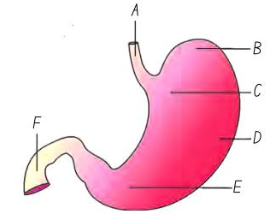
A) B- Fundus, C- Cardiac, D- Body, E- Pyloric
B) B- Cardiac, C- Fundus, D- Body, E- Pyloric
C) B- Fundus, C- Cardiac, D- Pyloric, E- Body
D) B- Fundus, C- Body, D- Cardiac, E- Pyloric
The wall of alimentary canal from oesophagus to rectum posses four layers. The sequence of these layers is –
A) Serosa-Mucosa-Submucosa- Muscularis
B) Muscularis-Serosa-Mucosa – Submucosa
C) Serosa-Muscularis-Mucosa-Submucosa
D) Serosa-Muscularis-Submucosa-Mucosa
The below diagram represents the TS of Gut. Identify A, G, D and E –
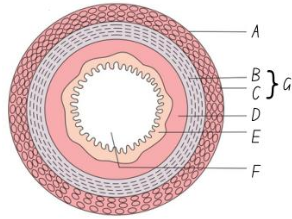
A) A- Serosa; G – Muscularis; D – Submucosa; E – Mucosa
B) A- Muscularis; G – Serosa; D – Submucosa; E – Mucosa
C) A- Serosa; G – Muscularis; D – Mucosa; E – Submucosa
D) A- Serosa; G – Submucosa; D – Muscularis; E – Mucosa
Epiglottis is a cartilaginous flap which prevents the entry of food into –
A) Glottis
B) Gullet
C) Oesophagus
D) None of the above
Duodenal glands/Brunner’s glands are present in –
A) Submucosa
B) Mucosa
C) Muscularis
D) Serosa
Mucosa forms irregular folds (rugae) in the-
A) Ileum
B) Stomach
C) Jejunum
D) Colon
Mucosa forms many small finger like villi in the
A) Stomach
B) Colon
C) Caecum
D) Small intestine
The many projections on the wall of small intestine function to –
A) Secrete digestion enzymes
B) Increase the surface area
C) Hold products of digestion so they do not enter the large intestine
D) Hold mucus, so ulcers do not form
Which layer of the gut is responsible for peristalsis?
A) Smooth muscles
B) Mucosa
C) Submucosa
D) Serosa
Which of the following statement is false?
A) Mucosal epithelium has goblet cells which secrete mucus for lubrication
B) Mucosa forms gastric glands in the stomach and crypts in between the bases of villi in intestine
C) Cells lining the villi have brush border or microvilli
D) All the four basic layer in the wall of gut never show modification in different parts of the alimentary canal
Lacteals, lymph capillaries are found in-
A) Spleen
B) Intestinal villi
C) Salivary gland
D) Mammary gland
Intestinal villi are supplied with –
A) Only blood capillaries
B) Only lacteals
C) Lacteals and valves
D) Blood capillaries and lacteals
The below diagram represents a section of small intestinal mucosa showing villi. Identify A, B, C and D –
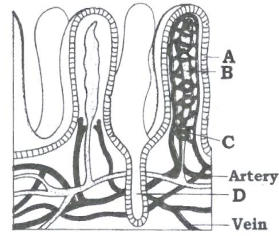
A) A- Villi, B – Lacteal, C – Capillaries, D – Crypts
B) A- Lacteal, B – Villi, C – Capillaries, D – Crypts
C) A- Villi, B – Lacteal, C – Crypts, D – Capillaries
D) A- Crypts, B – Lacteal, C – Capillaries, D – Villi
Number of salivary glands present in human being is –
A) 5 pairs
B) 3 pairs
C) 4 pairs
D) 2 pairs
Parotid glands are located below –
A) Eye
B) Tongue
C) Floor of mouth
D) In cheek near ear
Which of the following salivary gland is absent in human beings?
A) Zygomatic
B) Parotids
C) The sub-maxillary/sub-mandibular (lower jaw)
D) The sub-linguals (below the tongue)
Saliva is secreted by –
A) Liver
B) Gastric gland
C) Duodenal gland
D) None
Which one is the largest gland?
A) Liver
B) Pancreas
C) Salivary gland
D) Gastric gland
Liver secretes?
A) No digestive enzymes
B) Many digestive enzymes
C) Hormones
D) Succus entericus
Liver of man is-
A) Bilobed
B) 3-lobed
C) 4-lobed
D) 5-lobed
Digestive juice lacking enzyme but aiding digestion is –
A) Chyle
B) Chyme
C) Bile
D) Succus entericus
In adult human liver weighs –
(A) 2 kg
(B) 2-3 kg
(C) 500 g
(D) 1.2 to 1.5 kg
Liver is situated in –
A) Thoracic cavity
B) Above the thoracic cavity
C) In abdominal cavity below diaphragm
D) In abdominal cavity above diaphragm
Which of the following is the structural and functional unit of liver?
(A) Hepatic cells
(B) Hepatic cord
(C) Hepatic lobule
(D) Hepatic lobe
Find out the correct match –

A) A-II, B-I, C- IV, D-III
B) A-I, B-II, C- IV, D-III
C) A-I, B-II, C-III, D- IV
D) A – IV, B-III, C-II, D-I
Hepatocytes secrete –
A) Lipase
B) Bile, no digestive enzymes
C) Bile with digestive enzymes
D) Amylopsin
Bile is produced by –
(A) Gall bladder
(B) Liver
(C) Hepatic duct
(D) Blood
Cystic duct arises from –
(A) Liver
(B) Kidney
(C) Pancreas
(D) Gall bladder
Function of gall bladder is –
(A) Storage of bile
(B) Secretion of bile
(C) Formation of digestive enzyme
(D) Formation of bile salts
Common bile duct is formed when
A) Right and left hepatic ducts are fused
B) Bile duct is fused with pancreatic duct
C) Cystic duct is fused with right hepatic duct.
D) Cystic duct (duct of gall bladder) is fused with a common hepatic duct
In human beings which of the following opens into the duodenum –
A) Hepatic duct and pancreatic duct separately
B) Hepato-pancreatic duct
C) 1st hepatic duct, then pancreatic duct
D) 1st pancreatic duct then hepatic duct
Which of the following is incorrect about pancreas?
A) It is compound gland as it has both exocrine and endocrine part
B) Exocrine part secretes alkaline pancreatic juice having enzymes
C) Endocrine part secretes hormones like insulin and glucagon
D) It is surrounded by Glisson’s capsule
The below diagram is a duct system of liver, gall bladder and pancreas. Write the names of ducts from A to D –

A) Cystic duct, B – Bile duct, C – Pancreatic duct, D – Hepato- pancreatic duct
B) A- Bile duct, B – Cystic duct, C – Pancreatic duct, D – Hepato- pancreatic duct
C) A- Cystic duct, B – Bile duct, C – Hepato-pancreatic duct, D – Pancreatic duct.
D) A- Cystic duct, B – Pancreatic duct, C – Bile duct, D – Hepato-pancreatic duct
The process of digestion is accomplished by:-
A) Mechanical process
B) Chemical process
C) Both
D) Chemical & Electrical
Mastication of food & facilitation of swallowing is the two major function of:-
A) Teeth
B) Buccal Cavity
C) Mouth
D) Trachea
_____(i)_____ in saliva helps in ______(ii)_____ & _____(iii)______ the masticated food
A) (i) Mucus (ii) Lubricating (iii) Adhering
B) (i) Adhering (ii) Cohesion (iii) Surface tension
C) (i) Surface tension (ii) Cohesion (iii) Adhesion
D) (i) Lubrication (ii) Mucus (iii) Adhering
The bolus is conveyed into the pharynx and then into the ____(i)____ by _____(ii)
A) (i) Swallowing (ii) Deglutition
B) (i) Deglutition (ii) Swallowing
C) (i) Oesophagus (ii) Deglutition
D) (i) Oesophagus (ii) Mastication
The muscular contraction in oesophagus is known as:-
A) Swallowing
B) Peristalsis
C) Churning
D) Both (B) & (C)
What controls the passage of food into the stomach:-
A) Gastro – oseophageal sphincter
B) Pyloric sphincter
C) Mucus in saliva
D) All of the above
The salvia secreted into the oral cavity contains:-
Water; Amylase; Ptyalin; Lysozymes; Na+; K+; Cl-; HCO-3, How many of the above are composition of saliva:-
A) Only 6
B) Only 7
C) Only 8
D) Only 5
Which enzyme is responsible for initiation of digestion in the oral cavity:-
A) Water splitting complex
B) Mucus splitting enzyme
C) Carbohydrate splitting enzyme
D) Protein splitting enzyme
What percentage of starch is hydrolysed in oral cavity:-
A) 20%
B) 30%
C) 40%
D) 50%
In oral cavity starch is pyrolysed into ____(i)____ ____(ii)___
A) A monosaccharide; Maltose
B) A disaccharide; Maltose
C) A disaccharide; Galactose
D) None of the above
Optimum pH required for the activation of carbohydrate – splitting enzyme is :-
A) 5.8
B) 6.8
C) 7.8
D) 4.8
Antibacterial agent present in saliva; that protects from bacterial infection is:-
A) Ptyalin
B) Amlylase
C) Lysozymes
D) Both
What major types of cells does the gastric gland contains:-
A) Mucus neck cells
B) Peptic of chief cells
C) Parietal oxyntic cells
D) All of the above
Factor essential for digestion of vitamin B12 is secreted by _____(i)_____ & the factor is _____(ii)_____
A) (i) peptic cell (ii) Lysozyme
B) (i) Intrinsic (ii) Peptic cell
C) (i) Oxyntic (ii) Intrinsic
D) (i) Parietal cell (ii) HCl
How many of the following statements are correct:-
(i) Proenzyme (Pepsinogen) is secreted by chief cells
(ii) Stomach stores food for 4 – 5 hours
(iii) Food thoroughly mixed up with acidic gastric juice is known as chyme.
A) Only one
B) Only two
C) All of them
D) None of them
Pepsinogen on the exposure of ____(i)____ converted into the active enzyme _____(ii)____
A) (i) Proenzyme (ii) Lysozyme
B) (i) HCl (ii) Pepsin
C) (i) Lysozyme (ii) HCl
D) (i) Churning (ii) Pepsin
Pepsin converts _____(i)____ into ______(ii)_____ & ____(iii)_____
A) Proteins; Proteoses; Peptones
B) Proteoses; Peptones; Proteins
C) Peptones; Proteins; Proteoses
D) Peptones; Proteoses; Proteins
What prevent the gastric epithelium from excoriation:-
A) Mucus & Bicarbonates
B) Bicarbonates only
C) Mucus only
D) HCl
The acidity in stomach for activation of pepsinogen required is
A) 1.8
B) 3.8
C) 6.8
D) 7.8
The proteolytic enzyme found in the milk for infants are
A) Pepsin
B) Lectin
C) Rennin
D) None of these
Lipases are also secreted by gastric glands in:-
A) Small amount
B) Moderate amount
C) Large amount
D) None of the above
___________ of movements are generated by the muscularis layer of the small intestine.
A) A certain type
B) Various type
C) Churning type
D) None of the above
How many of the following is released into the small instestine:-
(i) Bile juice (ii) Gastric juice (iii) Pancreatic juice (iv) Intestinal juice
A) Only One
B) Only Two
C) Only Three
D) Only Four
Which of the following guards the release of Pancreatic and Bile juice into duodenum:-
A) Plyloric sphincter
B) Hepato – Pancreatic duct
C) Sphincter of oddi
D) Dust of Santorini
The contents of Pancreatic juice are:-
Trypsinogen; Chymotrypsinogen; Pepsinogen; Pro – carboxypeptidase; amylases; Lipases; nucleases
A) All seven of the above
B) Only five of the above
C) Only six of the above
D) Only four of the above
What are inactive enzymes of Pancreatic juice:-
Trypsinogen; Chymotrypsinogen; Pepsinogen; Pro – carboxypeptidase; amylases; Lipases; nucleases
A) All seven of the above
B) Only five of the above
C) Only three of the above
D) Only four of the above
What activates the enzymes of pancreas :-
A) Enterokinase & Pepsin
B) Enterokinase & Trypsin
C) Enterokinase & HCl
D) Chymotrypsin & Enterokinase
Bile released into duodenum contains the :-
A) Bile salt
B) Bile pigment
C) Both
D) Goblet cells
Intestinal mucosa secretes enzyme:-
A) Lysozyme
B) Enterokinase
C) Mucus
D) Both (B) & (C)
The composition of bile salt is:-
A) Bilirubin & Biliverdin
B) Bicarbonates & Cholesterol
C) Phospholipids
D) None of the them
The breaking down of fats into very small micelles is known as:-
A) Digestion
B) Pyrolysis
C) Emulsification
D) Absorption
The goblet cells of intestinal mucosal epithelium secretes:-
A) Enterokinase
B) Mucus
C) Lipase
D) All of the above
Succus entericus contains:-
(i) Disaccharide & Lipase (ii) Dipeptidase & Nucleosidase (iii) Mucus
A) Only (i) & (ii)
B) All
C) Only (ii) & (iii)
D) None
What is the pH of intestinal juice:-
A) 7.0
B) 7.8
C) 6.0
D) 6.8
Succus entericus is the combination of secretion of :-
A) Mucus cells
B) Brush bordered cells
C) Both
D) None
Which provides alkaline medium for enzymatic activities:-
A) Mucus
B) Bicarbonates
C) Both
D) None
Brunner’s glands helps in :-
A) Secretion of HCl
B) Providing an Neutral medium
C) Providing an alkaline medium
D) Secretion of proteoses
Which of the following is partially hydrolysed protein:-
A) Proteoses
B) Peptones
C) Chyme
D) All
Which of the following statement is incorrect:-
A) Carbohydrates in chyme is hydrolysed by salivary amylase.
B) Fats are broken down by lipases.
C) Bile helps in the break down process of fats
D) None of the above
Which of the following is correct:-
A) Final steps of digestion occur very close to the mucosal epithelium of the intestine
B) Nucleic acids in pancreatic juice acts on nucleases to form nucleotides & Nucleosides
C) Succus entericus acts on the start products of chime
D) All
Which of the following reaction in duodenal region:-
A) Lactose Glucose + Galactose
B) Nucleic acidsNucleotides
C) StarchDisaccharids
D) All
The undigested and unabsorbed substances are passed on to:-
A) Jejunum
B) Ileum
C) Caecum
D) Duodenum
Which of the following statements is incorrect
A) No digestion occurs in the large intestine
B) In large intestine absorption of water; minerals & certain drugs occurs.
C) Mucus helps in adhesion of undigested particles
D) None of the above
The undigested, unabsorbed substances are called:-
A) Chyme
B) Faeces
C) Bolus
D) Gullet
The entry of food into the caecum from Ileum is prevented by:-
A) Pyloric sphincter
B) Sphincter of oddi
C) Ileo – caecal valve
D) None
Which is the temporary storage region for faeces:-
A) Ileum
B) Caecum
C) Colon
D) Rectum
Which of the following statements is incorrect
A) The activity of GIT are under neural and hormonal control for proper coordination of different part.
B) The sight, smell and presence of food in oral cavity can stimulate secretion of saliva
C) Gastric and intestinal secretions are stimulated by neural signals.
D) None of the above
Muscular activity of different part of the alimentary canal can be moderated by:-
A) Local mechanism
B) CNS
C) Both A and B
D) PNS
Hormonal control of secretion of digestive juices is carried out by local hormones produced by
A) Gastric mucosa
B) Intestinal mucosa
C) Intestinal submucosa
D) Both (A) & (b)
Which of the following is correct match :-
Absorption occurs through:-
A) Passive transport
B) Active transport
C) Facilitated method
D) All
Absorption of glucose, amino acids & some electrolytes like chloride ions occurs through simple diffusion in _______
A) Small amount
B) Moderate amount
C) Large amount
D) None
Which of the following is true:-
A) Passage of substances into blood stream depends upon the concentration gradient
B) Glucose and amino acids are absorbed facilitatively
C) Transport of water depends upon osmotic gradient
D) All of the above
Which of the following is true:-
Principle organ for absorption of nutrients is:-
A) Mouth
B) Stomach
C) Small Intestine
D) Large Intestine
The absorbed substances finally reach the tissues which utilised them for their activities its known as:-
A) Assimilation
B) Absorption
C) Deglutition
D) Defecation
Which is the ejection of intestinal content through the mouth:-
A) Jaundice
B) Diarrhoea
C) vomiting
D) None
Irregular bowel movement causes:-
A) Jaundice
B) Vomiting
C) Constipation
D) Indigestion
Dietary deficiency of proteins and total food calories are wide spread in
A) North & North – east Asia
B) South America & Central Africa
C) East & south – east Asia
D) North America & central Africa
Marasmus occurs in:-
A) Children more than a year in age
B) Infant more than a year in age
C) Foetus
D) Infant less than a year in age
Kwashiorkar occurs in
A) Children more than a year in age
B) Infant more than a year in age
C) Foetus
D) Infant less than a year in age
Which of the following gastric cells indirectly help in erythropoiesis?
(a) Chief cells
(b) Mucous cells
(c) Parietal cells
(d) Goblet cells
Which of the following terms describe human dentition?
(a) Thecodont, Diphyodont, Homodont.
(b) Thecodont, Diphyodont, Heterodont.
(c) Pleurodont, Diphyodont, Heterodont.
(d) Pleurodont, Monophyodont, Homodont.
Which cells of “Crypts of Lieberkuhn” secrete antibacterial lysozyme?
(a) Paneth cells
(b) Zymogen cells
(c) Kupffer cells
(d) Argentaffin cells
The hepatic portal vein drains blood to liver from :
(a) Stomach
(b) Kidneys
(c) Intestine
(d) Heart
A baby boy aged two years is admitted to play school and passes through a dental check-up. The dentist observed that the boy had twenty teeth. Which teeth were absent?
(a) Canines
(b) Pre-molars
(c) Molars
(d) Incisors
Which of the following options best represents the enzyme composition of pancreatic juice?
(a) Amylase, pepsin, trypsinogen, maltase
(b) Peptidase, amylase, pepsin, rennin
(c) Lipase, amylase, trypsinogen, procarboxypeptidase
(d) Amylase, peptidase, trypsinogen, rennin
Which of the following guards the opening of hepato-pancreatic duct into the duodenum?
(a) Semilunar valve
(b) Ileocaecal valve
(c) Pyloric sphincter
(d) Sphincter of Oddi
In the stomach, gastric acid is secreted by the
(a) gastrin secreting cells.
(b) parietal cells.
(c) peptic cells.
(d) acidic cells.
Which of the following statements is incorrect?
(a) Goblet cells are present in the mucosa of intestine and secrete mucus.
(b) Oxyntic cells are present in the mucosa of stomach and secrete HCl.
(c) Acini are present in the pancreas and secrete carboxypeptidase.
(d) Brunner’s glands are present in the submucosa of stomach and secrete pepsinogen.
The primary dentition in human differs from permanent dentition in not having one of the following type of teeth.
(a) Premolars
(b) Molars
(c) Incisors
(d) Canine
Gastric juice of infants contains
(a) nuclease, pepsinogen, lipase.
(b) pepsinogen, lipase, rennin.
(c) amylase, rennin, pepsinogen.
(d) maltase, pepsinogen, rennin.
The initial step in the digestion of milk in humans is carried out by :
(a) Lipase
(b) Trypsin
(c) Rennin
(d) Pepsin
Fructose is absorbed into the blood through mucosa cells of intestine by the process called
(a) active transport.
(b) facilitated transport.
(c) simple diffusion.
(d) co-transport mechanism.
Identify the cells whose secretion protects the lining of gastro-intestinal tract from various enzymes
(1) Chief Cells
(2) Goblet Cells
(3) Oxyntic Cells
(4) Duodenal Cells
Match the following structures with their respective location in organs :
(a) Crypts of Lieberkuhn (i) Pancreas
(b) Glisson’s Capsule (ii) Duodenum
(c) Islets of Langerhans (iii) Small intestine
(d) Brunner’s Glands (iv) Liver
Select the correct option from the following :
(a) (b) (c) (d)
(1) (iii) (i) (ii) (iv)
(2) (ii) (iv) (i) (iii)
(3) (iii) (iv) (i) (ii)
(4) (iii) (ii) (i) (iv)
Match the items given in column I with those in column II and choose the correct option
Column-I Column-II
(a) Rennin (i) Vitamin B12
(b) Enterokinase (ii) Facilitated transport
(c) Oxyntic cells (iii) Milk proteins
(d) Fructose (iv) Trypsinogen
(1) a-iii, b-iv, c-ii, d-i
(2) a-iv, b-iii, c-i, d-ii
(3) a-iv, b-iii, c-ii, d-i
(4) a-iii, b-iv, c-i, d-ii
Kwashiorkor disease is due to :-
(1) Simultaneous deficiency of proteins and fats
(2) Simultaneous deficiency of proteins and calories
(3) Deficiency of carbohydrates
(4) Protein deficiency not accompained by calorie deficiency
Intrinsic factor that helps in the absorption of vitamin B12 is secreted by :-
(1) Goblet cells
(2) Hepatic cells
(3) Oxyntic cells
(4) Chief cells
The proteolytic enzyme rennin is found in :
(1) Intestinal juice
(2) Bile juice
(3) Gastric juice
(4) Pancreatic juice
Identify the correct statement with reference to human digestive system
1) Vermiform appendix arises from duodenum
2) Ileum opens into small intestine
3) Serosa is the innermost layer of the alimentary canal
4) Ileum is a highly coiled part
The enzyme enterokinase helps in conversion of
1) pepsinogen into pepsin
2) protein into polypeptides
3) trypsinogen into trypsin
4) caseinogens into casein
Sphincter of oddi is present at:
1) Junction of hepato-pancreatic duct and duodenum
2) Gastro-oesophageal junction
3) Junction of jejunum and duodenum
4) IIeo-caecal junction
Succus entericus is referred to as:
1) Intestinal juice
2) Gastric juice
3) Chyme
4) Pancreatic juice