
15 PLANT GROWTH AND DEVELOPMENT
PLANT GROWTH AND DEVELOPMENT
Plant Growth and Development
Root, stem, leaves, flowers, fruits and seeds arise in orderly manner in plants. The sequence of growth is as follows:
-
Life cycle of plant:
- Plants complete their vegetative phase to move into reproductive phase in which flower and fruits are formed for continuation of life cycle of plant.
-
Growth and differentiation:
- Development is the sum of two processes growth and differentiation. Intrinsic and extrinsic factors control the process of growth and development in plants.
-
Growth:
- Growth is a permanent or irreversible increase in dry weight, size, mass or volume of cell, organ or organism. It is internal or intrinsic in living beings.
-
Growth is a quantitative phenomenon:
- In plants growth is accomplished by cell division, increase in cell number and cell enlargement. So, growth is a quantitative phenomenon which can be measured in relation to time.
-
Plant growth is generally indeterminate:
- Plant growth is generally indeterminate due to capacity of unlimited growth throughout the life. Meristem tissues are present at the certain locality of plant body.
-
Open form of growth:
- The plant growth in which new cells are always being added to plant body due to meristem is called open form of growth.
-
Root apical meristem and shoot apical meristem:
- Root apical meristem and shoot apical meristem are responsible for primary growth and elongation of plant body along the axis.
-
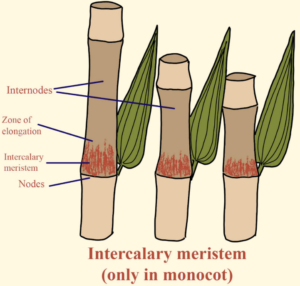
Intercalary meristem:
- Intercalary meristem located at nodes produce buds and new branches in plants.

Secondary growth in plants
Secondary growth in plants is the function of lateral meristem that is vascular cambium and cork cambium.
-
Seed Germination:
- The seed germinates only when favourable conditions for growth exists in the environment. In absence of favourable conditions it goes into a period of suspended growth or rest, called dormancy.
-
Abscission:
- Shedding of plant organs like leaves, flowers and fruits etc. from the mature plant.
-
Apical dominance:
- Suppression of the growth of lateral buds in presence of apical bud.
-
Dormancy:
- A period of suspended activity and growth usually associated with low metabolic rate. Some, seeds undergo a period of dormancy and can germinate only after dormancy period gets over.
-
Phytochrome:
- A pigment, found in plants which control the light dependent developmental process.
-
Phytohormone:
- Chemical’s secreted by plants in minute quantities which influence the physiological activities.
-
Senescence:
- The last phase of growth when metabolic activities decrease.
-
Vernalization:
- A method of promoting flowering by exposing the young plant to low temperature.
-
Quiescence:
- Non germination of a viable seed due to non-availability of proper environmental conditions.
-
Vivipary:
- It is the germination of seed while it is still attached to the parent plant and is nourished by it. e.g., Rhizophora and Sonneratia. As the germinating seed forms a seedling. It all down into the mud due to increase in weights. In the mud, lateral roots develops for anchorage.
-
Heterophylly:
- Occurrence of more than one type of leaves in plants e.g., larkspur, Coriander leaves of Juvenile plant are different in shape from mature plant.
-
Bolting:
- Elongation of internodes prior to flowering in plants like Cabbage.
Photoperiodism
Response of Plants to relative periods of day/ night to induce flowering.
Long Day Plants (LDP):
Plants which need exposure to light for period exceeding critical duration e.g., wheat, rice, cucumber.
Short Day Plants (SDP):
Plants that need exposure to light for period less than the critical length e.g., Cabbage.
Day Neutral Plants (DNP):
There is no correlation between exposure to light duration & induction of flowering e.g., Tomato.
Growth is measurable
- At cellular level, growth is the increase in amount of protoplasm. It is difficult to measure the increase in amount of protoplasm but increase in cell, cell number and cell size can be measured.
- The parameter used to measure growth is increase in fresh weight, dry weight, length, area, and volume and cell number. All parameters are not used for every kind of growth.
Phase of growth
- Formative phase
- Phase of Enlargement
- Phase of maturation
Formative phase:
Formative phase is also called as the phase of cell formation or cell division. It occurs at root apex, shoot apex and other region having meristematic tissue. The rate of respiration is very high in the cells undergoing mitosis division in formative phase.
Phase of Enlargement:
Phase of Enlargement newly formed cells produced in formative phase undergo enlargement. Enlarging cells also develops vacuoles that further increase the volume of cell. Cell enlargement occurs in all direction with maximum elongation in conducting tissues and fibers.
Phase of maturation:
the enlarged cells develops into special or particular type of cells by undergoing structural and physiological differentiation.
Growth Rate
Growth Rate increase in growth per unit time is called growth rate. Growth rate may be arithmetic or geometrical.
Arithmetic Growth
Arithmetic Growth the rate of growth is constant and increase in growth occurs in arithmetic progression- 2, 4, 6, 8 ……. It is found in root and shoot elongation.
Lt = L0 + rt
Length after time = length at beginning + growth rate x time.
Geometric Growth
- Here initial growth is slow and increase rapidly thereafter. Every cell divides. The daughter cells grow and divide and the granddaughter cells that result into exponential growth.
- Geometrical growth is common in unicellular organisms when growing in nutrient rich medium.
- Sigmoid growth curve consists of fast dividing exponential phase and stationary phase. It is typical of most living organisms in their natural environment.
Exponential growth can be represented as follows:
W1 = W0ert. W1 = final size, W0 = initial size, r = growth rate, t = time of growth and e is the base of natural logarithms (2.71828).
- Quantitative comparison between the growth of living system can be made by
- Measurement and comparison of total growth per unit time is called the absolute rate.
- The growth of given system per unit time expressed on a common basis is called relative growth rate.
Condition for growth
- Necessary condition for growth includes water, oxygen and essential elements. Water is required for cell enlargement and maintaining turgidity. Water also provides medium for enzymatic conditions.
- Protoplasm formation requires water and micro and macronutrients and act as source of energy.
- Optimal temperature and other environmental conditions are also essential for growth of the plant.
- Cells produced by apical meristem become specialized to perform specific function. This act of maturation is called differentiation.
- The living differentiated cells that have lost ability of division can regain the capacity of division. This phenomenon is called dedifferentiation. For example, interfascicular cambium and cork cambium.
- Dedifferentiated cells mature and lose the capacity of cell division again to perform specific functions. This process is called redifferentiation.
Development
It is the sequence of events that occur in the life history of cell, organ or organism which includes seed germination, growth, differentiation, maturation, flowering, seed formation and senescence.
Sequence of development process in plant cell:
Different structures develop in different phases of growth as well as in response to environment. The ability to change under the influence of internal or external stimuli is called plasticity. Heterophylly in cotton plant is the example of plasticity.
Plant Growth Regulators
- Plant Growth Regulators are simple molecules of diverse chemical composition which may be indole compounds, adenine derivatives or derivatives of carotenoids.
- Auxin was isolated by F.W. Went from tips of coleoptiles of oat seedlings.
- The ‘bakane disease’ of rice seedlings is caused by fungal pathogen Gibberella fujikuroi. E. Kurosawa found that this disease is caused due to presence of Gibberellin.
- Skoog and Miller identified and crystallized the cytokinesis, promoting active substance called kinetin.
Auxin
Auxin was first isolated from human urine. It is commonly indole-3-acetic acid (IAA). It is generally produced at stem and root apex and migrate to site of action.
Functions:
- Cell enlargement.
- Apical dominance
- Cell division
- Inhibition of abscission
- Induce Parthenocarpy
Gibberellins
Gibberellins are promotery PGR found in more than 100 forms named as GA1, GA2, GA3….. GA100 The most common one is GA3 (Gibberellic Acid).
Functions:
- Cell elongation.
- Breaking of dormancy.
- Early maturity
- Seed germination.
Cytokinins
Cytokinins the plant growth hormone is basic in nature. Most common forms include kinetin, zeatin, etc. They are mainly synthesized in roots.
Functions:
- Cell division and cell differentiation.
- Essential for tissue culture.
- Overcome apical dominance.
- Promote nutrient mobilization.
Ethylene
Ethylene it is a gaseous hormone which stimulates transverse or isodiametric growth but retards the longitudinal one.
Functions:
- Inhibition of longitudinal growth.
- Fruit ripening
- Senescence
- Promote apical dominance
Abscisic Acid
Abscisic Acid it is also called stress hormone or doormen. It acts as a general plant growth inhibitor. Abscisic acid is produced in the roots of the plant and terminal buds at the top of plant.
Function:
- Bud dormancy
- Leaf senescence
- Induce Parthenocarpy
- Seed development and maturation.