
10 CELL CYCLE AND CELL DIVISION PRACTICE QUESTIONS
All cells reproduce by dividing into _ _ _ _ _ , with each parental cells giving rise to_ _ _ _ _ cells each time they divide.
A) One; four daughter
B) Two; two daughter
C) One; two daughter
D) Two; four daughter
A cell cycle comprises all the listed events, except:
A) Cell growth
B) DNA replication
C) Transcription
D) Cell division
Consider the following statements-
Statement-I: cell growth (in terms of cytoplasmic increases) is a contingent process which occur during cell cycle.
Statement-II: DNA synthesis occur only during one specific stage in the cell cycle.
Statement-III: The event of cell cycle are under genetic control.
A) Statement-I is false & statement-II and III are true
B) Statement-I and II are false & statement-III are true
C) All statement are true
D) None of the above stated statement are true.
Cell of human divide once in approximately-
A) 60 minutes
B) 90 minutes
C) 24 hours
D) None of these
Read the following statements and choose the correct option.
Statement A: The M-phase represents the phase when actual cell division occurs
Statement B: Interphase represents the phase between two successive M-phases
A) Only statement A is correct
B) Only statement B is correct
C) Both the statements are incorrect
D) Both the statements are correct
Match the columns and choose the correct option
Column I Column II
(a) G1 phase (i) Quiescent stage of the cell cycle.
(b) G2 phase (ii) DNA denoted as 2C, increases to 4C
(c) Synthesis phase (iii) Proteins are synthesized in preparation for mitosis
(d) G0 phase (iv) Cell contain initial amount of DNA i.e., 2C
A) a-iv, b-iii, c-i, d-ii
B) a-iv, b-iii, c-ii, d-i
C) a-iii, b-i, c-iv, d-ii
D) a-ii, b-iv, c-ii, d-i
An average duration of yeast cell cycle is-
A) 60 minutes
B) 90 minutes
C) 20 minutes
D) One day
Cell cycle is divided into how many basic phases
A) One
B) Two
C) Four
D) Six
Which of following is/are enlisted as basic phases of cell cycle?
A) G0 phase
B) S phase
C) Interphase
D) Metaphase
The phase of cell cycle during which mitosis occur is-
A) Interphase
B) M-phase
C) G-phase
D) S-phase
The phase between two successive Mphase is-
A) Interphase
B) G-phase
C) S-phase
D) M-phase
The time span of interphase and M-phase is an average human cell cycle is-
A) 12 hours each
B) 95% M-phase & one hour interphase
C) 8 hour M-phase & 16 hour interphase
D) One hour M-phase & 23 hour interphase
The correct sequence of cell is-
A) M -> G2 -> S -> G1
B) S -> G2 -> G1 -> M
C) M -> G1 -> G2 -> S
D) G1 -> S -> G2 -> M
The process which mark as start & usually end of M-phase are-
A) Division of cytoplasm & Karyokinesis respectively
B) Cytokinesis and division of cytoplasm respectively
C) Separation of daughter chromosome & cytokinesis respectively
D) Karyokinesis & karyokinesis respectively
Resting phase of cell-cycle is-
A) M-phase
B) Interkinesis
C) G1 & G2 phase
D) Interphase
Interphase is divided into_ _ _ phases further.
A) 4
B) 3
C) 2
D) 5
Which of following stage corresponds to the interval between mitosis & initiation of DNA replication?
A) S-phase
B) G2-phase
C) M-phase
D) G1-phase
Select the correct statement about G1 phase-
A) Cell is metabotically inactive
B) DNA does not replicate
C) DNA replicate
D) Chromosome number is doubled
Correct sequence of phase of M-phase is-
A) Cytokinesis -> Prophase -> Metaphase -> Anaphase -> Telophase
B) Prophase -> Anaphase -> Metaphase – > Telophase -> Cytokinesis
C) G0 -> G1 -> S -> G2
D) None of these
What would be amount of DNA (C) and number of chromosome (N) in animal cell just after completion of S phase if the initial amount is 2C and 2N?
A) 2C and 2N respectively
B) 4C and 4N respectively
C) 4C and 2N respectively
D) 2C and 4N respectively
Duplication of centriole occur in-
A) M-phase
B) G2-phase
C) S-phase
D) G0-phase
The S-phase of animal cell marked by-
A) DNA replication
B) Centriole duplication
C) Cell growth and protein synthesis
D) A & B
The G2 of cell cycle is pronounced by-
A) Cell growth and division
B) Cell duplication
C) Protein synthesis & centriole duplication
D) Cell growth & protein synthesis
Find mismatch column.
Column-I Column-II
A) Karyokinesis Separation of daughter chromosome
B) cytokinesis Division of cytoplasm
C) Interphase Smallest phase of cell cycle
D) M-phase Mitosis phase
The inactive stage of cell cycle is-
A) Quiescent stage
B) G1
C) S – Phase
D) A & B
Choose the correct statement with respect to G0 phase:
A) Also known as quiescent stage and start after G2 phase
B) Cell of this stage remain unactive and no longer proliferation
C) Cell of this stage remain in active but no longer proliferation unless called to do so depending on the requirement of organism
D) Cell of this stage remain active and proliferation till death without any condition
How many chromosome does onion somatic cell have –
A) 12
B) 14
C) 16
D) 20
What number of chromosome does onion somatic cell have in G, S, G2 & M – phase respectively
A) 32, 16, 16, 32
B) 16, 32, 16, 16
C) 16, 16, 16, 16
D) None of these
Mitotic division occur in –
A) Diploid somatic cell
B) Haploid male honey bee
C) A & B
D) Gametes
Match the following column:
Column – I Column – II
a) G1 Phase i) Metabolically active cell, do not proliferate
b) S Phase ii) Content of DNA doubled
c) G0 phase iii) Protein synthesised
d) G2 Phase iv) Metabolically active cell grows continuously
A) a – iv), b – ii), c – i), d – iii)
B) a – i), b – ii), c – iv), d – iii)
C) a – iv), b – iii), c – i), d – ii
D) None of these
M – phase refer to –
A) Metaphase
B) Meiosis
C) Karyokinesis
D) A & B both
Most dramatic period of cell cycle is-
A) Gap 1 only
B) M-phase
C) S-phase only
D) Interphase
Equational division refer to –
A) Meiosis
B) Mitosis
C) Number of cell chromosome in parent & progeny cell is same
D) B & C
Karyokinesis of mitosis is divided into ________ stages
A) 2
B) 3
C) 4
D) 8
Correct order of mitotic division is –
A) Metaphase → Anaphase → Prophase → Telophase
B) Prophase → Metaphase → Anaphase → Telophase
C) Anaphase → Telophase → Metaphase → Prophase
D) Telophase → Prophase → Anaphase → Metaphase
Select the correct option:
I) Prophase is first stage of Karyokinesis.
II) It occur after completion of protein synthesis during cell cycle
A) Both (I) & (II) are true
B) Both (I) & (II) are false
C) (I) is true but (II) is false
D) (I) is false but (II) is true
During prophase, which of the following occurs?
A) Condensation of chromosomal material
B) Chromosomal material become tangled
C) Centrosome duplication
D) Movement of both centriole at one pole of cell
Choose the incorrect match
A) Beginning of movement of chromosome to opposite poles – Prophase
B) Two asters with spindle – Mitotic apparatus
C) Attachment of spindle – Metaphase
D) Chromosome move to opposite poles – Metaphase
Mitotic apparatus consist of –
A) Four asters with spindle fibres
B) One asters with spindle fibres
C) Two asters with spindle fibres
D) Centrosome with their microtubules without spindle fibres.
How many of following structures are observed when cells are viewed under the microscope at end of prophase Golgi body, ER, Nucleolus, Nuclear envelop, centrosome
A) Zero
B) One
C) Three
D) All of these
How do the chromosome appear during prophase of animal cell during mitosis
A) Consisting of four chromatid which remain attached to centromere
B) Consisting of two chromatid which remain attached to centromere
C) Consisting of four chromatid without centromere
D) As chromatin material without any defined structure
Asters formed during prophase are –
A) Composed of microtubules originate from centromere
B) Composed of protein which secreted by golgi body
C) Highly condensed area of chromosome
D) None of these
What difference would indicate early prophase & late prophase of animal cell.
Early Prophase |
Late Prophase |
| A) Nucleolus & nuclear
membrane present |
Nucleolus &
nuclear membrane are absent |
| B) Chromosomes
are highly condensed |
There is no
condensation of chromosome |
| C) Nucleolus &
centrosome are present |
Nucleolus &
centromere are absent |
| D) Other
organelles like ER, golgi body complexes are not observed |
Other organelles
like ER, golgi complex are observed.
|
Identify correct stage of given diagram.
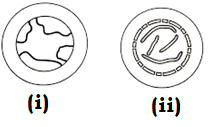
A) Late prophase Early prophase
B) Early prophase Late prophase
C) Metaphase Prophase
D) Prophase Metaphase
The complete disintegration of nuclear envelop marks start of:
A) Late prophase
B) Metaphase
C) Anaphase
D) None of these
Identify stage of given diagram
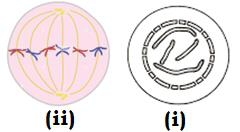
A) Early prophase, metaphase
B) Late prophase, transition to metaphase
C) Early prophase, transition to metaphase
D) Late prophase, metaphase
Which stage of cell cycle is best to study chromosome morphology
A) Late prophase
B) Early prophase
C) Anaphase
D) Metaphase
Condensation of chromosome is completed in –
A) Stage where centrosome is duplicated
B) Stage where DNA content doubled
C) Stage where complete integration of nuclear envelope occurs
D) Stage where complete disintegration of nucleus envelope occurs
Metaphase chromosome is made up of –
A) Two non – sister chromatid which are held together by centromere
B) Four sister chromatid which are held together by centromere
C) Two sister chromatid which are held together by centromere
D) Four non – sister chromatid which are held together by centromere
Kinetochores are
A) Precursors of microtubules
B) Sites of attachment of spindle fibres
C) Site for origination of spindle fibres
D) Small disc – shaped structure at telomere of chromosome
Metaphase is characterised by –
A) Some chromosomes coming to lie at the pole
B) One chromatid of each chromosome connected by its centromere to spindle fibres from one pole
C) Sister chromatid connected by its kinetochore to spindle fibres from opposite poles
D) All of these
Identify stage

A) Transition to metaphase
B) Anaphase
C) Metaphase
D) Telophase
At the onset of anaphase, each chromosome split into –
A) One chromatid B) Four daughter chromatids
C) Two daughter chromosomes D) Eight chromatids
Anaphase is characterised by –
i) Migration of daughter chromatid toward equator.
ii) centromere of each chromosome remain directed toward pole
iii) centromere of each chromosome remain directed toward equator
iv) Chromatid split and centromere separate
v) Chromatid separate after centromere split
A) i, ii, v
B) ii, v
C) iii, v
D) ii, iv
Identify stage –
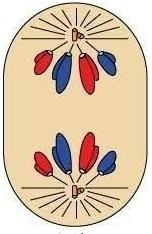
A) Anaphase
B) Telophase
C) Interphase
D) Metaphase
During telophase:
(i) Chromosome cluster at opposite spindle poles
(ii) Two daughter nuclei formed
(iii) Chromosomes lose their individuality
(iv) It is reversal of prophase
(v) Nucleolus is not reformed
Choose the incorrect statement:-
A) i), (ii)
B) (iii), (iv)
C) (v) only
D) none of these
Match the following column –
Column I Column II
a) Syncytium i) Divide the cytoplasm of animal cell
b) Cell-plate ii) Occur in liquid endosperm of coconut
c) Cell furrow iii) Method of cytokinesis in plant cell
A) a-iii, b-ii, c-i
B) a-ii, b-iii, c-i
C) a-i, b-ii, c-iii
D) a-ii, b-i, c-iii
Cell plate represent –
A) Primary lamella
B) Middle lamella
C) Both
D) formation of plate by lysosome
Mitosis usually results in
A) haploid daughter cells with identical genetical complement
B) growth of multicellular organism
C) diploid daughter cells without identical genetical complement
D) haploid daughter cells without identical genetical complement
Which one is odd w.r.t. significance of meiosis?
A) Increase genetic variability in organisms
B) Helps in restoring of original chromosome number in a sexually reproducing species.
C) Ensure production of haploid phase
D) Cell repair
The growth in plant is/are contributed by
A) Mitotic division in apical meristem
B) Meiotic division in lateral meristem
C) Meiotic division in apical meristem
D) A & B both
a) The nucleo-cytoplasmic ratio in organism is restore by mitosis
b) The cells of the upper layer of the epidermis, cells of lining of gut, and blood cells are being constantly replaced by Mitotic division.
Choose the correct option from following :-
A) Statement (a) is true but (b) is false
B) Statement (b) is true but (a) is false
C) Statement (a) & (b) are true
D) Statement (a) & (b) are false
Meiosis result in
A) production of gametes
B) reduction in number of chromosomes
C) introduction of variation
D) all of these
Meiosis ensure the production of …………… phase in life cycle of sexually reproduction organisms whereas fertilization restore ……….. phase.
A) haploid & haploid respectively
B) haploid & diploid respectively
C) diploid & diploid respectively
D) diploid & haploid respectively
Which of the following statement is correct?
A) Meiosis involves single cycle of nuclear and cell division
B) Doubling of chromosomes occur once during s-phase
C) Recombination between sister chromatid of non-homologous chromosome
D) Pairing of homologous chromosome
At the end of meiosis-II, how many haploid cells are formed?
A) One
B) Two
C) Zero
D) Four
Recombination occurs between –
A) sister chromatid of non-homologous chromosome
B) non-sister chromatid of non homologous chromosome
C) sister chromatid of homologous chromosome
D) non-sister chromatid of homologous chromosome
Longest phase of meiosis is :
A) Prophase-I
B) Prophase-II
C) Metaphase-I
D) Telophase-II
During which of the given phases, homologous chromosomes separate, while sister chromatids remain associated at their centromere?
A) Anaphase of mitosis
B) Anaphase II
C) Anaphase I
D) Metaphase I
Prophase-I of meiosis is divided into …………. phase based on chromosomal behaviour.
A) 2
B) 3
C) 4
D) 5
Identify correct sequence of prophase-I.
A) leptotene, Diplotene, Zygotene
B) Zygotene, pachytene, leptotene
C) Diplotene, Zygotene, Pachytene
D) None of these
A bivalent is
A) Pair of non-homologous chromosomes
B) The complex formed by a pair of synapsed homologous chromosomes.
C) Formed during pachytene statge
D) More clearly visible at zygotene Stage
Synaptonemal complex dissolves during-
A) Leptotene
B) Diakinesis
C) Zygotene
D) Diplotene
During which phase of meiosis centromere splits?
A) Anaphase I
B) Anaphase II
C) Telophase II
D) Telophase I
Choose the correct option with respect to leptotene:
(i) It is the foremost and the short-lived stage of prophase
(ii) It begins when the process of compaction of chromosome is accomplished
(iii) chromosome become visible under light microscope
(iv) It followed by zygotene
A) One statement that is (ii) is incorrect
B) i, ii and iii are correct while (iv) is incorrect
C) iii & iv are correct while i, ii are incorrect
D) All statement are correct
Zygotene is characterized by –
(i) chromosome start pairing
(ii) non-homologous chromosome paired
(iii) synapsis occurs between nonhomologous chromosomes
(iv) formation of synaptomeal complex in homologous chromosomes
(v) formation of synaptonemal complex in non homologous chromosomes
A) i, ii, v
B) i, iii, iv
C) i, iv
D) i, ii, iii, v
Bivalent stage is –
A) complex formed by a pair of synapsed homologous chromosomes
B) complex formed by a pair of synapsed non-homologous chromosomes
C) complex formed by four pair of synapsed homologous chromosomes
D) complex formed by four pair of synapsed non-homologous chromosomes
Crossing over occurs in –
A) leptotene
B) zygotene
C) Pachytene
D) diplotene
Pachytene is stage that is/are :-
A) long lived than zygotene
B) two chromatid of each bivalent chromosomes becomes distinct
C) short lived than leptotene
D) long lived than leptotene & short lived than zygotene
Choose the correct statement from following:
A) Pachytene is characterised by appearance of recombination nodule
B) Recombination nodule is site of crossing over
C) Both A & B
D) Recombination nodule formed in diplotene
Given below are statements (I – VI). Choose correct set with respect to crossing over.
I) It occurred between sister chromatid of homologous chromosomes.
II) It is enzyme mediated process.
III) Recombinase enzyme involved in it.
IV) It occurs at recombination nodules.
V) It occurs between non sister chromatid of non-homologous chromosomes.
VI) It occurs between sister chromatid of non-homologous chromosomes.
A) I, II, III & IV B) V, II, III & IV C) II, III, IV & VI D) II, III & IV
Diplotene is not characterized by
A) Dissolution of synaptonemal complex.
B) Tendency of recombined homologous chromosomes of tetrad to separate from each other, except at sites of crossover crossovers.
C) Formation of chiasmata
D) Tendency of recombined non homologous chromosome of bivalent to separate from each other, except at sites of crossover.
Chiasmata is –
A) X – shaped structures
B) Formed by recombined chromosome yet to be separated
C) Site of cross over
D) All of these
Which stage of Meiosis – I last for months or year in some vertebrate oocytes?
A) Diakinesis
B) Diplotene
C) Pachytene
D) Zygotene
Diakinesis marked by –
A) Terminalisation of chiasmata
B) Chromosomes are fully condensed
C) Meiotic spindle assembled
D) All of these
Meiotic spindle assembled to prepare –
A) Non homologous chromosome separation.
B) Formation of aster ray.
C) Homologous chromosome separation.
D) Both B & C
Match the following
Column I Column II
I. Leptotene a) Compaction of chromosome
II. Zygotene b) Separation of chromosome except at crossover
III. Pachytene c) Terminalisation of chiasmata
IV. Diakinesis d) Appearance of recombination of nodules
V. Diplotene e) Synapsis
A) I-a, II-e, III-d, IV-c, V-b
B) I-a, II-b, III-d, IV-c, V-e
C) I-c, II-d, III-a, IV-e, V-b
D) None of these
Identify stage
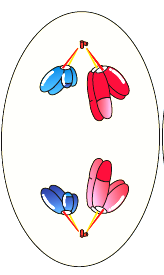
A) Homologous chromosome separate, while sister chromatid remain associated at centromere.
B) Homologous chromosome along with sister chromatid separate.
C) Spindle attached to Kinetochore in this stage.
D) This stage followed by diakinesis.
Spindle fibre attach to kinetochores of homologous chromosome in –
A) Metaphase – I of meiosis
B) Metaphase – II of meiosis
C) Both A & B
D) Anaphase of mitosis
Identify stage
| A | B |
|
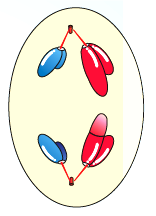 |
A) a = Anaphase I, b = Anaphase II
B) a = Anaphase II, b = Metaphase II
C) a = Anaphase II, b = Anaphase I
D) a = Anaphase I, b = Anaphase II
Dyads of cells are formed in –
A) Telophase – I
B) Telophase – II
C) Diakinesis
D) Both A & B
Meiosis – II initiated immediately after
A) Telophase – I
B) Prophase
C) Cytokinesis – I
D) Chromosome have fully elongated
Which of the following resembles with normal mitosis
A) Meiosis – I
B) Meiosis – II
C) Both
D) None of these
In the beginning of Meiosis – II, a cell contain four chromatid. What number of chromatid is expected to be in each daughter cell at end of telophase – II
A) 4
B) 2
C) 8
D) 16
Find mismatched column
Column I |
Column II |
| A) Metaphase – II | Chromosomes align at equator and
microtubule from opposite poles of spindle get attached to kinetochores of non-sister chromatid |
| B) Prophase – II | Nuclear membrane Disappear |
| C) Telophase – II | Formation of tetrad of cells |
| D) Anaphase – II | Splitting centromere which hold sister
chromatid together, allow them to move toward opposite pole of cells |
Movement of chromatid toward opposite pole is achieved by-
A) Shortening of microtubules attached to centromere
B) Shortening of microtubules attached to kinetochores
C) Elongating of microtubules attached to kinetochores
D) Elongating of microtubules attached to centromere
Conservation of specific chromosome number of each species is achieved across generations in sexually reproducing organism is done by
A) Mitosis
B) Meiosis only
C) Meiosis & Mitosis
D) None of these
Choose the correct statement about meiosis
A) Increase genetic variability of an individual of an organism
B) decrease genetic variability of an organism from one generation to other
C) Reduction of chromosome by one fourth
D) Play an important role in evolution
The stage during which separation of the paired homologous chromosomes begins is:
(a) Pachytene
(b) Diplotene
(c) Zygotene
(d) Diakinesis
DNA replication in bacteria occurs
(a) within nucleolus.
(b) prior to fission.
(c) just before transcription.
(d) during S phase.
Which of the following options gives the correct sequence of events during mitosis?
(a) Condensation nuclear membrane disassemblyarrangement at equatorcentromere division segregation telophase
(b) Condensation crossing over nuclear membrane disassembly segregation telophase
(c) Condensation arrangement at equator centromere division segregation telophase
(d) Condensation nuclear membrane disassembly crossing over segregation telophase
Anaphase Promoting Complex (APC) is a protein degradation machinery necessary for proper mitosis of animal cells. If APC is defective in a human cell, which of the following is expected to occur?
(a) Chromosomes will be fragmented.
(b) Chromosomes will not segregate.
(c) Recombination of chromosome arms will occur.
(d) Chromosomes will not condense.
Spindle fibres attach on to:
(a) Telomere of the chromosome.
(b) Kinetochore of the chromosome.
(c) Centromere of the chromosome.
(d) Kinetosome of the chromosome.
Which of the following is not a characteristic feature during mitosis in somatic cells?
(a) Spindle fibres
(b) Disappearance of nucleolus
(c) Chromosome movement
(d) Synapsis
In meiosis crossing over is initiated at:
(a) Pachytene
(b) Leptotene
(c) Zygotene
(d) Diplotene
A somatic cell that has just completed the S phase of its cell cycle, as compared to gamete of the same species, has
(a) same number of chromosomes but twice the amount of DNA.
(b) twice the number of chromosomes and four times the amount of DNA.
(c) four times the number of chromosomes and twice the amount of DNA.
(d) twice the number of chromosomes and twice the amount of DNA.
Choose the correct option for the following events of meiosis in correct sequence.
(A) Crossing over (B) Synapsi s
(C) Terminalisation of chiasmata (D) Disappearance of nucleolus
(a) B A C D
(b) A B C D
(c) A B D C
(d) D C B A
Match the description given in column-I with their steps given in column-II and identify the correct answer.
Column-I Column-II
A) Synapsis aligns homologous chromosomes I) Anaphase-II
B) Synthesis of RNA and protein II) Zygotene
C) Action of enzyme recombinase III) G2 – phase
D) Centromeres do not separate but chromatids
move towards opposite poles IV) Anaphase-I
V) Pachytene
(a) A – II; B – III; C – V; D – IV
(b) A – I; B – II; C – V; D – IV
(c) A – II; B – III; C – IV; D – V
(d) A – II; B – I; C – III; D – IV
During which phase(s) of cell cycle, amount of DNA i n a cell remains at 4C level if the initial amount is denoted as 2C?
(a) G0 and G1
(b) G1 and S
(c) Only G2
(d) G2 and M
In ‘S’ phase of the cell cycle,
(a) amount of DNA doubles in each cell.
(b) amount of DNA remains same in each cell.
(c) chromosome number is increased.
(d) amount of DNA is reduced to half in each cell.
The enzyme recombinase is required at which stage of meiosis?
(a) Pachytene
(b) Zygotene
(c) Diplotene
(d) Diakinesis
The correct sequence of phases of cell cycle is :
(1) M G1 G2 S
(2) G1 G2 S M
(3) S G1 G2 M
(4) G1 S G2 M
Cells in G0 phase:
(1) exit the cell cycle
(2) enter the cell cycle
(3) suspend the cell cycle
(4) terminate the cell cycle
After meiosis-I, the resultant daughter cells have:-
(1) Same amount of DNA as in the parent cell in S phase
(2) Twice the amount of DNA in comparison to haploid gamete.
(3) Same amount of DNA in comparison to haploid gamete
(4) Four times the amount of DNA in comparison to haploid gamete
Crossing over takes place between which chromatids and in which stage of the cell cycle?
(1) Non-sister chromatids of non-homologous chromosomes at Zygotene stage of prophase I.
(2) Non-sister chromatids of homologous chromosomes at Pachytene stage of prophase I.
(3) Non-sister chromatids of homologous chromosomes at Zygotene stage of prophase I.
(4) Non-sister chromatids of non-homologous chromosomes at Pachytene stage of prophase I.
Attachment of spindle fibers to kinetochores of chromosomes becomes evident in :
(1) Anaphase
(2) Telophase
(3) Prophase
(4) Metaphase
In a mitotic cycle, the correct sequence of phases is
(1) S, G1, G2, M
(2) G1, S, G2, M
(3) M, G1, G2, S
(4) G1, G2, S, M
During Meiosis 1, in which stage synapsis takes place ?
(1) Pachytene
(2) Zygotene
(3) Diplotene
(4) Leptotene
Match the following columns and select the correct option :
Column – I Column – II
(a) Smooth (i) Protein synthesis endoplasmic reticulum
(b) Rough (ii) Lipid synthesis endoplasmic reticulum
(c) Golgi complex (iii) Glycosylation
(d) Centriole (iv) Spindle formation
(1) (a)-(ii), (b)-(i), (c)-(iii). (d)-(iv)
(2) (a)-(iii), (b)-(i), (c)-(ii), (d)-(iv)
(3) (a)-(iv), (b)-(ii), (c)-(i), (d)-(iii)
(4) (a)-(i), (b)-(ii), (c)-(iii), (d)-(iv)
Match the following events that occur in their respective phases of cell cycle and select the correct option :
(a) G1phase (i) Cell grows and organelle duplication
(b) S phase (ii) DNA replication and chromosome duplication
(c) G2 phase (iii) Cytoplasmic growth
(d) Metaphase inM-phase (iv) Alignment of chromosomes
(1) (a)-(ii), (b)-(iii), (c)-(iv), (d)-(i)
(2) (a)-(iii), (b)-(iv), (c)-(i), (d)-(ii)
(3) (a)-(iv), (b)-(i), (c)-(ii), (d)-(iii)
(4) (a)-(i), (b)-(ii), (c)-(iii), (d)-(iv)
Dissolution of the synaptonemal complex occurs during
1) Leptotene
2) Pachytene
3) Zygotene
4) Diplotene
Some dividing cells exist the cell cycle and enter vegetative inactive stage. This is called quiescent stage (G0). This process occurs at the end of :
1) G2 phase
2) M phase
3) G1 phase
4) S phase
Identify the correct statement with regard and G1 phase (Gap 1 ) of interphase
1) Nuclear Division takes place
2) DNA synthesis or replication takes place
3) Recognisation of all cell components takes place
4) Cell is metabolically active, grows but does not replicate its DNA
Meiotic division of the secondary oocyte is completed
1) At the time of fusion of a sperm with an ovum
2) Prior to ovulation
3) At the time of copulation
4) After zygote formation
Match the following with respect to meiosis
a) Zygotene i) Terminalization
b) pachytene ii) Chiasmata
c) Diplotene iii) Crossing over
d) Diakinesis iv) Synapsis
Select the correct option
A b c d
1) ii iv iii i
2) iii iv i ii
3) iv iii ii i
4) i ii iv iii
Which of the following stages of meiosis involves division of centromere?
(1) Metaphase II
(2) Anaphase II
(3) Telophase II
(4) Metaphase I
Match List – I with List – II
| List – I | List – II | ||
| a) | S phase | i) | Proteins are synthesized |
| b) | G2 phase | ii) | Inactive phase |
| c) | Quiescent stage | iii) | Interval between mitosis and initiation of DNA replication |
| d) | G1 phase | iv) | DNA replication |
a b c d
1) iv ii iii i
2) iv i ii iii
3) ii iv iii i
4) iii ii i iv
30. The fruit fly has 8 chromosomes (2n) in each cell. During interphase of Mitosis if the number of chromosomes at G1 phase is 8, what would be the number of chromosomes after S phase?
1) 16
2) 4
3) 32
4) 8
The centrioleundergoes duplication during:
1) prophase
2) Metaphase
3) phase
4) s-phase
Which stage of meiotic prophase shows terminalisation of chiasmata as its distinctive feature?
1) Zygotene
2) Diakinesis
3) Pachytene
4) Leptotene
Which one of the following never occurs during mitotic cell division?
1) Spindle fibres attach to kinetochores of chromosomes
2) Movement of centrioles towards opposite poles
3) Pairing of homologous chromosomes
4) Coiling and condensation of the chromatids
The appearance of recombination nodules on homologous chromosomes during meiosis characterizes:
1) Synaptonemal complex
2) Bivalent
3) Sites at which crossing over occurs
4) Terminalization
Select the incorrect statement with reference to mitosis:
1) All the chromosomes lie at equator at metaphase.
2) Spindle fibres attach to centromere of chromosomes.
3) Chromosomes decondense at telophase
4) Splitting of centromere occurs at anaphase
Regarding Meiosis, which of the statements is incorrect?
1) There are two stages in Meiosis, Meiosis –I and II
2) DNA replication occurs in S phase of Meiosis-II
3) Pairing of homologous chromosomes and recombination occurs in Meiosis-I
4) Four haploid cells are formed at the end of Meiosis-II